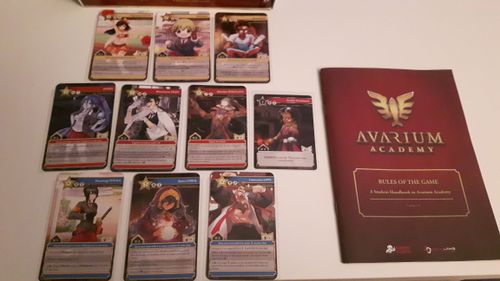
Avarium Academy
Avarium Academy Rulebook
Table of Contents
Table of Contents
- 1. How to Win
- 2. Contents & Card Types
- 3. Duel Setup & Layout
- 4. Gameplay
- 5. Recruiting Students, Getting Ready & Exhausting
- 6. Schemes, Surprises & Abilities
- 7. Fights, Damage & Getting Expelled
- 8. Playing Multiple Effects
- 9. Advanced - Battle Royale (4-Way Multiplayer)
- 10. Advanced - Clarifying Priority & Timing
- 11. General Rules FAQ
1. How to Win
There are 3 ways to achieve victory in Avarium Academy:
- Achieve your Idol's Win-Con,
- Expel all other players by bringing their Merit down to zero,
or
- Have the most Merit when the School runs out of cards.
2. Contents & Card Types
CONTENTS: Your set of Avarium Academy should contain the following:
- 1 Play Board
- 1 Rulebook
- 4 Merit Dials
- 20 Attack Tokens
- 40 Reputation Tokens:
- 30 1-Reputation Tokens
- 10 5-Reputation Tokens
- 112 Cards:
- 8 Idol cards
- 60 Student cards
- 40 Scheme cards
- 4 Quick Tip cards
CARD TYPES: To help you achieve victory, you will have access to three (3) types of cards: Idols, Students, and Schemes.
IDOLS are powerful characters who determine the Win-Con for your Class. They are your avatars and start in your Class. They help set the Merit your Class starts with as well as provide an amount of Reputation for you to spend at the start of each turn. While most Idols can be very helpful, fight damage taken by an Idol results in a loss of Merit, so be very careful when fighting with them!
Idol card parts:
- Reputation Gain: The Idol's gold star provides you with Reputation each turn!
- Club: The group he/she subscribes to.
- Name: Our last names come first.
- Title: Lets you know what your Idol is really known for.
- The Art: How else would you know what muscles look like?
- Combat: How hard your Idol fights in, er, Fights.
- Win-Con: Your Idol's shortcut to Winning!
- Merit: When this reaches zero, you'll be expelled!
- Rules Text: What your Idol can and can't do!
- Expansion: A possibly meaningless symbol.
STUDENTS are characters recruited from the School who assist you in achieving your goals. They start in the Courtyard and can be recruited by any player from the Courtyard into your Class by spending Reputation. There are many things a Student can be used for, so be quick about recruiting them, or your enemies might get to them first!
Student card parts:
- Recruit Cost: Students have silver stars that will cost you Reputation to recruit them!
- Title Bar Colour: Students aren't popular enough for their names to be remembered, but the colours on their titles still mean something... Blue is for Paragons. Red is for Delinquents. Yellow is for Neutrals.
- Gender: We subscribe to a 3-gender system: male / female / unknown.
- Title: Students are commonly known for being Students.
- The Art: Interestingly, some Students are prettier than others.
- Defense: How much damage it can take before it is expelled.
- Combat: Students can be just as aggressive as Idols... occasionally.
- Rules Text: What this Student can or cannot do.
SCHEMES are one-time effect cards that can only be played during your Plan Phase. Scheme card parts:
- Play Cost: Schemes have silver stars that will cost you Reputation to play them!
- Name, Title Bar: What to call your Schemes as you hatch your nefarious plot. A lighter colour could mean that it's a Surprise!
- Club, Gender: ... do not exist for Schemes.
- Title: Schemes are just schemes... or are they?
- The Art: A visual interpretation of how the Scheme should turn out.
- Rules Text: What this Scheme can or cannot do.
- Card Number: Random codes meant for some, ignored by most.
- Credits: Names you should Google after you're done playing.
CLUBS: There are 12 clubs that an Idol or Student can be a part of in Avarium Academy so far, each with their own distinct taste for members:
The clubs are: Council, Sports, Cheerleader, Sciences, Arts, Musics, Host, Martial Arts, Faiths, Sentai, Space, and None. (Each club has its own symbol on the printed chart; the symbols are icons and are not reproduced here.)
3. Duel Setup & Layout
Avarium Academy is a battle card game that can be played with 2-4 players. There are many formats that both this set and this game can possibly expand into, but to play Avarium Academy by itself, you can start with the following 2-player Duel format.
First, find one other player. He/she will be your enemy for the coming game. Shake your enemy's hand in the most sportsman-like manner you can, spread the Play Board, and follow these steps:
-
Each player picks one of the eight Idol cards at random and places it face up in front of him/her. (Players unfamiliar with battle card games should start with only the Basic Idols.)
Basic Idols Advanced Idols Hatsurugi TOUKA Sebastian WOLFGANG Peppermint KITTY Hazenmyier HOJO Kumara RAJ Syeira CORAL AMYBA Lourvarius LOVE The area directly in front of each player becomes that player's "Class" where everything they control will be, while the section on the board to their left will become the "Hallway" for their Class.
-
Each player takes a "Merit Dial" and sets the number on the Merit Dial to be equal to the amount of Merit stated on their Idol card. This will be used to keep track of the Merit of each player.
-
Shuffle all Students (red-backed cards) face-down to form the common "School" deck. The area beside it will become the common "Expel Pile" where expelled Students will be placed (faced-up).
-
From the School, flip six cards face-up and place them in two rows between all players. This forms the common "Courtyard" for all players.
-
Shuffle all Schemes (blue-backed cards) face-down to form the common "Library" deck. The area beside it will become the common "Trash Pile" where used Schemes will be placed (faced-up).
Layout notes from the board diagram:
- Reputation Pool: A common place to put all Reputation Tokens when they are not used.
- Attack Tokens: Placed on Idols/Students after they have attacked.
- Hallway: Students you recruit from the Courtyard are placed here until they enter your Class at the end of turn.
4. Gameplay
Avarium Academy is a battle card game with two commonly-shared decks: the School (for Students) and the Library (for Schemes).
If the Library runs out, reshuffle the Trash Pile back into the Library and continue playing. If the School runs out, the game immediately ends and the player with the most Merit wins automatically.
Flip a coin to decide who starts first. The player who goes second starts with 2 Reputation extra. (Reputation is your "currency" in this game and stays with you until you use it.)
NOTE: Use Reputation Tokens to keep track of your Reputation!
Turn Breakdown - Start Phase
Start your turn with the following:
- Check your Idol's Win-Con*
- Ready your Idol and Student Cards*
- Gain Reputation from your Idol
- Draw a card from the top of the Library
The 4 steps happen at the beginning of each turn automatically.
*Does not apply on the first turn of any player.
Turn Breakdown - Plan Phase
After the Start Phase, you may then choose any of these possible actions to take:
- Recruit a Student from the Courtyard
- Play a Scheme
- Declare a Fight*
Any of these three actions can be repeated as many times as you like, in any order you like, until you choose to end your turn.
Turn Breakdown - End Phase
Once you decide to end your turn, say the words "I end my turn" in your best impersonation of your Idol you can muster and all players proceed to do the following simultaneously:
- Put all Students in their Hallway into their Class.
- If any player has more than 5 Students in their Class, they must expel any number of Students until they have exactly 5 Students in their Class.
- If they have more than 5 cards in their Hand, they must trash any number of their cards until they have exactly 5 cards in their Hand.
- Remove all Attack Tokens from all cards and end all "end of turn" effects.
You then pass the turn to your opponent.
5. Recruiting Students, Getting Ready & Exhausting
Idols may start in your Class, but if you want Students to join your Class, you'll have to spend Reputation to recruit Students from the Courtyard to join your Class.
To start recruiting a Student, spend Reputation equal to the Reputation Cost of the Student, then put the Student on top of your Hallway. While it's there, the Student is considered to be "in your Hallway".
Whenever a card leaves the Courtyard, it must be replaced immediately before anything else can happen. Whenever any player makes a decision, there should be 6 cards in the Courtyard.
During your turn's End Phase, all Students in each player's Hallway are placed into their respective Classes at the same time.
Once a Student is in your Class, it will remain there until it is expelled.
You can have a maximum of 5 Students in your Class. If you exceed this amount by your End Phase, you must expel Students from your Class until it is 5.
NOTE: Reputation is gained during your Start Phase based on the number on your Idol's gold star.
NOTE: Students in the Courtyard do not belong to any Class until they are recruited.
NOTE: Idols are not exhausted when receiving damage in fights, and cannot be exhausted to play Schemes.
READY: As long as a card is upright, it is considered "ready".
Any Student that enters your Class enters "ready" (in an up-right position). This happens regardless of how it enters your Class.
Idols and Students are "readied" (turned back upright) naturally during your Start Phase.
EXHAUST: Constant battle can exhaust your Idols and Students. There are 3 ways Students can naturally become exhausted (the printed list below shows four items; transcribed as printed):
- Receiving damage in fights,
- Used as a payment to play Schemes,
- Effect from a Scheme card,
- As a cost for its own ability.
When this happens, turn the Idol or Student card sideways (either way works). As long as the card remains sideways, it is considered "exhausted".
A card can only be exhausted once, and cannot be exhausted again.
Exhausted cards cannot be assigned to fights and deal no damage in fights.
6. Schemes, Surprises & Abilities
There are many unique features in Avarium Academy that can affect the game.
SCHEMES: Schemes are one-time effect cards that can only be played during your Plan Phase. To play a Scheme, you must first reveal it from your hand, read out the card's effect, and then pay its cost before its effect can take place.
NOTE: Players usually gain Schemes during their Start Phase by drawing from the top of the Library.
There are 2 ways to pay for a Scheme's cost:
- Spend an amount of Reputation equal to the Scheme's Cost.
- Exhaust a Student in your Class whose cost is equal or higher than that of the Scheme's Cost.
Once the cost has been paid, play out the Scheme's effect by following its rules text. Then, trash the Scheme by placing it into the Trash Pile.
SURPRISES: There is also a sub-set of Schemes called "Surprises" which can be played at any time. They have the word SURPRISE! printed in bold at the start of its rules text.
Unless stated specifically, Surprises can be played at any time (e.g. when your enemy draws a card, during a fight etc.).
NOTE: All Surprises are Schemes, but not all Schemes are Surprises.
ABILITIES: Most Idols and Students have helpful abilities listed within their rules text. Some have abilities that are always active; others take place only when a condition is met; some may even require a cost before they can be played!
For those with abilities that are always active, its effect must be considered as long as they are in your Class.
For those with abilities that take place only when a condition is met, read the ability out loud once the condition is met before playing out the ability by following the rules text.
NOTE: If a card's ability contradicts a game rule, follow the card's ability instead.
Abilities that require a cost are called "activated abilities", and will have a cost stated before a ":". These abilities have an effect that you can activate at any time (unless stated otherwise) by paying the cost.
These costs may involve paying Reputation, Merit, or even exhausting the Idol or Student itself, but can be repeated as long as you can pay for it.
NOTE: If "Exhaust" is a cost, the Idol or Student must be exhausted to play the ability.
There are also small sub-sets of abilities that may be harmful to you, but no card is truly useless – some of these cards can just hold hidden advantages that you may have yet to explore!
7. Fights, Damage & Getting Expelled
Fights are the main way you can expel an enemy player, Idol or Student from School.
No player may fight on their first turn.
Each Idol or Student may only attack once each turn, and there can only be one fight at a time.
NOTE: Any Student in an enemy's Class is an "enemy Student".
Step 1. Set!
CHOOSE YOUR LEADER: To start a fight in Avarium Academy, choose a ready Idol or Student with no Attack Tokens on it, and declare it as the "Attacking Leader" from your Class during your Plan Phase.
CHOOSE YOUR TARGET: Declare any one enemy Idol or Student as the target of your attack. This enemy Student becomes the "Defending Leader".
NOTE: Exhausted Idols or Students can still be the target of attack. They just can't hit back!
Idols can only be the target of an attack if its Player's Class no longer has any ready Students that can be attacked.
Step 2. Party Up!
SUPPORT YOUR PARTY: You may then assign one (1) of your ready Idol or Students - not already in the fight - to support the Attacking Leader. This forms the "Attacking Party" and cannot be changed once it is confirmed.
DEFENDER'S SUPPORT: The Defending Leader's player may then assign any one (1) of their ready Idol or Students - not already in the fight - to support the Defending Leader. This forms the "Defending Party" and cannot be changed once it is confirmed.
Players may also choose to play Student abilities and/or Schemes (if any are allowed) at any point before this in the Fight.
REMEMBER! Students with Attack Tokens cannot be assigned to lead or support fights.
Step 3. Fight!
ASSIGN DAMAGE: tabulate the Combat of all cards in your Attacking Party deal it as damage to your enemy's Defending Party. Your enemy then does the same with his Defending Party to your Attacking Party.
Damage must be dealt to the Leaders of each respective party first. Once, and only once, the Leader has been expelled can you divide any remaining damage as you wish among the other Idol or Students in your enemy party.
EXPEL & EXHAUST: Although it is declared in turn, damage from fights are dealt simultaneously, which means any effect that disappears as a result of an Idol or Student being expelled loses its effect at the same time.
- In the case of Idols, any damage received by it results in a loss of Merit equal to the damage dealt. It remains ready.
- In the case of Students, if the damage dealt to it is equal or higher than its Defense, it is expelled and placed into the Expel Pile. If not, the Student becomes exhausted.
- No effects may be played at this point in the Fight to alter or change a card's Combat and/or Defense.
NOTE: No Schemes or Students abilities can be activated in Steps 3 and 4.
NOTE: Only Students become exhausted after receiving fight damage; attacking by itself doesn't cause Idols or Students to become exhausted.
CLEAN UP: Lastly, "remove" any damage remaining on Students still in their Classes and put an Attack Token on each of your Idol and/or Students that attacked (including your supporters).
This is will help you keep track of the Idol and/or Students that attacked; the next time you Fight the same student again, its Defense will be full!
8. Playing Multiple Effects
Every time an effect is about to be played, any player may choose to add their own effects to the list of effects to be played out. This could be to interact with other effects, or simply to maximize a card.
When one or more effects are played at about the same time, which one comes into effect first can sometimes affect the decisions you make, especially when the effects belong to different players.
To determine how multiple effects are played out, there are 3 main scenarios for consideration:
- Scenario A: Last In First Out – When multiple effects are played by multiple players in turn, the effects are activated in reverse order to when they are played. As the name implies, the last effect to be played would be the first to take place, followed by the second-last (and so on).
- Scenario B: Turn Priority – Is it your turn? When both you and your enemy have Students entering your Classes at the same time during your turn, play out all your effects first.
- Scenario C: Player's Prerogative – When you have multiple effects that you have to play out at the same time, you choose the order in how they are played out.
Finally, if an effect has multiple parts, the entire effect (as written on the card's rules text) has to be played out before any new effects can be added.
9. Advanced - Battle Royale (4-Way Multiplayer)
When playing with 3 or more players, additional rules may apply.
Starting Reputation
In the Duel format, the player that starts second gains 2 Reputation at the start of the game. However, in the Battle Royale format, this amount can differ for each player.
| Bonus | Player 1 | Player 2 | Player 3 | Player 4 |
|---|---|---|---|---|
| 2 Players | +0 Reputation | +2 Reputation | - | - |
| 3 Players | +0 Reputation | +1 Reputation | +2 Reputation | - |
| 4 Players | +0 Reputation | +1 Reputation | +2 Reputation | +3 Reputation |
Fights and Helpers
In a multiplayer game, players whose Idols or Students are not involved in the fight may assign one Idol or Student from their Class to further support the Attacking or Defending Party.
This can be done after both Attacking and Defending Parties have been confirmed, and done in the order of the Players' turn (starting from the Attacking Party's Player).
Players may only assign ONE Helper to ONE fight ONCE each turn. Helpers are still considered to be in their own Classes, although they are counted in that Fight.
10. Advanced - Clarifying Priority & Timing
In more advanced games, there can be moments when one or more players may want to take actions (e.g. play Schemes or Student abilities) in response to another player's decision. However, who goes first can often come into question, especially in multiplayer games as the order in which some actions play out can affect their decisions.
PRIORITY: When two or more players would want to take an action at the same time, a turn order is needed between the players to better define whose turn it is to take an action.
In such cases, when you are allowed to take your action, you are referred to as being given "priority".
Priority is always first given to the player whose turn it is. This means, during your turn, you must take your steps/actions first before any other player is allowed to.
TIMING: Priority always starts from the Active Player first, and is passed to the next player (in accordance to the turn order) when...
- A step in a turn ends (e.g. When the enemy's turn ends, at the end of your Win-Con step, at the end of each step in a fight.)
- When an action is declared (e.g. When a player plays a Scheme and/or Student ability.)
- At the end of an action (e.g. When a Student enters your Hallway at the end of a Recruit.)
NOTE: If it is your turn, you are the "Active Player" and will always have first priority!
NOTE: Taking actions in between your effects also passes the priority to other players!
Once the priority is handed to another player, that player may then choose to take an action or hand the priority to the next player. This passing of priority is repeated until no player wants to take any additional actions and the priority returns full circle to the last player that took an action.
Effects from Schemes/Student abilities do not take effect until everyone has passed their priority and chosen to not take any further action, whereby all effects are played out in order as described in "Playing Multiple Effects" (pg. 18).
NOTE: No backsies! You cannot take back an action once it is declared.
Turn Timing Breakdown
When non-Active Players can play cards/effects.
- Start Phase: Win Check, Get Ready!, +Reputation, Draw Card
- Plan Phase: Recruit, Fight!, Scheme
- End Phase: Move Students In, Expel Excess Students, Trash Excess Schemes, Remove Attack Tokens
- Next Player's Turn
Fight Timing Breakdown
- Set!: Choose Your Attacking Leader, Choose Your Target of Attack
- Party Up!: Support Your Party, Defender's Support
- Fight!: Assign Damage, Expel & Exhaust, Clean Up
11. General Rules FAQ
Q: When does my Idol's Win-Con kick in? A: It varies depending on your Idol. If your Idol has "Start your turn" in its Win-Con (e.g. Raj), it needs to wait until your turn's Start Phase Win-Con check. If it doesn't (e.g. Touka), it kicks in the instant the condition is met.
Q: What if I lose all my Merit at the same time I achieve my Win-Con? A: You still lose. If you aren't in the school to savour the spoils of your victory, you have still lost.
Q: What if the School runs out and two or more players are tied for the highest amount of Merit? A: The winner is declared by the turn order (i.e. the player that starts first wins).
Q: Who is the target of a card's effect if the effect doesn't state the target? (e.g. [Record-O-Matic]'s "EXHAUST: Gain +3 Merit") A: You are. If a card's effect does not state its target for any effect, the default target is the player playing/controlling the card (i.e. you).
Q: Does exhausting an Idol/Student remove it from the fight? A: No. If an Idol/Student is already in a fight, exhausting it will only mean that it stays in that fight exhausted.
Q: Can I choose not to assign any of my damage during fights? A: No. All damage must be assigned until there are no possible targets left. Similarly you cannot "over" assign damage to an Idol/Student (e.g.) by assigning 10 damage to a Student with only 3 Defense. (The remaining damage is ignored.)
Q: If a student with a "Join my class" ability leaves and joins my class multiple times, would its ability take effect? A: Yes. That Student's ability would still take place each and every time it joins your class.
Q: Can I play an effect as actions are being played? (e.g. play a Scheme after an enemy has used his/her Reputation to recruit a student, but before the student enters the enemy's Hallway.) A: No. All actions, like effects, should be treated as one whole; the entire effect as it is written has to be played out once it starts, and no new effects can be added in between the playing of the action or card effect.
Need more clarification? You can find our card-specific FAQ over at: http://faq.avariumthegame.com/