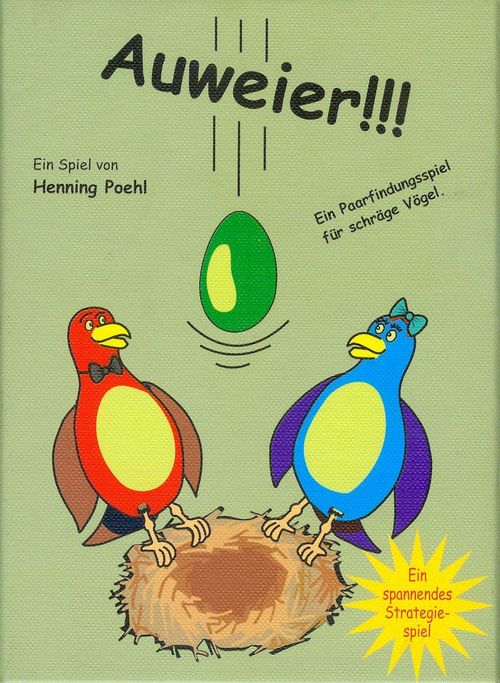
Auweier
Auweier Rulebook
Table of Contents
Table of Contents
Setup
Each player receives a card set in their colour.
A card set consists of 28 cards:
- 1 male bird of the matching colour
- 1 female bird of the matching colour
- 3 egg cards with 1-3 eggs of the matching colour
- 13 worm cards with values from 1 to 7
- 1 False Worm card (FW)
- 2 Crow cards (K)
- 6 Wedding cards (H)
- 1 short rules card (Kurzregel)
Each player places their male bird face up on the table in front of them, so that everyone knows which colour each player has.
Now the females are placed in the middle of the table, and next to each female the egg cards are placed in a stack. The egg cards are stacked so that the single egg is on top and the three-egg card is at the bottom.
Afterwards, each player sorts their cards however they like, in the order they would like to receive them in their hand.
Attention: The cards are later drawn from the face-down draw pile, so the cards at the back will be the first ones drawn during the game.
Each player places their cards face down in front of them as a draw pile and draws 6 hand cards.
The starting player is determined (by a counting rhyme or with a die) and receives the start player card.
Turn Sequence
On a normal turn, the player whose turn it is places any card from their hand in front of a female of their choice. The card played should clearly be identifiable as belonging to a particular female. Afterwards, the player draws one card from their draw pile. If the draw pile is empty, the player continues the rest of the game with a reduced number of cards.
The next player clockwise then takes their turn.
When a worm card is played in front of a female that already has one or more worm cards of the same player, the most recently played card is placed on top of the earlier ones so that the values of each card are easy to see, and every player always knows which player has placed which total value in front of a female.
Play continues in turn until a Wedding card is played.
Wedding Cards and the Wedding Phase
Wedding cards interrupt the normal turn sequence.
As soon as a player has played a Wedding card, a Wedding phase begins. No cards may be drawn any more until the Wedding phase has ended and all pairings (see below) have been completed. The player who played the card may also not draw a card any more.
The player who played the Wedding card receives the start player card.
All other players may then decide, in turn, whether they also want to play a Wedding card on any female. Afterwards, all players who have played a Wedding card may decide whether they want to play a further Wedding card on another female. This continues until no player wants to play another wedding. Then the players who have played one or more Wedding cards each play, in turn, one worm card at a time and hand it over to any female they choose (including females in front of which they have no Wedding cards).
This continues until no player wants to play any more worms.
If a player passes, they may not rejoin later.
When all players are finished placing cards, it is evaluated which male can successfully mate with a female.
A male successfully mates with a female if, on the one hand, he has a Wedding card in front of that female, and on the other hand, he is also the male who has given that female the greatest total value of worms (in case of a tie, the males go away empty-handed).
The male who has successfully mated with a female receives the top egg card from that female's egg stack.
For each female, the Wedding cards together with all worms of the corresponding male are then removed and placed on the discard pile. It is completely irrelevant whether that male was also able to mate successfully with the female or not.
Worms that lie in front of a female without a Wedding card stay there for the rest of the game.
Now all players refill their hand cards to six.
After a Wedding phase, the starting player (the player who holds the start player card) begins by playing a card of their choice.
Game End
The game ends as soon as a player who must play a card can no longer play one.
Since no card has to be played during a Wedding phase, the game can never end during a Wedding phase.
The game also ends, of course, as soon as the last egg has gone to a male.
Afterwards, the eggs collected are scored.
Scoring
Base value:
- 1st egg of a female: 1 point
- 2nd egg of a female: 2 points
- 3rd egg of a female: 3 points
Bonus:
- for each egg of your own colour: +1
- for eggs of two different colours: +2
- for eggs of three different colours: +5
- for eggs of four different colours*: +10
* Only possible in a four-player game.
The player with the most points wins the game.
Example of scoring: At the end of the game, the Yellow player has the following cards in hand:
- 1st egg (Yellow), 1st egg (Red), 2nd egg (Yellow), 3rd egg (Green)
The calculation is as follows:
- 2 x first egg = 2 points
- plus 1 x second egg = 2 points
- plus 1 x third egg = 3 points
The sum (2 + 2 + 3) gives 7 points.
The Yellow player also receives bonus points:
- 2 x eggs in own colour = 2 points
- eggs of three different colours = 5 points
The sum of the bonus points (2 + 5) is 7.
The Yellow player has therefore scored 14 points in the game.
Card Explanations
Male birds: They show which colour each player is playing.
Female birds: These are the focus of the game. Worms are given to them.
Egg cards: The nests on the egg cards show one, two and three eggs. They correspond to the first, second and third egg in a nest, since once the second egg has been laid there are two eggs in a nest, and so on. The male does not take the eggs out of the nest; he only receives the corresponding card as proof of paternity, while the female actually stays on the nest and incubates the eggs.
Worm cards (values 1 to 7): There are: 3 of value 1, 3 of value 2, 2 of value 3, 2 of value 4, 1 of value 5, 1 of value 6, 1 of value 7, and one False Worm (FW).
Worms are placed in front of a female of the player's choice. They stay there until the player has played a Wedding card themselves. Then, at the end of a Wedding round, they are removed from the game.
Otherwise, worms in front of a female can only be taken away by Crows or by the False Worm.
The two worms marked with an asterisk (*) after the number (one of value 2 and one of value 5) are worms that crows do not like. They are therefore spurned by the crows and not eaten.
The False Worm (FW) can be played like a normal worm, except that its value is zero.
A player whose turn it is may, instead of playing a card, also exchange a False Worm lying in front of a female for a real one from their hand, or exchange a real worm lying face up for a False Worm from their hand.
Exchanging a False Worm with another card of one's own may be done at any time when it is a player's turn, and may be done as often as desired during the game.
There is only one restriction: during a Wedding phase, a False Worm may lie in front of each female only once. That is, if a False Worm is removed from in front of a female during a Wedding phase, it may not be placed again in front of that same female during the same Wedding phase (but it may be placed in front of a different female).
Attention: If at the end of a Wedding phase the False Worm lies in front of a female together with one's own Wedding card, it goes onto the discard pile with the other worms.
Wedding card (H): The first Wedding card of a Wedding phase (the card that opens the wedding round) may only be placed in front of a female in front of whom at least one worm of the relevant male (player) lies. The value of the worms must also be the highest value lying in front of that female.
All further Wedding cards played in a Wedding phase may be placed in front of any females. Worms are no longer required for these.
Crow cards (K): Crows eat worms. This card is played on an opponent's worm. If several worms of one player lie in front of a female, the crow must take the top worm. Crows do not eat False Worms (they do not fall for it) and do not eat worms that do not taste good to them (worms with a * beside the number).
Crows may not be played during a Wedding phase!
Tips for the First Game
Before the first game, one does not yet know what the individual cards mean and how they work. For the first game I recommend taking the following cards into your hand:
- 1 Crow, 1 Wedding, 1 False Worm
- 1 worm of value 1 or 7
- 1 worm of value 2* or 5*
- 1 worm of value 3 or 4
The draw pile can simply be shuffled. Only the Wedding cards should be distributed fairly evenly.
During the first game you will best see which cards you do not like, and in later games you can sort them differently accordingly. But one never knows how the other players will sort their cards.
Special Rules for Two Players
In a two-player game, a third female and her eggs in a neutral colour are placed in the middle of the table. There are therefore more females than males. Otherwise the game does not differ in any way from the game with more players.
Variant: Lucky Eggs
In this variant the cards are not sorted during setup. This variant is meant for players who prefer the "game of chance", or who want to play with younger children:
Each player first takes one Wedding card and the False Worm from their set of cards and takes them into their hand. They then shuffle the rest of the cards and place them face down in front of them as a draw pile, and immediately draw four cards from the draw pile so that they have six hand cards.
The rest of the game is played as the normal game, with the exception that Crows, in this variant, may also eat during the Wedding phase.
Example
The example shows a layout during a three-player game. The caption printed beside the diagram reads: "Example of a layout during a game with 3 players. The cards of each player are marked with the corresponding letters." The diagram is a picture of the board and is not reproduced as text.
The example text explains the illustration as showing the position during a Wedding phase. As can be seen from the Wedding cards lying face up in the picture, a Wedding phase is in progress.
The start player card lies with Player A, because they played the first Wedding card and thereby triggered the Wedding phase. Since they have more worms lying in front of only the yellow female than their opponents, they could only place their wedding in front of the yellow female.
Player B then also placed a Wedding card in front of the yellow female. They may do so, even though they have fewer worms in front of the female than Player A, because the Wedding phase is now already running. Player C placed a Wedding card in front of the green female. Player A did not want to play any further Wedding card. Thereupon Player B was up again, and placed a Wedding card in front of the red female. Player C passed in consequence, and Player B has also had enough now. Now it is Player A's turn again, and they could now place a worm card from their hand in front of any female.
All the worm cards lying out were already there before Player A had played the Wedding card. Now all worm cards are safe from crows until the end of the Wedding phase, and Player B was lucky to get their six-worm through.
Since no cards may be drawn during a Wedding phase, Players A and C now still have 5 cards in hand, while Player B, who played two Wedding cards, has only 4 cards in hand. Now further worms may be placed, in turn, in front of any females, including females in front of which no Wedding card lies, for example to prevent someone from getting an egg there. So a good deal can still change. Let us now assume that this is already the end of the Wedding phase. No player wants or is able to play any more worms. Player A receives the 2nd egg of the yellow female, while Player C receives the first egg of green. Player B receives no egg, since they no longer have more worms in front of any female than their opponents. Player C has indeed the most worms lying in front of the red female, but since they did not play a Wedding card there, they do not get the 2nd egg of red either.
Afterwards, all of Player A's cards in front of the yellow female are removed. All of Player B's cards are removed, since they played Wedding cards in front of both females in front of which they had worms, and Player C must remove their cards in front of the green female.
All players refill their hand cards to six, and beginning with Player A, the game continues normally.
Background
The designer's notes on the background of the game are reproduced here in translation.
The idea for this game came to me from the brood behaviour of the Dunnock (Heckenbraunelle).
The Dunnock is a very common, but also very inconspicuous bird of our native wildlife.
In the Dunnock, the males have territories independent of the females. Each male now tries to incorporate as many of the females' territories as possible into his own territory.
Unlike in the game, however, the females of the Dunnock are not won over with worms, but by driving other males out of the females' territory.
It can then quite well happen that females who live at the edges of males' territories are also claimed by several males. These females then mostly mate with several males.
Later, when the young are raised, the males help depending on how often they have mated with the females. Put simply: a male who has often mated with a female also often helps with raising the brood, since the brood is very likely his. A male who has mated only rarely helps only rarely, since the probability that the young are his is low.
The first version of the game, which followed the conditions of the Dunnock exactly, was unfortunately completely unplayable, because it was deadly boring and long-winded.
I therefore dispensed with realism and instead introduced other biological aspects.
Interested readers can find out more about this on my homepage www.sphinxspiele.de.
Overall, a well-playable game has now come out of it, in which one can even learn something.
Two remarks may be permitted here:
- The much-praised fidelity of some bird species does not hold up on closer inspection.
- Animal behaviour should never be used as a justification for human actions, since nature knows no ethics and no morality.
If this game finds a reasonable response, this game will be the first in a series of biological games that deal with the behaviour of animals. There is no lack of ideas, at least for me and for "nature".