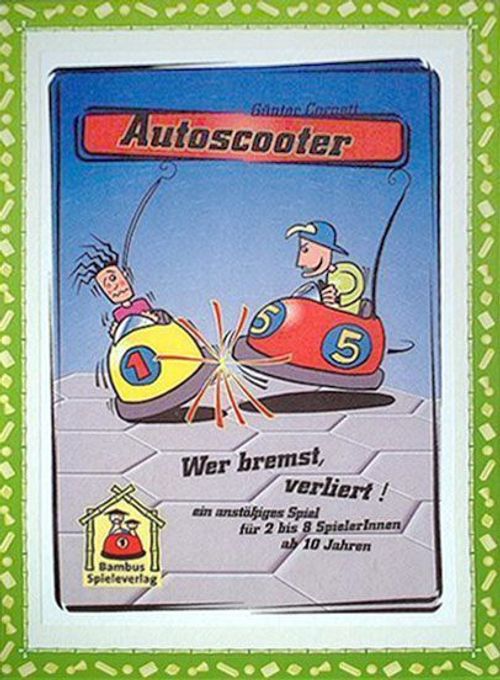
Autoscooter
Autoscooter Rulebook
Table of Contents
Table of Contents
Components
Included in this game are:
- 1 game board with 38 hexagonal spaces (»hexes«)
- 8 bumper cars
- 80 coloured tokens (»chits«) for keeping score
- 8 car charts (overview of movement options and crash table)
- 1 pad of log sheets
- 24 speed markers
- this rule booklet
In addition, you must provide a pen for each player.
What's Driving Bumper Cars About?
Each player tries to ram (or »bump«) the other players' cars as often and as effectively as possible. All players plot the intended movement of their car secretly and simultaneously; then, the movement is executed. Thus, even with 8 players the game plays fast, fluently and without down times.
Preparations
One bumper car is placed on each of the marked starting spaces. Players agree on who drives which car (draw lots if necessary). Each player gets the car chart(s) for his car(s) and scoring chits according to the table:
| Players | Cars per player | Chits per player | Notes |
|---|---|---|---|
| 2 | 3 or 4 | 20 | Beginners: 3 cars, experienced players: 4 |
| 3 | 2 | 20 | |
| 4 | 2 | 20 | |
| 5 | 1 | 15 | Optional rule (Additional Rules for a 5-Player Game) recommended |
| 6 | 1 | 12 | |
| 7 | 1 | 10 | |
| 8 |
Cars not belonging to any player will remain stationary on their starting spaces throughout the game, blocking those spaces for all other cars (in other words, they behave like the barrier). Unused chits go back into the box. Each player gets a pen and a log sheet to plot his game turns.
The speed markers serve to keep track of the current speed of the cars. Since all cars are stationary at game start, the markers are, for now, put aside.
The car charts show which cars belong to which player. Therefore, they must be placed in plain view in front of each player. The graphics on their front side show the possible moves. The crash table on the back illustrates the consequences of crashes. The charts may also be used to shield your log sheet from view while plotting the moves.
On the log sheet you find turn sequence numbers for each car. Enter the players' names under the car colours. We recommend crossing out the columns of cars not participating in the game.
The Game
Each round has 2 phases:
- Planning — All players decide on their intended moves simultaneously and secretly.
- Action — The turn sequence is announced. Players move their cars in that sequence and evaluate the consequences of possible crashes.
1. Planning
Determining the Turn Sequence
Each player chooses a turn sequence number for his car and marks it on the log sheet. Later, in the action phase, the cars will move in the order of those numbers, lowest number first, then next higher etc. No further planning is necessary for cars beginning the round stationary. Of course, this is true for all cars in the first round of play; later it concerns all cars that currently have no speed markers.
Choosing Movement Direction and Speed
This only concerns cars that begin the round in motion. For each of his cars, the player chooses one of the movement options (A, B, C, … , N, O, P) shown on the car chart and writes that letter into the circle next to the turn sequence number chosen.
The car speed is given in hexes per round; it is:
- 1 hex for movement options A – E,
- 2 hexes for movement options F – O,
- 3 hexes for movement option P.
You can take sharp turns only with low speed, while the car will go straight at high speed only. The speed is noted with speed markers that are stacked on the pole at the car's rear: 1 marker = 1 hex/turn, 2 markers = 2 hexes/turn, 3 markers = 3 hexes/turn.
While choosing the movement option please consider that the car speed may only change by one hex per round, so you may not choose an option that would cause a speed jump from 1 to 3 or vice versa. No car may be voluntarily braked to a standstill.
Apart from these limitations, each player has, in principle, all movement options available.
2. Action Phase
1. Announcing the Turn Sequence
One after the other, the players announce their turn sequence numbers and note the other players' numbers on their log sheet.
The player with the lowest number will move his car first, then the player with the next higher number etc. until all players have had their turn.
After each turn, strike out or check off that number; it may no longer be used in any subsequent turn. Thus, a game of »Bumper Cars« will always last 11 rounds.
2. Movement of Cars
If it is a car's turn to move, 4 possible situations can arise:
A — The target space and all intermediate hexes are vacant. The car is placed on the target space, pointing in the direction indicated by the movement option chart. Record the current speed by adjusting the number of speed markers on the car.
B — The hex adjacent to the current hex is occupied, or the hex side in front of the car is a barrier. This results in a crash at the speed the car had at the start of this round; do not adjust the number of speed markers for now. The car remains in its current hex; it does not move. Proceed to evaluate the crash results.
C — The hex adjacent to the current hex is vacant but another hex in the plotted path is occupied and blocks movement. The player moves his car to the hex immediately before the blocked hex, pointing into the blocked hex. Set the speed markers to the speed of the plotted movement (even if the car did, in fact, move less than that). Proceed to evaluate the crash results.
D — The player's car is stationary (speed 0, no speed markers). It does not matter why the car is stationary, i.e. whether it began the round stationary or was stopped as the result of a crash. The player moves the car to a vacant, adjacent space of his choice, choosing one of the positions A...E from the movement options chart for the direction. Then he puts one speed marker on the car's pole to indicate a current speed of 1. Any originally chosen movement option of that car is ignored.
Remark: It takes some time to change the speed of a car. A movement of at least one space is required to accelerate or slow down. Stationary cars may not bump other cars; if all adjacent spaces are occupied, the car remains stationary.
Crash
A crash happens when a car does not arrive in its target hex because another car or the barrier blocks the way. The car's movement ends on the hex adjacent to the blocking hex or hex side. The crash results are evaluated immediately, before the next car moves. First, find out how many points the ramming player scores, then adjust speed and direction of the participating cars if necessary.
There are 5 main types of crashes:
1. A car bumps a moving car's front: The driver of the faster (!) car collects, from the driver of the slower car, a number of scoring chits equal to the difference of the cars' speeds. If the currently moving car was slower, his driver has to part with the chits! After that, all speed markers of both cars are removed (they are now both stationary).
2. A car bumps a stationary car: The driver of the moving car collects a number of scoring chits from the other player equal to his »ramming speed«. After that, his speed markers are removed (both cars are now stationary).
3. A car bumps a moving car's rear: The driver of the moving car collects a number of scoring chits from the other player equal to his »ramming speed«. By the basic rules, nothing else happens. If playing by the advanced rules the bumped car is »jolted«, possibly starting a chain reaction involving many cars (see Variant Rules for Experienced Players).
4. A car bumps a moving car's side: The driver of the moving car collects a number of scoring chits from the other player equal to the total of both cars' speeds. The bumped car is turned 60° (one hexside) away from the point of impact. If a car that did not execute its own move yet is turned, its movement will still be executed as plotted. However, the car will end on a space quite different from what the player planned.
5. A car crashes into the barrier: The player loses a number of his scoring chits equal to his speed (return them to the box). Then, he removes all speed markers from his car. The same rule is applied when a car is bumped which doesn't belong to anyone.
Special Cases and Remarks
When a player bumps his own car (which is possible in a 2- to 4-player game) he pays all chits for both cars into the box.
When a player has no chits left and would have to pay scoring chits, the other player draws a blank: he gets no chits; bad luck for him.
If a player plotted an illegal move, that car will do a straight move with its current speed. If no movement was plotted at all, his highest available turn sequence number is used.
End of the Game
The game ends when all turn sequence numbers have been used, i.e. after round 11. The player with the most scoring chits at that time wins.
Additional Rules for a 5-Player Game
(These rules may also be used with 2, 3, 6 or 7 players.)
For one car that is not used by any player, the car chart is laid out. In each planning phase, in addition to plotting their own moves, all players plot a movement for that car by noting a movement option letter on their log sheets. The player who came out with the highest turn sequence number for his own car gets an additional movement turn for the »wild car« immediately after his regular turn has been completed.
Scoring chits won or lost by bumping the »wild car« are taken from or returned to the box, respectively.
The reason why this rule is especially recommended for a 5-player game is that the game gets more interesting when as many cars as possible are involved.
Variant Rules for Experienced Players
Jolting Cars by Bumping Them from the Rear
If a car is bumped from behind it is »jolted« one hex forward.
If that space is already occupied by another car the jolt is passed on to that car, or the chain of cars. The »crash« is considered to have occurred between only the moving car and the last car in the chain; all intermediate cars are just passing on the energy. The scoring also is only calculated between the moving and the last car. This case is called an »indirect crash«.
If an indirectly bumped car is hit sideways it is turned by 60° as described before.
In case of a frontal indirect crash the speeds of both the original and the rammed car are set to 0.
If an indirect bump hits the rear of a car it is moved one space forward; if that space is occupied it jolts the car there as described above.
If a car is jolted into the barrier its driver pays doubly: first for being rammed, to the ramming player, and then for crashing into the barrier.
Scoring for Experienced Players
At game start each player gets the 10 scoring chits in the colour(s) of his car(s).
At game end, the total number of scoring chits of each player is multiplied by the number of different colours of chits he holds. The player with the highest result wins.
When paying for crashes a player must always pay with chits of the colour of which he holds the most chits. However, the last chit of each colour may only be expended if he does not hold more than one chit in any other colour.
Subject to these rules, the driver of the ramming car may choose which chits to take.
Scoring for 2 to 4 Experienced Players
In combination with the variant rule above, players may agree upon this further rule: the result is evaluated for each car separately. The player with the one highest score wins, even if his other cars have very bad results.