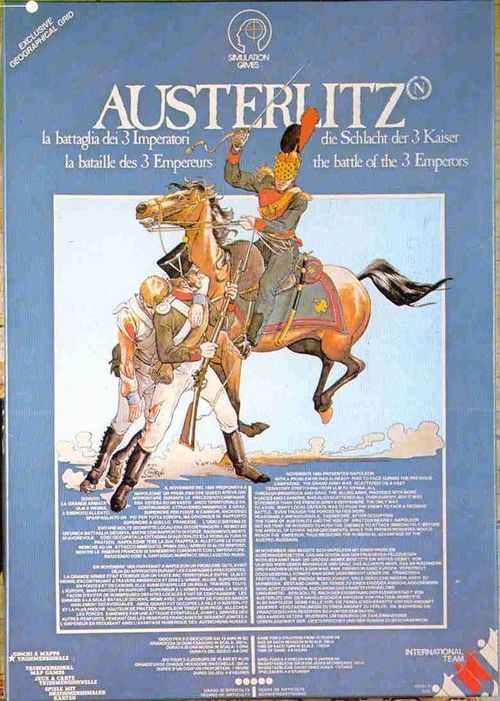
Austerlitz: The Battle of the 3 Emperors
Austerlitz: The Battle of the 3 Emperors Rulebook
Table of Contents
Table of Contents
Set-up
Set-up of the game. Both sides set up their units within the spaces of the Game or Historical Sectors (1 to 24) including the sectors border number spaces, on their side of the RED border with respect to the stacking rules. Soult must place at least 2 combat units within each of his 5 at start sectors.
Stacking. The game board consists of square or octagonal spaces were units can be placed: only 1 combat unit: infantry, artillery, or cavalry is allowed in a space. 1 Command may be placed on top of a combat unit and 1 artillery unit may be stacked with 1 infantry unit.
There were NO woods on the map of Austerlitz. Optional rule: Add 4 woods spaces East of Sokolnitz adjacent to the river and 2 woods spaces Northwest of Telnitz adjacent to the river.
Order of Battle.
| Command | CR | Game Sector | Historical Sector | Line Inf. | Light Inf | Drag. | Light Cav | Hvy Cav | Field Arty | Hvy Arty | Horse Arty |
|---|---|---|---|---|---|---|---|---|---|---|---|
| Combat | 1- 3 | 2-4 | 1 | 1-2 | 2-3 | (2) | (2) | (1) | |||
| Movement | 5 | 5 | 8-10 |
*): under command of Liechtenstein.
The Phases of a game turn.
The Allied player executes steps 1 to 5; followed by the French player:
- Phasing player fires any artillery units. Field artillery that fires can't move in step 3. Add effects of Mist in first 3 game turns for targets not placed on hills: arty add 3, 2 and 1 spaces to the target in turns 1-3 and cavalry subtracts 2 and 1 CF from charges in turns 1 and 2.
- Phasing player may move any unit, one by one, have combat with some of them (in formation), then moves other units which have not yet moved and have combat until all units have moved and/or had combat. Units in Square formations may have combat and movement in any order they like. Each unit of the phasing player may execute combat only once per turn; those of the non-phasing player may be attacked multiple times in a phasing players turn. During the first 4 turns the French player rolls for the entry of Davout (on the arrow). Turn 1: Davout arrives on die roll: 1-3 and each following turn 1 is added for a successful arrival.
- Phasing player may move any Field Artillery unit without a Smoke or "DIS" marker.
- Phasing player may move any Commands.
- Phasing player removes all Smoke markers (own and enemy) and all own DIS-markers, except on Cavalry units which charged in this round.
Check for victory. If at the end of turn 9 a player has eliminated 10 combat units more than his adversary, he wins. The game ends after the 18th game turn. Both players score victory points for eliminating enemy units: 1 for each infantry or cavalry unit, 3 for each artillery unit and 5 for each Guard ("crown" icon on it) unit or Command; 1/2 for each enemy unit demoralized. Player with the most points wins the game. If Napoleon or Kutuzov is captured the game ends immediately.
Units and Commands
Units in the game. There are infantry units (normal and light); cavalry units (heavy, light and dragoons) and artillery units (Field artillery: heavy 12 pdr or normal and horse arty). They all have a front side and a side with a triangle icon, pointing in the direction they can move. For infantry and cavalry units this is all on the same side; for artillery each are on opposite sides of the counter. Units placed on octogons have their front and back towards 3 adjacent spaces, units placed on squares have front and back only to 1 adjacent space. Combat units all have a Movement Factor (MF) on the left side and a Combat Factor (CF) on the right side; commands have a Command Rating (CR), a Command Range (Cr) and a Movement Factor (MF).
Commands. Only 1 command may be placed in a space. If placed on an own unit, the command is captured if that unit is eliminated. A lone command is captured if an enemy unit enters its space.
Infantry units. Infantry units placed in a Square formation, in a town or castle have a front to all bordering spaces.
Formations
Formations. Infantry units can be placed in formations to be more effective in combat. There are 3 types of infantry formations: Line, Column and Square. Infantry units in a formation benefit from modifiers in attack and defense: +1 CF for each other infantry unit in the formation to a maximum of +3 CF. Infantry placed in a Square formation (use marker) has a +1 strength point but only in defense. A Line or Column formation is composed of at least 2 infantry units; a square consists of only 1 infantry unit. In a Line formation infantry units are placed next to each other with their front pointing in the same direction. Units in a Column formation are placed after each other with their front pointing in the same direction or with an angle not greater than 45 degrees. A Square formation may never be moved adjacent to any other formation. Units placed in woods, towns or castle can't be part of a formation. If they move and stay in this terrain that part of a formation is dissolved. Formations are broken in two separate formations if divided by a river. Square formations may not cross unbridged rivers. Infantry in formations may stack with artillery units; in a Square formation also, but the Square then can't move and the artillery unit can't fire. Units may leave or join a formation using their full MF. Units that starting outside a formation that join a Line or Column formation during movement don't increase the strength of the formation during the phasing players turn (but benefit in defense of that formation in the other players turn). Units of a formation may be moved to form another type formation and then attack in the same turn, except for Russian units which may not attack after a change of formation in a turn.
- Light infantry: use the value of normal infantry if the light infantry unit is part of a formation.
- Dragoons placed in a Line or Column Formation may act as normal infantry unit and may benefit in combat from other units in the formation and/or a command rating.
Formations & Commanders. Any infantry unit in a formation within range (6 hexes) of its corps commander may benefit from his rating during combat. If that unit or corps commander is within range of a supreme commander (Napoleon or Kutuzov) then use the ratings of the supreme commander. Compute differences between commanders ratings in range of a unit in combat. If a unit (detached or in formation) is not within range of a commander then use a CR of 0 for that unit. If the difference is 1 or 2; then 1 is added/subtracted from the attackers die roll. If difference is 3 or 4; then 2 is added/subtracted and if the difference is 5 or 6; then 3 is added/subtracted.
- Attacks of a unit in a formation, within range of a Command, against an artillery or cavalry unit have +1 on die roll and cavalry attacks against an infantry unit in a formation within range of a Command suffers from -1 on the die roll.
Artillery
Artillery units. Artillery units may fire on any enemy unit except a lone Command. Their CF is used only in defense and only if not stacked with an infantry unit. Each artillery unit may fire ONCE during the phasing players turn and ONCE with "opportunity fire" in the non-phasing players turn. Field artillery: may fire OR move, but not both in an own players turn. A change of direction of an artillery unit in its hex, is also part of "movement". Heavy Artillery (12 pdr) add +1 to the die roll. Horse artillery: may fire and move or move and fire, but if doing so must use their lower MF. Field of Fire (FoF): field artillery = 9 spaces; horse artillery = 7 spaces. If the guns point to a "long" border of its space, the first space is 1 square/octogon; then 3 spaces/octogons, then 5 aso. If the guns point to a "small" border of an octogon, the first space is 1 octogon (diagonal), then 3 bordering spaces, then 5 aso.
Line of Sight (LOS). Artillery may only fire at targets over spaces that does not block their LOS. Own or enemy units, castle, town, woods or hills between the artillery unit and its target block the LOS. If placed on a the ridge of a hill an artillery unit MAY fire over own or enemy units below them. Add 2, 2 and 3 spaces to the range if a target is respectively in Woods, Town or castle.
Resolution of artillery Fire. Roll 2 dice for each shot on the Artillery Table. The target is missed, must retreat 1-5 spaces or is eliminated ( E ). If artillery shoots at a target which are combined with other units, they all suffer the same fate.
Counter battery fire. Artillery may shoot at an enemy artillery unit in range if the target is not shielded in the Square formation. If stacked with 1 infantry unit the artillery can fire at both (and both suffer the same fate) or at the artillery alone in which case the infantry is not affected. If artillery fires only at enemy artillery as the target, the Artillery Table is NOT used. Roll 1 die: on 1-2 the front of a target is turned 180 degrees; on 3-5: the same happens but the target is also demoralized (turn the unit upside down to its "lighter" side); on a 6 the target is eliminated.
Movement
Movement.
- Entering each space cost 1 MF;
- Entering Woods cost 2 MF; they can only be entered by infantry units.
- Squares move at a cost of 2 MF per space, but lose their formation if moving into woods, towns or castle or crossing a river.
- Crossing non-bridged rivers or ridges (uphill only) cost +1MF.
- Artillery units may only cross rivers over bridges.
- If moving along a road 2 MF is added, but only if the extra spaces are spent moving along the road. Units may combine road with off-road movement in order to add the extra 2 MF.
- Units move into the direction their triangle icon is pointing to. If units are placed on a space their front always points to a bordering space, never to a corner of its space.
- If units want to change direction during movement they must first turn in their space, pay 1 additional movement point and then move forward paying movement costs. The point is not paid if movement is executed along a road or movement by light infantry, commands or Squares.
- Column formations may only make direction changes of max. 45 degrees. Units in a line formations may make changes of 45 or 90 degrees, but units with the greater turning radius move more spaces than those who only turn in their space.
- Units in a Column formation may add 1 to their MF if they use this MF to attack, not using the extra MF to make a turn in the last space.
- Cavalry units has 2 different MF: a lower factor is used in attack, the higher if they don't attack.
- Units may move over (frozen) lakes spaces, but may not end their movement on a lake space. Each unit entering a lake hex must roll a die to check if the ice breaks and eliminates the unit: for Infantry on a roll of 1; for Cavalry on a roll of 1-2 and for Artillery on rolls of 1-3.
- Units (not commands) that are crossed by other units are "DIS". Double "DIS" means elimination.
- Units may not move over enemy units, except enemy commands, which result in their capture.
Cavalry Charges and Disorganization
Cavalry charge. Cavalry units may charge enemy units with +1 CF (Dragoons); +2 (Light cavalry) +3 CF (Heavy cavalry) if they cross 1 plain terrain in front of the enemy unit without making a turn of direction in that space and the enemy unit is not in Square formation, town, woods, castle or behind a uphill contour line or river. After a charge cavalry units are is Disorganized, mark them "DIS". A cavalry unit may choose not to charge and attack with its basic strength not to become "DIS". Placement of a cavalry unit in a space opposite the Front of an enemy infantry unit or executing a charge in the FoF of an enemy artillery, which has not yet fired, risk Opportunity Fire.
Disorgananization. If units move over friendly units they cause the friendly unit being "Disorganized": place a DIS-marker on that unit. Place DIS-markers also on Cavalry units which have executed a Charge. Units which are disorganized may not be moved, fire or attack. They can defend normally; artillery may only fire in defense (not interdict cavalry charges) with -1 on the die of the artillery table. Double disorganization of the unit means elimination. DIS-markers are removed at the end of a phasing player turn.
Combat
Combat. An attack can be made with 1 or more units on 1 or more spaces against 1 or more defending units in ONE space. Compute the difference between modified CF's of attacker and defender; if the result is < -1 an attack is not allowed by the CRT (defending infantry may then execute chance fire). If a Command is attacked alone it is automatically captured. If a Command is stacked with combat units it suffers the same result as the units it is stacked with.
- Attacking units may benefit from modifiers if attacks are made against the rear (-2 CF) or sides (-1 CF) of defending units. Infantry placed in Squares, towns or castle has no rear or sides. Placed on an octagon space the front and rear of units are on 3 sides, the flank of a unit only 1 side. These reductions are doubled if defending infantry is demoralized. If an artillery or cavalry unit is attacked from the sides or rear, the attacker can never not suffer any adverse results on the CRT; treat these results as "N".
- Defending units benefit from terrain: -1 CF from each unit attacking uphill, across a river or light and heavy cavalry (not Dragoons!) attacking a town, woods or castle; +1 for defending units in woods; + 2 CF for a defending infantry unit in a town or castle.
Combat resolution. Compute the difference between modified CF's of attacker and defender and roll 1 die. Outcome can be A Elim, D Elim, A Retreat 1-5, D Retreat 1-5 or "N" (no result). Retreats and new facing of units are both decided by the winner, but he must choose the least damaging route available and the retreat route must be in a straight line AWAY from the victorious unit. Retreating units are eliminated if retreating on an enemy units or commands, across an unbridged river; artillery/cavalry into Woods. Squares that have to retreat get a DIS-marker. A retreat through a space next to the front of an enemy infantry unit provokes opportunity fire. Squares that have to retreat get a DIS-marker. Retreats over own units result in disorganization (place DIS-marker); retreat ON own units forces these units to retreat a hex in the same direction. Demoralized units that retreat over own units also demoralize them. Units are eliminated if disorganized or demoralized twice in a turn.
Demoralization. Units which must retreat because of artillery fire or combat > 3 spaces during one of the players turns become "Demoralized" and are turned to their (lighter) backside. A demoralized unit has its CF halved (rounded up). Demoralized artillery fires with 1 result lower on the artillery table: D1 =N, D2 = D1, D3=D2, D5=D3 and E =D5). Demoralized units that move over friendly units causing the friendly unit being demoralized as well. Double demoralization means automatic elimination. Demoralized units become normal again, if they succeed in retreating an enemy unit > 3 spaces by combat or artillery fire. If all 3 Guard Infantry units of one side are eliminated all units of that side are Demoralized in the following 2 game turns.
Reactions
Non-phasing players reactions.
- Infantry Opportunity fire. Each time a player moves a unit into a space opposite the "Front" of an enemy Infantry unit, without attacking that infantry unit, the enemy unit may execute "Opportunity fire" (basic unit strength comparison) without adverse effects for itself.
- Counter-charge. If a cavalry unit charges against the front side of an enemy cavalry unit (only 1 side if placed on an octagon facing a square), the defending cavalry unit may execute a counter-charge, once per turn, halving the (basic) attack factor of the charging unit (rounded up).
- Artillery opportunity fire. Non-phasing player may fire at any charging cavalry unit or when attacked by an infantry unit in its FoF, once in the phasing players turn. Place smoke marker.
Tables
Artillery results Table: roll 2 dice; add +1 to die if 12 pdr
| Range\Dice | 2 | 3 | 4 | 5 | 6 | 7 | 8 | 9 | 10 | 11 | 12 |
|---|---|---|---|---|---|---|---|---|---|---|---|
| ½ | 1 | 1 | 3 | 3 | 5 | 5 | E | E | E | E | |
| 3 | 1 | 1 | 2 | 2 |
1= no of spaces target(s) must retreat (5= demoralized); E=eliminated; blank=no result
Horse Artillery results Table (if moving & firing): roll 2 dice
| Range\Dice | 2 | 3 | 4 | 5 | 6 | 7 | 8 | 9 | 10 | 11 | 12 |
|---|---|---|---|---|---|---|---|---|---|---|---|
| ½ | 1 | 1 | 3 | 3 | 5 | 5 | E | E | |||
| 3 | 1 | 1 |
1= no of spaces target(s) must retreat (5= demoralized); E=eliminated; blank=no result
Attack Combat Results Table: roll 1die
| CF difference\Die | 1 | 2 | 3 | 4 | 5 | 6 |
|---|---|---|---|---|---|---|
| -1 | AE | A5 | A3 | A1 | D1 | |
| 0 | A5 | A3 | A1 | D2 | ||
| +1 | A3 | A1 | D1 | D3 | ||
| +2 | A1 |
1-5= no of spaces Attacker/Defender must retreat (5= demoralized); E=eliminated; blank=no result