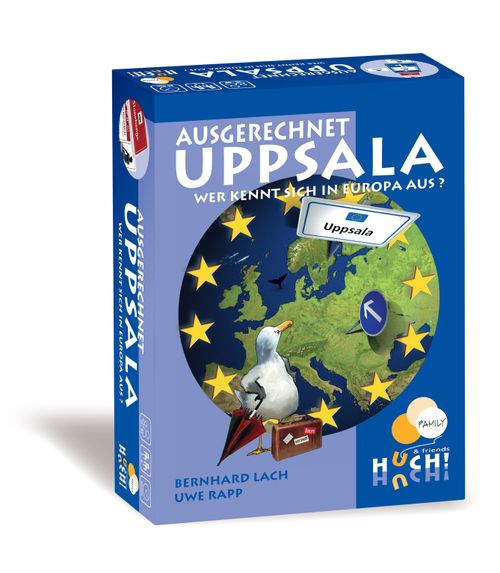
Ausgerechnet Uppsala
Ausgerechnet Uppsala Rulebook
Table of Contents
Table of Contents
Overview
For 2 to 6 players ages 10 and up.
Components
- 200 place cards (160 places and 40 landmarks/sights)
- 2 intermission cards
- 1 direction card
- 35 wooden chips
Paper and a pencil are also needed.
Objective
The places must be arranged on the table according to their geographical location, in a north-south or west-east direction. Whoever makes as few mistakes as possible while catching as many opponents' mistakes as possible is rewarded with chips, and wins.
Setup
Shuffle the place cards well and sort them so that the place names face up, with the coordinates and other information on the back of the card. Then form three stacks of 15 cards each. Set the remaining cards aside for now.
Place one intermission card on top of the first stack, then place the second stack on top of that, then the second intermission card, and finally the third stack of place cards on top of that. Put the resulting stack of cards on the table within easy reach of all players.
Place the direction card in the middle of the table. Take the top card from the place cards that were set aside and place it on the direction card. This is the starting card.
Each player receives 4 chips. The remaining chips will be needed later.
Gameplay
The youngest player begins. Play proceeds clockwise. On their turn, a player takes the top card from the stack and reads the place name aloud. Caution: no player may look at the coordinates on the back of the card! The player then decides whether to place this card in a west-east or north-south direction. Since only the starting card is on the table at the beginning of the game, the starting player has four options for placing their card: above the starting card (north), below the starting card (south), to the left of the starting card (west), or to the right of the starting card (east).
The next player takes the top card from the stack and decides whether to place their card above, below, to the left, or to the right, or whether to place it between two cards that are already on the table, and so on.
Caution: a place card may only ever be placed in a west-east or north-south direction relative to the starting card. Over the course of the game, the cards thus form a cross. No other placements are allowed.
Once a player has decided on a position, they place their card there. It now lies either in a west-east or north-south relationship to the starting card. The card only needs to be correctly placed in that one direction. (As the cross grows, a new card can usually be inserted at up to ten different points along it — at either end of an arm, or between any two cards already placed along that arm.)
Now It's Up to the Other Players
The player to the left of whoever placed the card is asked first whether they want to challenge the card just placed. If they do not challenge it, the question passes to the next player in turn order, and so on. If everyone agrees that the card just placed is correctly positioned, the next player takes their turn placing a card.
However, if a player believes the card is placed incorrectly (too far west or too far east, if it lies in a west-east direction; too far north or too far south, if it lies in a north-south direction), they now turn face-up both the card just placed and one neighboring card.
Right or Wrong?
The card just placed is only checked against the neighboring card that was turned over with it. All other cards on the table are irrelevant. The coordinates (geographic longitude and latitude) of each place are printed on the back of the card. If a card placed in the west-east direction is challenged, only the two west (W) or east (E) coordinates are relevant. If a card placed in the north-south direction is challenged, only the two north (N) coordinates are relevant. The card just placed is correctly positioned if the numbers increase in the direction of the arrow.
Caution: at the Prime Meridian, which passes through England, France, and Spain, the direction of the arrow reverses. Starting from the Prime Meridian, the numbers increase both to the east and to the west. A place card with a west coordinate therefore always lies west of a place card with an east coordinate, and vice versa.
It can occasionally happen that two cards are revealed with exactly the same geographic longitude or latitude. In that case, both cards are considered correctly placed.
If a card was rightfully challenged — that is, the card is indeed placed incorrectly — the challenger receives one chip from the player who placed the card. The card is removed from the game.
If a card was wrongfully challenged — that is, the card is in fact placed correctly — the player who placed the card receives one chip from the challenger. Both cards remain in place and are turned back over, so that only the place names are visible again.
A player who has no chips left does not have to give one up; the recipient may then take a chip from the supply instead. If there are not enough chips left in the supply, players may exchange 5 chips for one place card that has already been removed from the game. That place card then counts as 5 chips at the final scoring.
Interim Scoring
Play continues around the table until the first intermission card appears. This triggers an interim scoring, in which all players estimate how many cards in the cross currently on the table are incorrectly placed. Each player secretly writes down their number. All the cards on the table are then turned over and checked.
Important: checking always begins from the starting card and only ever compares a card to its immediate neighbor. In this way, each card in all four directions is checked, one after another, to see whether it is geographically in the correct position (see above).
If a card is incorrectly placed, it is immediately set aside. At the end, the cards that were set aside are counted. Every player who guessed the correct number receives two chips from the supply. If no player guessed the correct number, every player whose guess was closest to the correct result receives one chip.
Continuing the Game
All the place cards on the table, including the starting card, are removed from the game. A new starting card is drawn from the cards that were set aside at the start of the game, and play continues around the table as described above.
End of Game
Once all (3 x 15) cards in the stack have been used up, one final interim scoring is carried out. After that, the game ends. The player with the most chips wins.
Tip
Players who want to get to know the game first, or who are playing with children who are not yet very familiar with Europe, can sort out some of the "difficult" place cards before the game.
Variant: Population
The cards also show population figures for each place. You may play using this information instead: rather than arranging the places according to their geographical location in a north-south or west-east direction, arrange them according to population.
For this variant, do not lay out a cross — instead, lay out a straight line, placing the places from bottom to top so that the smaller places are at the bottom and the larger ones at the top. The direction card is not needed for this variant. Challenging a placement and distributing chips work exactly as in the standard rules of Ausgerechnet Uppsala.
Note: the population figures used in Ausgerechnet Uppsala are taken from the Fischer Weltalmanach 2006. Compared to other or more recent sources, there may be discrepancies.