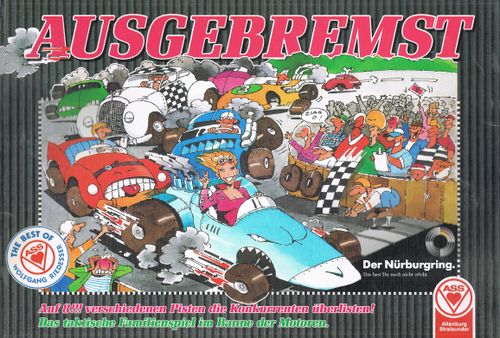
Ausgebremst
Ausgebremst Rulebook
Table of Contents
Table of Contents
Contents
- 3 double-sided game board halves
- 2 clips
- 6 cars and 6 plastic bases
- 6 x 28 race cards in 6 different colours
- 6 x 4 gear cards (numbered 1-4) in 6 different colours
Normal Family Game
Preparation
Before the start each player gets a car and the corresponding color race cards. Each player removes from his card deck the 4-spot cards (looking at the "dice-spots" in the top right), as well as the gear cards - they are put aside, since they are required only for the advanced game.
If fewer than 6 play, the remaining card decks for the neutral cars remain in the game (with all cards).
Which Racetrack?
Through diverse combinations of the 3 double-sided game board halves, 8 routes can be made. The corresponding game board halves are attached with the clips provided so that they cannot slide apart. Some routes are raced in the clockwise direction and some are counter-clockwise. The first race is clockwise on the Bleifuss-Drom.
Sequence of the track combinations:
| Sequence | Track Combination | Direction | Distance | Difficulty |
|---|---|---|---|---|
| 1 | Bleifuss-Drom | clockwise | 74 spaces | easy |
| 2 | Plattfuss-Circuit | clockwise | 76 spaces | middle |
| 3 | Nurburg-Ring | clockwise | 80 spaces | hard |
| 4 | Bleifuss-Circuit | anti-clockwise | 73 spaces | easy |
| 5 | Nurburg-Drom | anti-clockwise | 80 spaces | hard |
| 6 | Plattfuss-Ring | anti-clockwise | 77 spaces | middle |
| 7 | Nurburg-Circuit | clockwise | 79 spaces | hard |
| 8 | Plattfuss-Drom | anti-clockwise | 77 spaces | middle |
Naturally you can drop track combinations out if you don't want to drive all 8 routes.
Starting Lineup
There are always 6 cars at the start, even if fewer than 6 play. The neutral cars drive as blockers in the race.
The starting lineup is determined among the players: each player pulls blind a card out of his race card deck. The player with the highest number puts his car on the best starting place. All other participants follow in the clockwise order.
If fewer than 6 play, the neutral cars are put on the best starting places. Then the player with the highest number follows, etc. Example: if only 3 players are in the game, use the 3 neutral cars in starting places 1-3.
Starting with the 2nd race, the starting lineup is determined by the finishing order of the previous race, with exception of the neutral cars if there are fewer than 6 players. The neutral cars always get the best starting places, independent of their finish. The winner of the previous race is followed by the second-place car, etc. If cars did not reach the finish line, decide order by the distance from the finish line. Whoever was farthest from the goal receives the worst starting place in the next race.
The seat order always changes to fit the starting playing order. The players seat in each race corresponding to the order of the previous race's finish. The winner stays seated, while the other players seat themselves clockwise according to their placing. The second sits on the left of the winner, the third on the left of the second, etc.
Playing Race Cards
Before the race each player shuffles his race cards and puts them face down on the table. The race cards for the neutral cars (if fewer than 6 players) are placed between the first and last player, also face down. Each player draws from his deck a hand of 3 cards. He keeps them hidden from the other players.
If fewer than 6 play, the neutral cars open the race. One of the players takes the top card of the race deck, turns it over and moves the car forward the corresponding number of spaces, always in the shortest possible line. See also the Neutral Cars section below.
At the first player's turn he plays 1 of his 3 race cards face up before him and moves his car the corresponding number of spaces forwards using the number at the top left of the card. In the family game the dice points at the top right of the card don't have any meaning. He fills his hand with the top race card from his deck, so that he always has 3 race cards in hand. Then all players play in clockwise order in the same way.
Each race goes over a distance of 3 laps, during which each participant must stop once in the pit stop.
The race cards provide slightly more points than are needed to survive a race. Whoever drives his car through the curves always on the shortest, ideal line, namely the interior track, needs the least spaces to move and thus the least card points.
A race card deck has 84 points. Under the section on race distance can be read the exact number of spaces on the course if a car starts from the first row and always drives on the ideal line, i.e. the shortest way. From this it can be easily seen that the more often a player detours onto additional spaces, in the outside curves, the harder it is to reach the finish line. Whoever starts on the second row must already travel 1 space more, etc. Thus, there are 8 different racetracks, each requiring a different kind of tactic.
The Race Rules
One car per space
Only 1 car may be on each game space.
Forward-only
The cars may only be moved forward.
Changing lines
Cars may change lanes only as they move forward (i.e. diagonally). A purely sideways move is not allowed.
It is advisable, before each turn, to work out the exact route because you could move to a space to block a car in front of you.
Example: Player B plays a "3" and blockades player A.
Move restrictions
Each player must move the full number of spaces on his race card. He must play a card if possible and he must accept detours through the curves, if necessary. If he cannot move the full amount with any of his three cards, because all would be blockaded, he shows his cards to the other players and skips the turn.
Special Rule for the "6" Race Card
Except at the start, the player in the lead may not play a 6-space card, nor can he if he shares the lead with a rival. In the curves the number of the spaces up to the curve-end decides who is in the lead. The same is true for the pit alley.
As soon as the winner has run over the finish line, the remaining players are allowed to play the 6 card any time.
Exception: When a leader has three "6" in his hand, he can play a "6" only if:
- His car is on a blocking space, blocking the whole track.
- He shares the lead with player(s) who also have three "6"s and together they block the whole track.
Blockades
If a player has been blockaded so the car cannot move forward, the player shows his cards to the other players and loses a turn without playing a race card.
Solid white line
Players are not allowed to cross the solid white lines. The cars must stay in their lanes. Cars can change lanes right up until the last field before a solid white line.
Overtaking
Rival cars cannot move through other cars, but may only overtake them if a lane is free.
Bottleneck spaces
The bottleneck spaces narrow the track to one lane. Cars on these spaces create blockades that prevent any passing.
Pit stops
Each car must stop once in the pit stop alley in either the first or second time round the course. Whether this happens after the first or the second round is up to the tactical considerations of the player, because one can pass in the pit alley and the exit could be easily blockaded. Players may not go into the pit alley immediately at the start. Several cars may be in the pit alley simultaneously.
A car must come to a stop on at least one of the pit spaces to count as having made a pit stop.
Example: One should pay attention as one approaches the pit alley, because only over field A can the player make it into the pit alley. Whoever stands on field A hinders the players from moving into the pit alley. Whoever is on field C blockades the pit exit.
If the entrance to the pit alley is blocked on the second round, he must lose a turn until the entrance is clear again. The players may check off on a form who has already made a pit stop and who has not (see "Race Guide"), or just place one of the spare cards removed from the decks at the start by the pit alley.
Neutral cars
- Neutral cars must always be moved to their advantage, always as straight as possible even if it's to the disadvantage of another player. In the event of a dispute, the majority of the players decide.
- A neutral car always plays the top card from its deck.
- If a neutral car runs out of cards, it is pulled off the track.
- Should a neutral car be blockaded so that it can't move, then no card is drawn.
- The special rule for race card "6" also applies to neutral cars, if they are in the lead. The 6 card is played but the car doesn't move.
- Neutral cars basically always try to go into the pits in the first round if their card permits it.
Finish line reached
After three laps the first car over the finish line wins.
The races are awarded the following points:
- 1st place: 9 points
- 2nd place: 6 points
- 3rd place: 4 points
- 4th place: 3 points
- 5th place: 2 points
- 6th place: 1 point
Neutral cars don't receive any points. Cars finishing after a neutral car don't automatically move up a position, though. They only get the points for their actual finish.
When all players know what point score they've attained, the next race course is set up and the players take their new starting positions according to the previous finish (see Starting Lineup above).
Finish line not reached
If a player runs out of cards before the finish line the car is taken off the board. This player gets no points. In the next game round this player starts from the last spot. Should several players not reach the finish line, set the start for the next round according to the number of spaces each car is away from the finish.
Race Bookkeeper
The players should elect one among themselves to keep the race bookkeeper (notetaker). That player writes down the points scored and keeps track of pit stops for each player.
Game scoring sheets can be found at the end of the German rules. Should you require more, they can be copied.
Advanced Game Rules
Three important changes are in the Advanced Game that allow for more tactics and concentration by players and reduce the luck factor. A practiced player has more of an advantage over a beginner than in the family game.
- In the advanced game each player, before each race, chooses among 3 possible card combinations in his color.
- Before each race, players sort their cards into 4 face-down gear stacks. From these stacks players draw their cards.
- The player has the option of bypassing the pit stop if he thinks he can finish, or stopping in the pits to collect extra cards, which can then be used to finish the race.
These game rules cover only the changes from the family game. All other rules remain the same.
Preparation
Each player gets a card deck of 28 racing cards and 4 gear cards in the color of his car. Through sorting out certain cards, each deck becomes either a fast deck, average deck, or a slow deck, each with exactly 84 points in total. The player must decide before each race which deck to use for that race.
Fast Race Card Deck: Remove the nine cards with 9 dots in the top right of the card. These are sorted out and placed to one side. The remaining 19 cards should be composed of:
- 6 x "6"
- 5 x "5"
- 3 x "4"
- 2 x "3"
- 2 x "2"
- 1 x "1"
Average Race Card Deck: Remove the six cards with 6 dots in the top right of the card. These are sorted out and placed to one side. The remaining 22 cards should be composed of:
- 5 x "6"
- 4 x "5"
- 4 x "4"
- 3 x "3"
- 3 x "2"
- 3 x "1"
Slow Race Card Deck: Remove the four cards with 4 dots in the top right of the card. These are sorted out and placed to one side. The remaining 24 cards should be composed of:
- 4 x "6"
- 4 x "5"
- 4 x "4"
- 4 x "3"
- 4 x "2"
- 4 x "1"
Players should hide the cards that have been put aside face down so other players cannot tell which tactic has been chosen.
Each of the 3 card decks has its advantages and disadvantages, and a good player takes into account the particular race course, the risk he is willing to take, and his starting position while deciding which card deck to use.
Pit Stop Cards
After the player has sorted out his race card deck, he takes out his pit stop card(s) according to the track combination to be used and his starting position (see chart below), from his race card deck and puts them beside the pit stop lane. He may use this card(s) only if he makes a pit stop (see Pit Stops).
The Pit Stop Card Chart shows for each track combination and starting row, the cards to put in the pit stop area and the points left in reserve at the start without a pit stop.
| Track | Row 1 | Row 2 | Row 3 | Reserve |
|---|---|---|---|---|
| Bleifuss-Drom | 4 & 4 | 4 & 3 | 4 & 2 | 3 |
| Plattfuss-Circuit | 5 & 4 | 5 & 3 | 5 & 2 | 2 |
| Nurburg-Ring | 3 | 2 | 1 | 2 |
| Bleifuss-Circuit | 6 & 5 | 6 & 4 | 6 & 3 | 3 |
| Nurburg-Drom | 3 | 2 | 1 | 2 |
| Plattfuss-Ring | 4 & 2 | 3 & 2 | 3 & 1 | 2 |
| Nurburg-Circuit | 4 & 2 | 3 & 2 | 3 & 1 | 2 |
| Plattfuss-Drom | 4 & 2 | 3 & 2 | 3 & 1 | 2 |
Example: "4 & 4" signifies that the player puts 2 cards each with the value "4" beside the pit stop lane.
Gear Stacks
After the player has sorted out the pit stop card(s), he goes through his race card deck thoroughly and arranges the cards in four gear stacks on the four gear cards before him. This is done as follows:
The player holds the race cards concealed in one hand. With the other hand he assigns the highest card face down to one of the four gear cards. This starts what will perhaps be four uneven card stacks. The player decides which of the four card stacks he will assign each card value to (1-6).
Example: The 1st gear pile could have all "1" and "2" cards; the 2nd gear pile may have all "3"s; the 3rd gear pile may have all the "4" cards; and the 4th gear pile could have all the "5" and "6" cards.
Play
Only 2 cards in the hand: After all players have placed their race cards on their stack piles, each player draws 2 cards of his choice off the top of the gear stacks. These are the starting cards.
Playing cards from the gear stacks:
- Play a card openly.
- Move your car the appropriate number of spaces.
- Refill your hand up to two cards by drawing from the top of one of the four face-down gear decks of your choice. A player may not look through the decks during the game; the player must remember which cards he has placed in what stack at the beginning of the game. With this knowledge, a player should be able to plan in advance his next turn - unless another player messes up his plans.
A player should always have 2 cards in his hand. The next player must wait until the previous player has selected his new card before playing a race card from his hand.
Pit Stops (Advanced Game)
A player may decide to make a pit stop after the first or second lap. He picks up his pit stop card(s) as soon as his car comes to a stop in the pit stop lane. One pit stop card replaces the card that was played from his hand (instead of drawing from the card stacks). If there are two cards in the pit lane, the second is assigned to one of the gear stacks of the player's choice.
A pit stop is not required. A player may drive on without a pit stop if he decides he has the reserve points to finish without one.
Neutral Cars (Advanced Game)
Neutral cars do not make pit stops, but they may blockade the entrance and exits to the pit stop lane.