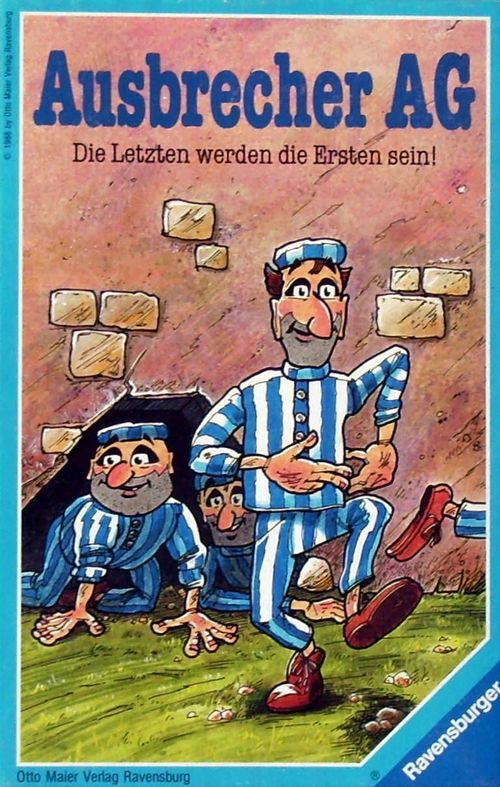
Ausbrecher AG
Ausbrecher AG Rulebook
Table of Contents
Table of Contents
Game Information
Dice game for 2-6 players, ages 10 and up. (The OCR of the German rulebook reads "8 - 6 players", an obvious misreading of 2-6.)
Contents: game board (die-cut), 7 wooden playing pieces, 7 wooden dice in different colors, 1 special die.
Object of the Game
The seven playing pieces are to reach the boats in the order that each player has secretly written down at the start. Each correctly predicted place earns the player points. The player with the most points is the winner.
The game board is assembled and laid on the table. The seven playing pieces are placed in any order on the seven windows of the prison. Each player also needs a sheet of paper and a pencil.
The Bet
At the start, each player writes down, completely secretly and hidden, on a sheet of paper the order in which, in their opinion, the seven playing pieces will arrive at the finish (that is, the 4 boats at the bottom edge of the game board).
Each player guards this sheet like a state secret. The other players naturally should not know which order one has bet on.
In the course of the game one will have to look at this sheet several times in order to recall one's own bet order to mind, and so not lose track of it. And remember: as a reward for each correctly predicted place, points await at the end.
(Illustration: a sheet headed "Order / Points" listing 1. Red, 2. Blue, 3. Light green, 4. Brown, 5. Yellow, 6. Orange, 7. Dark green.)
How the Game Goes: Bet - Roll - Move!
The starting space is the first space in front of the hole in the prison wall.
The Dice
Each of the seven playing pieces has a die of the same color. (The colors are brown, orange, light green, dark green, and so on for all seven.)
The player whose turn it is must, on each turn, roll three color dice of their choice and move the three playing pieces of the same colors. The playing pieces must always be moved forward by exactly the number of pips rolled. The player may decide for themselves in which order to move the playing pieces. Once a playing piece has been placed, the move may not be corrected any more.
Example: Ede is on turn and picks three dice: red, blue and yellow. Roll - then move: the red playing piece goes 3 spaces forward, then Ede moves the yellow one 5 spaces forward and finally the blue one 2 spaces forward. So, please - the next tough guy is up.
Must I always roll and move with the same three colors? No, on each turn one can choose a new combination of colors. It is important that one always rolls with all three dice at the same time. The playing pieces and dice belong to nobody; so everyone can roll with every die and move the corresponding playing piece.
Jumping
On the way to freedom, other playing pieces may be jumped over.
Walling In
Playing pieces can also be blocked, however. If a space is occupied by a playing piece and one or more playing pieces land on the same space at the end of their move, they are stacked on top of one another in the order in which they arrive.
Playing pieces lying underneath, and thus blocked, can only be moved on again when no other playing piece is standing on top of them.
White Special Die
The special die can, but does not have to, be rolled as an additional fourth die in any turn. By this number of pips, any playing piece of one's choice must be moved backward.
One may only select a playing piece that was not already moved forward in the same turn. So: moving forward and then immediately moving back again is not allowed!
It can happen that a playing piece is moved back to before the starting space. It can, however, be moved at any time again onto the way toward "freedom".
The special die may only be brought into play after the first round, that is, after all players have already had a turn.
End of the Game
If a playing piece lands on the last space or goes beyond it, it is immediately placed in the foremost free boat. In boats 1, 2 and 3 there is room for 2 playing pieces each; boat 4 holds only one playing piece. The first two playing pieces thus go into the boat with the No. 1, the next two into the boat with the No. 2, etc.
When a playing piece is in the finish, the die belonging to it is set aside.
When does the game end? When all playing pieces have arrived in the boats!
Important Note for All Tough Guys
If 2 playing pieces are in the finish, from then on only 2 color dice + the special die may be rolled.
If 4 playing pieces are in the finish, from then on only 2 dice may be rolled - that is, either 2 color dice, or 1 color die + the special die.
If all but two playing pieces are already in the escape boats, the following rule applies: should one of these two playing pieces be moved back, with the help of the special die, even to before the starting space, it counts automatically as the "last playing piece in the finish" and is immediately placed in boat No. 4. The other playing piece is likewise placed directly in boat No. 3.
The Great Settlement (Scoring)
When all the tough guys are sitting in the boats, the score is settled.
How is it scored? Quite simply: boat number = number of points. (Example: boat 3 = 3 points.)
For each bet-on playing piece that actually sits in the correct boat, the corresponding number of points is awarded. It does not matter whether the playing piece landed exactly on the predicted place. The main thing is that it is in the correct boat, that is, in the correct group.
The winner is the player with the most points!
(Illustration: two example bet sheets scored against the final boat positions, with totals of 9 and 11 points.)
Tactical Finesses and Sly Tricks
For the tough guys who want to know it all exactly, a few more tactical finesses and sly tricks.
The real professionals, who already have the total overview, will of course have noticed that a bed sheet hangs down from the right-hand cell, all the way to the path. Overly hasty escapers can agree before the start of the game to begin their common escape from this space. But watch out: the shorter way changes the tactics enormously!
Rolling the dice also allows a great many tactical possibilities.
Example: Brown is already out of the game, thus already sits in boat No. 1. Ede first moves with Orange, from now on into the first boat. Good! But then: Green is dangerously far ahead. So Ede next moves Green 4 spaces and then puts Blue with the 2 on top of it. Green is thus blocked for the time being and Blue is in a good position for the second boat!
The reverse move order would also have been possible (first Blue, then Green on top), but for Ede's bet sheet that would have been completely wrong.
(Illustration: Ede's bet sheet reads 1. Brown, 2. Orange, 3. Yellow, 4. Blue, 5. Green, 6. Red, 7. Dark.)
Another example of Ede's clever play
Ede rolls with Red, Yellow and Orange and additionally with the white special die. He notices that the pip count of the yellow die does not fit his plan. So, a quick decision: the yellow playing piece is instead moved backward by the pips of the white special die. The result of the yellow die is thus void.
Another possibility, with a suitable dice result, would have been to move a different playing piece onto the yellow one before its move, and thereby block it. In that case too, the result of the yellow die is void.
For tactical reasons one can choose from the outset dice of colors whose playing pieces are already blocked and, in this turn, cannot be freed either. In that case, perhaps only one playing piece of one color needs to be moved forward, which absolutely should be further ahead.
(Illustration: a stack of blue, light green and brown pieces blocks a further piece; the light green and brown dice are crossed out as unusable, while the dark green die is used.)
Freedom laughs...