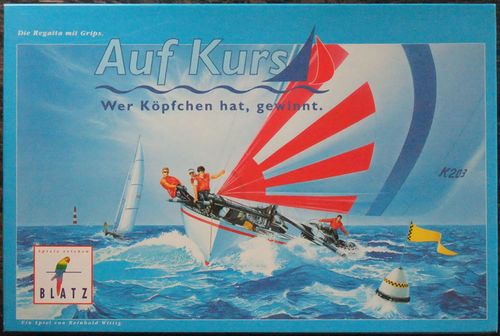
Auf Kurs
Auf Kurs Rulebook
Table of Contents
Table of Contents
Game Idea and Goal of the Game
Do you want to be the best? Good. Then you must decide the most favorable course around the buoy with the light rays from the lighthouses and come into harbor first with your yacht. And since no one knows ahead of time from where the wind will blow, it doesn't matter if you go left at the buoy or turn to the right.
2-6 players from 12 years.
Game Components
Besides a stiff breeze and good eye, for Auf Kurs you need:
- 1 game board
- 6 lighthouses
- 6 colored sailing yachts
- 2 buoys
Set-up
- Lay out the board.
- Each player chooses a sailing yacht and places it on any space of the start row (next to the dock).
- Decide who will go first. Note: So that the player who goes first will have no advantage, he doesn't take part in the construction of the lighthouses and the buoy.
- The lighthouses and one of the buoys are placed on the board in any way the players choose (fig. 2). Be careful, however: the light rays from the lighthouses always point along one of the six line directions (fig. 1). The light rays are represented by the wooden rods on the lighthouses and may not touch each other or any part of another lighthouse.
Fig. 1: The possible directions.
Fig. 2: How the board might look in a 2 player game of Auf Kurs (lighthouses, buoy and start places marked).
Fig. 3: How the start places might look in a 6 player game of Auf Kurs.
Play of the Game
The lighthouses point out the way with their light rays. They beam out over the whole ocean. In order to move forward, you must enter an unoccupied space where the rays of two lighthouses cross.
Fig. 4: Crossing point of two rays of light.
A little tip: you can use two pencils or something similar as extensions of the light rays to make determination of the crossing points easier.
Note: For movement direction to be valid, the same direction applies as for the light rays of the lighthouses. You and the other players may sail only straight routes in one direction (see fig. 1).
In each game turn, you have 9 points at your disposal. In order to move forward, you can exercise the following actions with them:
- Turn lighthouses. Each 60 degree turn (1/6 of a circle) of a lighthouse costs one point.
- Move lighthouses. Lighthouses can be moved to adjacent empty spaces. It costs two points for each space. Note: The direction of the light ray is not changed.
- Move your ship in a straight line. Each space costs one point.
- Drift. If a player can not make a legal ship move, his yacht drifts one space in a direction of his choice. Bad luck! His points are then used up and he may not change the position of the lighthouses.
Regatta Rules
Lighthouses and buoys are obstacles that you may not move over. However: You may jump over the ships of other players. [Translator's note: it is not clear if this means that you skip the space they are in, literally jumping over the other ship, or move through it. I believe that the latter interpretation makes more sense. As a result, we also play that you can move through a space containing another ship but you can't end your turn there. - PC] Light rays beam over ships and the turn-buoy but not over other lighthouses.
Light rays from two lighthouses that shine directly on each other do not form an intersection. Therefore only one of the two light rays from such a line may be used.
Example: Only one of the two light rays may be used.
The Tricks of the World's Best
If a player still has points left over at the end of his turn, he can use them to turn and move lighthouses. When doing this, he may move lighthouses that he has also used for the achievement of the goal. [Translator's note: I believe this means you can move and turn lighthouses that you have already used to enable ship movement that turn - PC] With this trick, you can set up your next turn, as well as place lighthouses unfavorably for the other players and, thus, take the wind from their sails.
End of the Game
The player who first gets his yacht back to the start row after going around the buoy wins the game. And, since no one ever knows ahead of time from where the wind will blow, it doesn't matter if he went around the buoy from the left or the right.
Game Variations
Auf Kurs is not complicated and, with a little imagination, you can experiment with the rules and the game components:
- The regatta participants can agree that every player gets to finish his turn in the round when the first yacht reaches harbor. If another sailor manages to make it into harbor in the same round, then whichever finishing player has the most points left over after the goal line is crossed gets the winner's cup.
- If six players want to play Auf Kurs, they can form teams: Players 1, 2, and 3 are one team and players 4, 5, and 6 form the other (see fig. 3). The respective crews should sit together. After all ships are placed on their start positions, the first team builds the lighthouses and the buoy. Then the second team starts. Each player of the team plays in turn according to the number of his own ship. The rest of the rules are the same as in the singles game. After the first team goes, the second team takes their turn. Of course, agreements can also be made within the teams over game tactics (everything very hush-hush, of course). The first team to bring a yacht back to harbor wins. However: Both of their other ships must have rounded the buoy and be at least on the row in front of where the buoy stands. For the opposing team, this requirement can be especially favorable in the hot end phase of the regatta because lighthouses can possibly be placed in the way of stragglers and, thus, take the wind from their sails.
- The team game can also be played by two players. Then each player controls two or even three boats.
- Auf Kurs is particularly interesting and exciting if not only one buoy must be rounded but, rather, two are used instead.
Auf Kurs at a Glance: The Quick Rules
Goal of the Game
- Round the buoy and be first to come back to the goal.
Set-up
- Choose a sailing yacht and place it on the start row.
- Build lighthouses and the buoy.
- The light rays from the lighthouses point into one of the six directions; they may not touch each other.
Play of the Game
You move as follows:
- With 9 points altogether, move into an unoccupied space where the light rays of 2 lighthouses cross.
- Only straight routes may be moved.
Turn Actions
- Turn lighthouses. Each 60 degree turn (1/6 of a circle) costs a point.
- Move lighthouses. Each newly reached neighboring space costs two points.
- Straight line moves. Each space costs a point.
- Drift. Drifting to a neighboring space costs all 9 points.
Lighthouses and the Buoy
- Lighthouses and the buoy are obstacles that may not be moved over.
- Light rays don't beam over other lighthouses.
- Light rays that shine directly on each other are not real intersections.
- Only one of these light rays may be used.
Points Left Over?
- Superfluous points may be used to turn and move the lighthouses.
End of the Game
- Whoever first comes back into the harbor after rounding the buoy wins the game.