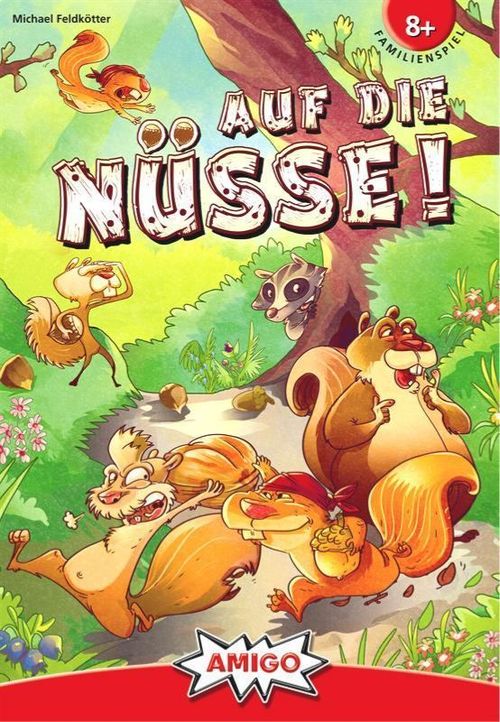
Auf die Nüsse!
Auf die Nüsse! Rulebook
Table of Contents
Table of Contents
Game Material
- 60 wooden squirrels (15 each in black, red, blue and white)
- 3 dice (2 white and 1 green)
- 32 nut store cards (8 cards per player, each with different motifs)
- Game board (with six hedges)
- David, the thieving raccoon
- 60 nut cards (12 each of walnuts, hazelnuts, beechnuts and acorns, plus 12 jokers)
Setup
Place the game board in the middle of the table and insert the six hedges.
Each player takes all squirrels of one colour and eight nut stores with the same motif. The nut stores are not assigned to a colour.
Shuffle the nuts, including the jokers. Lay the top four cards face up at the edge of the game board so that one card lies under each of the areas "2-4" / "5-6" / "8-9" / "10-12".
If fewer than four players play, some nuts are removed from the game before the start:
- With 2 players, remove two each of walnuts, hazelnuts, beechnuts and acorns and return them to the box.
- With 3 players, remove only one each of walnut, hazelnut, beechnut and acorn and return them to the box.
- The 12 jokers are needed at every player count.
One nut into the nut store. Each player receives one nut. They must place this card immediately in a store of their choice. Furthermore, eight nuts are set aside face down; they are needed at the end of the game. The remaining nuts are placed as a face-down draw pile next to the game board. Put the three dice and David the raccoon within reach.
The player who last saw a squirrel starts. The other players follow clockwise. Before the starting player begins, the other players may already place some squirrels on the game board. The left neighbour of the starting player may place one squirrel on any space of the 2-area. The next player (only with three and four players) places two, and the last player (only with four players) places three of their squirrels in the 2-area. Note that no player may place more than one squirrel in any one space and that no squirrel may be placed on the raccoon space.
(Board labels: Start track, draw pile, raccoon spaces, 2-area, 3-area, 4-area.)
Course of Play
At the start of their turn, each player rolls all three dice. Then they place a squirrel of their colour on the space of the start track that corresponds to the sum of the green die and one of the two white dice.
Example: Anna rolled a 2 with the green die and a 1 and a 6 with the two white dice. She can therefore place a squirrel either on space 3 or on space 8.
Note: Only one squirrel may stand on each space of the start track!
Each time a squirrel has been placed on the start track, the player has the choice of ending their turn or rolling again. As long as the player manages to place one of their squirrels on a free space of the start track each time, they may continue their turn.
Failed Roll
If, after their roll, the player cannot place a squirrel on the start track because the possible spaces are already occupied by squirrels, they must end their turn and take all squirrels from the start track back into their supply. Then it is the next player's turn.
Example: Marlene rolled a 4 with the green die and a 5 and a 6 with the two white dice. Unfortunately she already has a squirrel each on spaces 9 and 10. She must therefore end her turn and take all squirrels from the start track back into her supply.
Ending the Turn Successfully
After placing a squirrel on the start track, the player may decide to end their turn successfully instead of rolling again. They push all squirrels from the start track into the respective 2-area space lying above.
Collecting Nuts
At the end of each turn it is checked whether enough squirrels of a player stand in a space to collect nuts. First the 2-area is checked, then the 3-area and finally the 4-area. Each area is checked from left to right.
Checking the 2-area
In a space of the 2-area, at least two squirrels of one player must stand for them to take a nut. If enough squirrels stand in a space, the player takes two of them back into their supply and pushes any squirrels of the other players onto the space of the 3-area above. Own squirrels are never pushed on. Then the player takes the nut that lies under the start spaces of the 2-area from which they took the squirrels. The nut that was taken is immediately replaced from the draw pile.
Note: In the spaces of the 2-area belonging to the start-track spaces "2-4" and "10-12", it is possible for a player to have four squirrels after their roll. In this case, after taking the face-up nut for the first two of their squirrels, the player immediately also receives the newly laid nut for the other two squirrels.
Checking the 3-area
After the 2-area has been checked, the same is now done with the 3-area. Here three squirrels in a space are needed to receive a nut, but the spaces are also larger.
If a player has enough squirrels in a space, they take three of them out and return them to their own supply. Then they push squirrels of other players on into the 4-area and take one of the two nuts that lie under the start spaces of the 3-area. The nut that was taken is immediately replaced from the draw pile. If several players have at least three squirrels in a space of the 3-area, the one who sits closest clockwise to the player whose turn it currently is begins.
Note: If several players have enough squirrels in the same space, only the other players' squirrels of which there are fewer than three are pushed on.
Checking the 4-area
Lastly, the 4-area is checked. If a player has the corresponding number of squirrels in the 4-space, they take four of them back into their supply and may choose one of the four face-up nuts. The nut that was taken is immediately replaced from the draw pile. If several players have four squirrels in the 4-area, the one who sits closest clockwise to the player whose turn it currently is begins.
The Raccoon Spaces of the 2- and 3-Area
The two raccoon spaces work somewhat differently from the remaining spaces of the 2- and 3-area. If a player has two or three squirrels in the raccoon space of the 2- or 3-area respectively, they remove two or three of their squirrels and push the squirrels of the other players on as usual. However, they may both choose and take one of the four face-up nuts and additionally steal a nut from another player. A nut may only be stolen from a nut store that is not yet completely filled. Jokers may never be stolen. David, the thieving raccoon, is now placed in front of the player from whom was stolen. Nothing may be stolen from this player again until David has been moved to another player.
Illustration caption: David steals a hazelnut and is placed with the player who was stolen from.
Example
Marlene (red) ends her turn successfully and pushes her squirrels from the start track into the 2-area spaces above. In the 2-area space belonging to spaces 2, 3 and 4 of the start track, Marlene now has three squirrels. She takes two of the squirrels back into her supply and pushes Christine's blue squirrel up into the 3-area. Marlene's third red squirrel stays where it is. She takes the acorn and lays a new nut from the draw pile.
By pushing the blue squirrel into the 3-area, Christine (blue) now has three squirrels there. She takes them back into her supply and pushes all squirrels of her fellow players (black, white and red) on into the 4-area. She now has the choice between the two nuts under the "2-4" and the "5-6" space. She takes the walnut and lays a new nut from the draw pile.
By the pushing on of her squirrel into the 4-area, Anna (white) now has enough squirrels there to take a nut. She takes the four squirrels back into her supply, chooses one of the four nuts under the start track and lays a new nut. The squirrels of the other players are not pushed on any further.
Placing Nuts in the Nut Store
Each nut store has an empty and a filled side.
- Empty nut store (front): On the left is shown how many nuts fit in the nut store (number of nuts required). At the bottom right is the number of victory points the nut store is worth if completely filled at the end of the game.
- Filled nut store (back): The nut store is full and is turned over.
Each time a player has received one or more nuts, they must immediately place them in a nut store of their choice. Only nuts of one kind may lie in each nut store. In the further course of the game the nuts may no longer be moved to another nut store.
If a player has completely filled one of their nut stores, they turn it over to its back and put the nuts back in the game box. They are no longer needed for the rest of the game.
Jokers
In contrast to the other nuts, jokers do not have to be placed in a nut store immediately. They can be kept until the end of the game. Jokers count only as one of the two nuts depicted and may never be stolen by the raccoon.
End of the Game
The end of the game is triggered when the draw pile is used up while collecting nuts. Now the eight nuts set aside at the start of the game are used as the draw pile. First it is checked whether any further players in the 2-, 3- or 4-area have enough squirrels to get nuts.
Afterwards all squirrels still on the game board are pushed into the 4-area. Now all players receive, for each four of their squirrels, any one of the four face-up nuts. The one who sits closest clockwise to the player whose turn it currently is begins.
When all nuts and any remaining jokers have been placed in the nut stores, scoring takes place:
- Each filled nut store counts as many points as the number at the bottom right of the card indicates.
- Each nut in nut stores that are only partially filled counts one point.
The player with the most points wins the game. In case of a tie, the player who has the most valuable full nut store wins. If there is a tie here too, the players concerned share the victory.
Example: Uwe has three filled and two only partially filled nut stores. The filled nut stores count their full points; in the only partially filled ones each nut counts one point. 5 + 10 + 15 + 2 + 1 = 33.