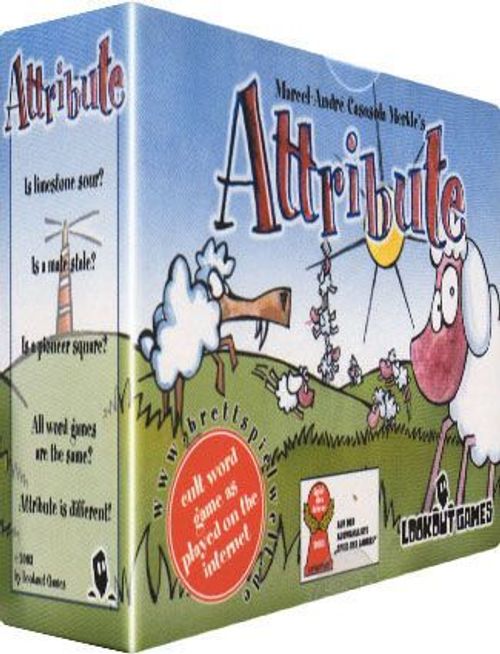
Attribute
Attribute Rulebook
Table of Contents
Table of Contents
Components
- 164 attribute cards
- 60 sheep cards
- 1 rules booklet
Each attribute card carries a single adjective. Its reverse (brownish) side is used to mark a scored point. Each sheep card shows either a green sheep or a red sheep.
Set-up
- Shuffle the attribute cards and the sheep cards as two separate decks and place both face-down on the table.
- Deal four attribute cards and one sheep card to every player.
- Choose a starting player. The published rule is that the player with the highest rank on Brettspielwelt announces the first topic; otherwise, decide randomly who goes first.
Every player therefore holds four attribute cards and exactly one sheep card at all times.
How to Play
A turn runs through four steps: commit the sheep, name the topic, commit an attribute, then reveal and grab.
1. Play the sheep card
After everyone has looked at their hand, all players place their sheep card face-down in front of themselves. The colour stays secret.
2. The active player names a topic
The player whose turn it is announces a topic — a person, an object, an idea, anything the table can react to.
3. Everyone plays an attribute card
All players (including the active player) choose one attribute card from their hand and place it face-down next to their own sheep card. What you are aiming for depends on your hidden sheep:
| Your sheep card | What you want your attribute to be |
|---|---|
| Green sheep | An attribute that fits the topic as well as possible |
| Red sheep | An attribute that fits the topic as badly as possible |
4. Reveal and grab
Someone counts to three. On three, all players simultaneously turn their attribute card face-up, leaving it on top of their own face-down sheep card. Each player and their two cards now form one card set.
Each player may then grab one card set played by another player, by putting a hand on that set's attribute and sheep card together. This is a speed contest: whoever gets a hand on a set first claims it. You may never grab your own set, and each set can be claimed by only one player.
Grabbing is optional — you should only want sets that hide a green sheep, because only those score. A player who does not like any of the sets on offer may pass and grab nothing.
Once every player has either claimed a set or declined to claim one, scoring happens.
Scoring
Scoring is judged per card set, from two directions: what you grabbed, and what happened to the set you played.
| If you grabbed an attribute... | If your attribute was not grabbed... |
|---|---|
| ...with a green sheep: +1 point | ...with a red sheep: +1 point |
| ...with a red sheep: -1 point | ...with a green sheep: -1 point |
So a grab pays off when the hidden sheep under it is green, and backfires when it is red. On your own side, you want a red sheep of yours to go unclaimed (nobody believed your attribute matched) and you do not want a green sheep of yours to be left behind (nobody agreed your attribute matched).
A single player can therefore gain and lose a point in the same turn, netting zero.
Keeping score with the cards
Attribute cards themselves are the point markers:
- When a player scores a point, an attribute card is turned to its brownish side and put into a scoring pile in front of that player.
- When a player loses a point, they discard one card from their scoring pile.
- Scores can never drop below zero. A player with an empty scoring pile who loses a point simply cannot discard, and so does not.
End of a Turn
- Used sheep cards go face-up into a sheep discard pile. When the sheep draw stack runs out, shuffle that discard pile to form a new sheep stack.
- Attribute cards that were played but not kept as points, together with cards discarded after losing a point, go into a separate attribute discard pile.
- Every player then draws one attribute card and one sheep card, restoring a hand of four attributes and one sheep.
- The next player in clockwise order announces a new topic.
End of the Game
Each player announces a fixed number of topics, depending on the number of players:
| Players | Topics announced per player |
|---|---|
| 3 | 6 |
| 4 | 4 |
| 5 | 3 |
| 6 | 3 |
| 7 | 2 |
| 8 | 2 |
The game ends once every player has announced that many topics. Whoever has scored the most points wins.
Variant: Different Scorekeeping
The online version at brettspielwelt.de uses a slightly different scoring that needs pen and paper:
- A player whose green sheep card set is claimed scores an additional point.
- A player whose red sheep card set is not grabbed loses a point.
With this variant, a player's total can go below zero.
Hints for New Players
- Attribute runs on puns, wordplay and wit, so interesting, funny and/or controversial topics make the best game. If you are stuck for a topic, use one of the other players as the topic.
- Bluffing is rarely a good idea. You only score when the other players agree with you about which attributes match and which do not.
Example of Play (One Turn)
Jeff, Stephen, Rick and Paul are playing. Jeff's topic is "dunghill".
Choosing attributes. Paul has a green sheep and happens to be holding "smelly", which he plays immediately. Stephen also has a green sheep but a much weaker hand — "bold", "bitchy", "remarkable" and "Eastern" — and gambles on "remarkable", hoping someone finds a dunghill interesting. Rick has a red sheep and so needs a poor fit, but his options ("silly", "dirty", "buoyant", "curvy") are all uncomfortably plausible; he settles on "curvy". Jeff also holds a red sheep and plays "intelligent".
Grabbing. The attributes are revealed. Paul's "smelly" is the obvious green-sheep bet and several players lunge for it, but Stephen is fastest and claims it. Paul then takes Rick's set, judging "curvy" more likely than "intelligent". Rick, remembering a talking dunghill from a famous puppet show, is comfortable with "intelligent" and grabs Jeff's set. Jeff is slow this round and is not convinced a dunghill is "remarkable", so he passes.
Scoring.
- Paul avoided losing a point on "smelly" because Stephen took it. But he grabbed Rick's set, which hid a red sheep, so he loses a point. Total: -1.
- Rick lost the chance to score for his unclaimed red "curvy" because Paul took it. He also grabbed Jeff's "intelligent", which hid a red sheep, costing him a point. Total: -1.
- Stephen scores a point for grabbing Paul's green-sheep "smelly" first. He loses a point because nobody thought a dunghill "remarkable" and his set carried a green sheep. Total: 0.
- Jeff gets nothing for his set: his red-sheep "intelligent" was grabbed by Rick, so it does not pay. Having chosen not to grab, he has no other way to score. Total: 0.