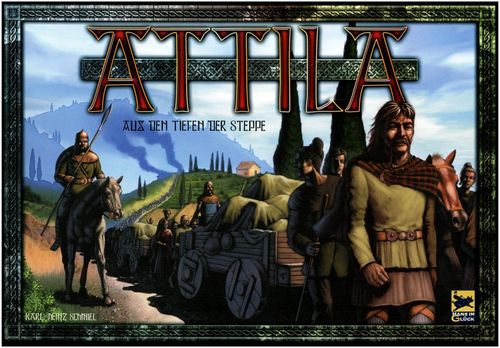
Attila
Attila Rulebook
Table of Contents
Table of Contents
Components
- 54 cards (9 for each of the 6 peoples: Franks, Huns, Goths, Saxons, Teutons, Vandals)
- 120 people pieces (20 for each of the 6 peoples)
- 35 scoring markers (7 per player, in 5 player colors)
- 15 action tiles
- 10 pacification tiles
- 5 player tiles
- 1 game board
- 1 influence board
- 1 rulebook
Setup
- Place the game board in the middle of the table. Set the influence board, all the people pieces, and the shuffled deck of cards beside it.
- Distribute the 10 pacification tiles onto the century spaces of the game board as follows: 1 tile on the "4th century" space, 2 tiles on the "5th century" space, 3 tiles on the "6th century" space, and 4 tiles on the "7th century" space.
- Each player takes the 7 scoring markers and the player tile of one color. Each player places 1 scoring marker next to the "zero" space of the scoring track on the board; the remaining 6 markers are kept beside or below the influence board. The player keeps the player tile in front of them to show which color they are playing.
- Each player then receives 6 cards, dealt face down. The remaining cards form the face-down draw pile, placed beside the board.
- Finally, each player receives a set of 3 action tiles.
The youngest player goes first. Play then continues clockwise. Throughout these rules, the player whose turn it is is called the active player.
Note: the players do not take control of individual peoples. In other words, the colors red, green, blue, and yellow used for the scoring markers are not tied to the matching colors of the people pieces.
Objective
The goal of the game is to score as many points as possible. Points are awarded to the players with the greatest and second-greatest influence over each people. The player with the most points at the end of the game wins.
Sequence of Play
On a turn, the active player, in this order:
- Plays a card and places a people piece (see 1).
- Takes influence (see 2).
- If applicable, resolves a conflict and pacification (see 3).
- If applicable, resolves scoring (see 4).
1. Play a Card and Place a Piece
The active player plays one card of their choice and places a piece of the matching people into one of the Roman provinces on the board.
The first piece of a people must always be placed in one of the 6 upper provinces. The 6 upper provinces are the ones bordering the reddish line drawn across the board. Every following piece of that same people can be placed:
- in one of the 6 upper provinces, or
- in a province where one or more pieces of that people are already present, or
- in a province adjacent to such a province.
After the piece is placed, the played card is discarded to the discard pile.
2. Take Influence
For the piece just placed, the player immediately gains influence over the corresponding people. To do so, they move one of their 6 scoring markers for that people forward on the influence board:
- 1 space, in the 4th century (as long as a pacification tile still lies on the "4th century" space).
- 2 spaces, in the 5th century (once the "4th century" space is empty and a pacification tile still lies on the "5th century" space).
- 3 spaces, in the 6th century (once the "4th and 5th century" spaces are empty and a pacification tile still lies on the "6th century" space).
- 4 spaces, in the 7th century (once the "4th, 5th, and 6th century" spaces are empty and a pacification tile still lies on the "7th century" space).
If the player does not yet have a marker at that people's track, they place it on the lowest space instead of moving it forward. If a marker of theirs is already on that people's track, they move it forward the appropriate number of spaces.
Important: a player may instead choose to forgo taking influence. In that case, they may place a second piece of the same people instead, following the normal placement rules, but without advancing their scoring marker for that piece.
Normally, the player's turn now ends, and they draw back up to 6 cards from the draw pile. Exceptions: a conflict and pacification (see 3) and a double turn (see 5) may still need to be resolved first.
3. Conflict and Pacification
Each province has room for only 4 pieces. As soon as a 5th piece would be placed into a province, a conflict occurs there. After the conflict, the province is pacified.
The conflict:
- Starting with the active player, each player in turn either plays one or more cards face down in front of themselves, or passes.
- Cards may be played for any of the peoples represented in that province, and several cards may be played for the same people.
- Once everyone has played or passed, all played cards are revealed and the strength of each people present in the province is determined. A people's strength equals the number of that people's pieces in the province plus the total number of cards played for that people.
- The people with the lowest strength must vacate the province: all of that people's pieces return to the general supply. If several peoples are tied for lowest strength, all of them are removed (a province can end up completely empty this way).
The pacification:
- After the conflict, a pacification tile is placed in the province, and the remaining pieces are set on top of it. The first pacification tile is taken from the "4th century" space. Later tiles are taken from the "5th century" space until it is empty, then from the "6th century" space, and finally from the "7th century" space.
- No further pieces may be placed into a pacified province.
Cards played during a conflict are discarded to the discard pile. Players may only refill their hand back up to 6 cards at the end of their own turn.
4. Scoring
As soon as the last pacification tile of a century is placed on the board, all six peoples are scored, in this order: first the Franks, then the Huns, Goths, Saxons, Teutons, and finally the Vandals.
The player(s) with the greatest and second-greatest influence over each people score points:
a. The player with the greatest influence (i.e. whose scoring marker sits furthest forward on that people's track) scores 1 point for every piece of that people on the board.
b. The player with the second-greatest influence scores 1 point for every province that people occupies.
c. If several players are tied for the greatest influence, the points for pieces and the points for provinces are added together, then split evenly among those tied players, rounding up if necessary.
d. If several players are tied for the second-greatest influence, the points for provinces are split evenly among those tied players, rounding up if necessary.
e. If only one player has any influence over a people at all, that player scores the points for pieces and the points for provinces combined.
Players advance their scoring marker on the board's scoring track by the number of points earned.
5. Action Tiles
At any point during their own turn, the active player may play one of their action tiles (maximum 1 per turn). The action tiles do the following:
- Double Turn: the player may play a second card and resolve it fully (first the consequences of the first card — conflict and pacification, scoring — then the second card with its own consequences). Only after both cards are resolved does the player refill their hand back up to 6.
- Exchange: the player may exchange any number of cards from their hand for the same number of cards from the draw pile.
- 2 Influence: the player may move their scoring marker for one people of their choice forward 2 spaces on the influence board, or their markers for two peoples of their choice forward 1 space each.
Once used, an action tile is removed from the game.
6. End of Game
The game ends:
- as soon as the last pacification tile has been placed, or
- as soon as a people has no pieces left in the general supply, or
- as soon as a scoring marker reaches the topmost space of the influence board (if it would need to move further, it simply stays on that top space).
The active player finishes their turn, and then a final scoring takes place, resolved the same way as every other scoring.
The player with the most points wins.
Two-Player Rules
With 2 players, the rules above apply with the following changes:
- Each player plays 2 cards on their turn (identical or different) and resolves them accordingly.
- When using the "Double Turn" action tile, only 1 additional card may be played (instead of 2).
- Scoring works the same way as usual, with one change: if there is more than 1 empty space between the leading player's marker and the trailing player's marker on a people's track, the trailing player scores nothing for that people, and those points are lost.
Additional Notes
Conflict with a single people: even if only pieces of a single people occupy a province, a conflict is still triggered when a 5th piece is placed. All of that people's pieces are removed, and the province becomes empty. A conflict for that people still takes place, so that players may play cards of that people simply to get rid of them.
Pacified provinces: the placement rule "in a province adjacent to such a province" also applies to a pacified province — read it in that case as "in a province adjacent to the pacified province."
Drawing cards: only the active player refills their hand, and only at the end of their turn. Any conflicts, pacifications, and scorings must be resolved first.
Arrows: provinces connected across the sea by an arrow are considered adjacent to one another.
End-of-game edge case: if the last remaining piece of the Vandals is placed as the 5th piece in a province, triggering a conflict, that piece returns to the supply after the conflict is resolved as normal, and the game continues.
The board: the fortifications drawn on the map have no effect on play. No pieces may be placed on Sardinia or Corsica. Greece counts as a single province (its mainland and the Peloponnese together).
Pieces: under no circumstances may a 6th piece ever be placed into a province — not even through a double turn, and not even when a player forgoes taking influence.
Scoring: a scoring always takes place when the last pacification tile is taken from a century space — not after every individual pacification.
Two-player counting tip: when scoring, an easy shortcut for the leading player is to advance their marker only by the difference between the number of that people's pieces and the number of provinces it occupies.