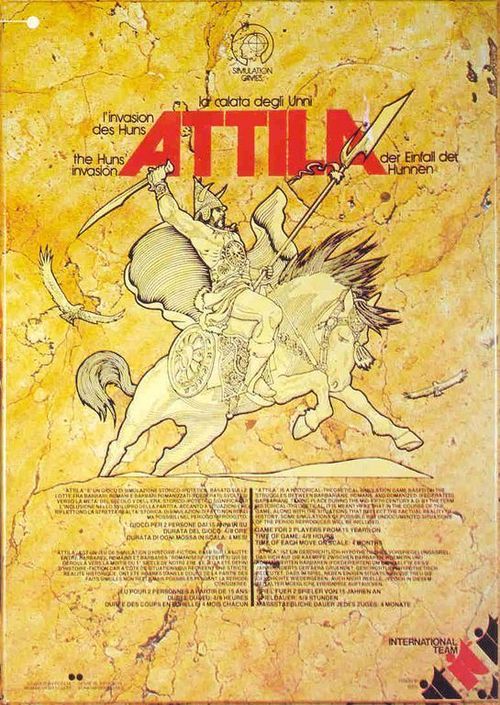
Attila: The Huns Invasion
Attila: The Huns Invasion Rulebook
Table of Contents
Table of Contents
Contents of the Box
The box contains:
- 1 board
- Roman and Barbarian pieces
- 6 cards to determine the outcome of combat
- 1 combat table
- 1 set of rules
- 1 Calendar
- 6 diplomatic cards for councils
Elements of the Game
The Board
The playing board is a map of Europe showing the boundaries of the Roman Empires, that of the East and that of the West, and the Barbarian territories, as well as the important rivers, the cities of major political, strategic, and demographic importance and the surrounding cultivated fields, which have an important role in the game.
The mountains have not been taken into consideration as their influence on the moves of the pieces would overcomplicate matters.
The moves are to be made over the honeycomb grid superimposed on the map. The scale of the map is approximately 1 to 7,000,000, and thus each hexagonal space is 70 km wide. The geography has been modified according to the requirements of the game and the geographical knowledge of the epoch.
The Pieces
The pieces represent the various combat units (hereinafter CTU's) and command units (hereinafter CMU's) which participated or could have participated in the Barbarian invasion.
The white ones are the Romans, Eastern or Western Empire according to whether they bear letters or numbers. The green ones represent the Huns, the yellow ones the Gepids, the dark blue the Heruli, the brown the Longobards, the pink the Ostrogoths, the light blue the Thuringians, the violet the Burgundians, the red the Franks, and the orange the Visigoths.
On each piece is printed an indication (Fig.1) of the following:
- type (legion, troop, hoard, etc.)
- denomination (III, α, etc.)
- movement factor (maximum number of spaces it can cover in a single turn)
- combat factor (CF) (value expressed in points of each unit)
Other pieces represent the command units which have a fixed movement factor (3 spaces per turn, except for the CMU's of the HUNS, which have 4 spaces per turn and the Pope, who has 5).
Auxiliary pieces have been added as indicators of the value of the various battles (the pieces numbered 1 to 7) and to mark the cultivated areas temporarily or permanently devastated. These pieces are placed on the battlefield forces sheet.
Foreword
Phases of the Game
"Attila" is played in several phases, corresponding to the period of the year in which the masses of the time could be moved about (Spring and Autumn). For each season there is a corresponding box on the calendar. In order to keep track of which phase is being played, there are special markers to put among the pieces (Fig.2).
Order of Turns
Each round corresponds to a series of turns in the following order:
a) Barbarian moves b) possible devastation of cultivated fields c) combat (Barbarian attacks) d) possible reduction of the Roman units being attacked e) Roman moves f) combat (Roman attacks)
1. Rules
Each player can, during his turn, move all, some or none of his CTU's or CMU's within the limitations indicated by the movement factor printed on the pieces. This move can be made in any direction or any combination of directions (Fig.3), within the following limitations:
1.1. No unit (neither a CTU or a CMU) can move into a space occupied by an enemy or neutral unit.
1.2. It is prohibited to stack two or more CTU's, CMU's and auxiliary pieces are, instead, exempt from this limitation.
1.3. Each CTU must stop as soon as it enters one of the six spaces immediately adjacent to an enemy CTU, the which shall be defined as the area of control (hereinafter AOC) (Fig.4) of this unit. Therefore it must stay there until it is brought out of the enemy AOC. The CMU's are never obligated to stop because of an AOC.
1.4. All units (CTU's and CMU's) must stop on all spaces which are crossed from one side to another by a section of a river, being able the next turn to move or proceed on other spaces over the same river, without restrictions.
1.5. Spaces over the sea (but not the beach) are off limits.
2. Areas of Control
The AOC's defined in 1.3 surround all the CTU's (but never the CMU's) under the following conditions:
2.1. The CTU's occupying cities have no AOC.
2.2. The CTU's immediately adjacent to cities have no control over the spaces covering those cities.
2.3. The CTU's placed in cities are free to leave them, in spite of their inclusion in enemy territory; once they leave, however, they must stop on the first space they come to that is controlled by the enemy.
2.4. The AOC's do not extend beyond rivers or closed borders (Fig.5).
3. Devastation
When the Barbarians have finished their moves (a), the devastation markers must be placed in the spaces covering cultivated lands occupied by Barbarian CTU's or CMU's or falling into their AOC's unchallenged by the Romans (that is, controlled by Barbarians and not occupied or controlled by Romans as well).
3.1. At the beginning of the Spring phase, before any move is made, the cultivated fields are "regained" in the spaces no longer controlled by Barbarians (or challenged by the Romans). Attila has the option to PERMANENTLY devastate the land over which he moves, leaving the special markers (Fig.6) (under Attila's horse the grass never grew back).
4. Combat
All the CTU's which, at the end of their turn, are on spaces in the actual AOC (see 1.3, 2.1, 2.2, and 2.3) of one or more enemy CTU's must attack them (Fig.7) fighting against them according to the following rules:
4.1. All CTU's actually in the enemy AOC must fight during the turn when they entered and all those as long as they stay there.
4.2. All enemy CTU's in one's own AOC must be attacked.
4.3. All CTU's must fight only against enemy units violating their AOC.
4.4. The order and distribution of the combat, within the aforesaid limits, is left to the judgement of the offence (that is the player in combat).
4.5. The CMU's are never obligated to fight, and can do so only when they are stacked onto their own CTU's (of the same nationality and not simply allied), of which the combat factor doubles, with the exception of Pope Leo I (Leo the First).
4.6. The CTU's placed in cities have their combat factor doubled in defence, except in the situations where they have been besieged and have thus already undergone a reduction of their power (this doubling of the combat factor (CF) cannot be added to that dealt with in 4.5). CTU's in cities are not obligated to attack and do not obligate the enemy to attack.
4.7. The CTU's of both players, engaged in a single combat action, add the CF's, thus establishing the difference between the sum of the CF's of the offence and the defence (Fig.8).
5. The Outcome of the Combat
The result of each combat action must be ascertained before going on to other actions. The results are decided upon in the following manner:
5.1. The difference between the CF's of the units in combat is ascertained, always rounding down the higher score to a (omit 1 "to a") number divisible by the lower score.
Ex. 1) A legion with a combat factor of 8, attacks a hoard with a combat factor of 4, thus 8/4 is reduced to 2/1.
Ex. 2) The same legion with a CF of 8 plus a cavalry division with a CF of 4 attack a hoard worth 5, then 8 + 4/5 = 12/5 and this is rounded off to 2/1.
5.2. The Offence takes the 3 attack cards (Fig.9) and secretly choses one and the defence does the same with the defence cards (Fig.10). On the combat table in the column corresponding to the ratio of forces in that battle, the intersection between the attack column chosen by the Offence and that of the Defence shall decide the outcome of the battle.
5.3. The abbreviations written on the attack card and on the table mean:
- al - linear attack
- cp - direct charge
- as - multiple charge
5.4. The abbreviations on the defence card mean:
- dl - linear defence
- dp - direct defence
- md - diversive manouvre
5.5. The results of the battles can be as follows:
DR or OR, that is Defence retreats or Offence retreats, meaning that all the CTU's and CMU's of the party in question must retreat one space, in the direction chosen by the party in retreat. Should the party so doing enter areas that are off-limits (across rivers, over allied or enemy CTU's, or into AOC's of the same or other enemies) the result is the same as A1 and D1.
AE1,2,3 or DE1,2,3 mean all the CTU's of the Offence or the Defence lose 1,2, or 3 combat points. In this case a numbered marker with the new value is placed on top of them. The winner also has the option to move them back a space or not.
5.6. In case of retreat, the pieces of the winners can advance occupying the spaces left vacant. The CMU's share the fate of the CTU's upon which they are placed. When attacked alone they are automatically eliminated.
5.7. The reductions which exceed the CF of the piece mean elimination.
6. Besieged Roman Units
All Roman combat units, of the East or the West (excluding their Barbarian allies), placed in cities with adjacent spaces of cultivated land which has been devastated and with at least one of these occupied by the adversary, are considered besieged (Fig.11), and undergo at the end of each phase c) a reduction of 1 of its CF in defence (see 4.6.). The Barbarian pieces are not subject to these reductions (their dependence on agriculture is much smaller).
7. Victory
The Barbarians obtain a victory if:
7.1. They continue to occupy at the end of the 16th round, at least one city in the Eastern Empire, one in Gaul, and another in Italy.
7.2. They obtain at least 20 points from the cities conquered.
8. The Romans instead win if able to prevent the Barbarians from accomplishing all of the above conditions for victory. By occupying at the end of the game some of the cities in Magontiacum, Ratisbona and/or Buda, the Romans have the right to subtract 3, 3 and/or 10 points respectively from the sum total of the Barbarians. See points for cities.
Special Rules
Romans of the Eastern Empire
9. They begin the game with Emperor Theodosius II. He died at the end of turn f) of the 11th round. At the beginning of turn e) of the 12th round his successor, MARTIANUS, appears in Constantinopolis, however, without moving until the next turn. The Eastern Empire Romans cannot move in the Western Empire (and vice versa).
Romans of the Western Empire
10. They cannot defend themselves from Barbarians allied with the HUNS, without invading the Barbarian territory before attacking the HUNS themselves.
10.1. The Pope must convince the VISIGOTHS, the FRANKS and the BURGUNDIANS to fight alongside of the Romans against the hoards under ATTILA. To this purpose, Pope LEO I must make a "diplomatic journey" to the cities where their leaders were, that is, respectively, TOULOUSE (TOLOSA), COLOGNE (COLONIA), and LUNGDUNUM. The outcome of the first two missions is automatic: as soon as the Pope arrives in the indicated space, those Barbarians are considered federated (allied) with the Romans, thus being able to move immediately, but going into combat only at the moment when Gaul is invaded by the HUNS. The BURGUNDIANS instead are influenced otherwise: the followers of ATTILA try to convince them to join the hoards of the invaders (the BURGUNDIANS had reasons to oppose both sides: they had recently been defeated by the Romans and the HUN mercenaries).
The battle between LEO I and the followers of ATTILA is decided by using the diplomatic and Council chart. As soon as LEO I stops at Lugdunum, the chart is applicable and (omit) the same proceedure as that of combat is followed, but using the diplomatic cards (Fig.12). Thus the result is determined by the intersection of the line and column which corrispond to the diplomatic cards chosen by the players. A neutral result implies the possibility of the Pope continuing his diplomatic offence in the following turn, so as to obtain a decisive outcome. If the BURGUNDIANS join forces with the Romans, the THURINGIANS (friends of the FRANKS, but anxious to invade Gaul) will do so with the HUNS (and vice versa). Neither one will do so, however, before the invasion of the West by the hoards of ATTILA.
10.2. Any Roman CTU (omit "'s") secretly marked on a sheet of paper by a Barbarian at the beginning of the game, is affected as follows:
10.2.1. If the Pope moves over it or in its AOC, this legion infiltrated by the followers of ATTILA kills LEO I, along with any CMU placed over him and proclaims ATTILA as the Pope. It remains neutral (that is, unable to attack or be attacked) until another Roman CTU is placed on it, restoring it to Roman loyalty.
10.2.2. If instead ATTILA moves into the AOC of the aforesaid legion, the effects are the same as above except for the death of LEO I, as the consacration of ATTILA as the Holy Pontificate would only make an Antipope of him.
10.3. The rivalry between Emperor VALENTINIANUS III and General AETIUS can lead to violent events. In three successive turns secretly marked by the Barbarians, the proximity of Aetius to the Emperor within a range of 2 spaces (one space between them) brings about the assassination of the former for Emperial provocation.
10.4. If at the end of the game LEO I is still alive and ATTILA has been proclaimed Antipope, LEO I has the option, if he is placed in a city, to call a Council to chase this Barbarian Antipope away from the throne of St. Peter. Here too, the Diplomatic and Council Chart is used. A neutral result, unlike rule 10.1, is permanent as the Cardinals are unable to decide between the Pope or the Antipope, thus causing the first "Schism of the West". If LEO I is defeated, ATTILA remains Pope to every right.
11. Mediolanum
The city of Mediolanum (Milan) had at that time one of the lowest birth rates in the Empire. For this reason the Roman CTU's besieged there have their power reduced by 2 points at a time.
12. Merovaeus
The king of the FRANKS, MEROVAEUS, ascends to the throne at the beginning of turn e) of the 7th round.
13. Theodoricus
This king of the VISIGOTHS dies at the beginning of turn f) of the 13th round.
14. Heruli, Longobards, and Ostrogoths
They can only attack the Western Empire (not being able to cross the Eastern territories).
14.1. They can attack the West from the first round, without however, occupying any cities until the HUNS have invaded the West (that is not before 449, in the 9th round). Even then all the cities in Gaul must be occupied before they can occupy any Italian cities (see 7.1). The other cities not belonging to Gaul or Italy can be occupied from the beginning of the game.
14.2. Any CTU of these allies of the HUNS, on being suborned by AETIUS, must be secretly marked by the Romans so that if ATTILA moves into a space adjacent to said unit, it can assassinate him. This can take place during any round of the game.
15. Gepids
They fight only against the Eastern Empire alongside the HUNS.
16. Huns
From the 1st through the 8th round they can only attack the Eastern Empire.
16.1. From the 9th round on, they can proceed with the invasion of the West (that is they can anticipate the true history by one year).
16.2. They can occupy no Italian city before occupying at least one city in Gaul.