Attangle
Attangle Rulebook
Table of Contents
Table of Contents
Material
- A hexagonal board with 4 spaces on each side (37 spaces)
- 18 white and 18 black stackable pieces.
Objective
The game is won by the player who can build 3 triple stacks.
Preparation
Initially the board is empty.
Players choose their color and place a stock of 18 pieces in front of them.
Play
White makes the first move. Then turns alternate.
During the game players enter new pieces and build stacks of pieces through capturing moves.
A player controls a stack if he owns the topmost piece. A stack can never be split.
Generally a player can either:
- Place a piece from the stock on any empty space (except the center d4, which must be unoccupied throughout the game), or
- capture an opponent's piece or stack of pieces on the board.
Players cannot pass their turn. If the stock is empty a player must make a capture or otherwise resign the game.
Generally, a capture is a movement of two friendly pieces from two different directions stacking up on an opponent piece.
After that the current player takes back the topmost piece (which will be always of his color) to the stock. The maximum height of a stack (after taking back one piece) is three.
So there are three possible captures:
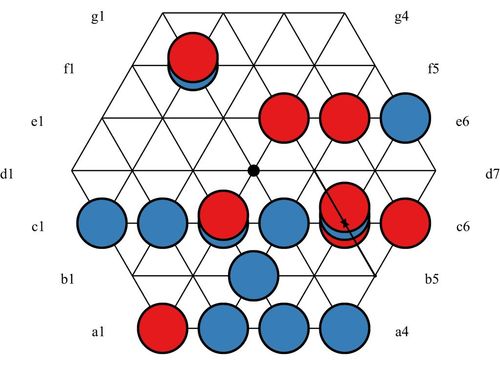
- Two single pieces capture a single piece (Fig. 2.1).
- Two single pieces capture a double stack (Fig. 2.2).
- One single piece plus a double stack capture a single piece (stacked so that two pieces of the current player are directly on top) (Fig. 2.3).
As a rule of thumb just remember: looking at the three pieces (or stacks resp.) of a capture move, only one double stack can be involved.
Pieces always move in a straight line and any number of unoccupied spaces. It is allowed to cross the center d4. Triple stacks cannot be moved.
Diagram captions
- Two single pieces capture a single opponent piece.
- Double stacks can be captured.
- Stacks can capture too.
- White or black: no captures are possible here.
End of the Game
A game is won by the player who builds up his third triple stack. Also, a player must resign if he has an empty stock and cannot make a capture move.
Diagram captions: White resigns. The (indicated) threat by black cannot be answered.
Variant: Grand Attangle
A variant of Attangle.
Equipment
- Hexboard with 61 spaces (5 spaces on the edges)
- 2 x 27 pieces, white and black
Preparation
Initially the players place 3 of their pieces according to the initial setup figure (not reproduced here).
The 7 specially marked spaces (called "voids") are handled like the center space of standard Attangle, i.e. no pieces can be placed there, capture moves across these spaces are allowed though.
Objective
- A player building their fifth 3-stack wins.
- A player loses if they have no moves left, i.e. no more pieces in hand and no capture moves on the board (like in the original game).
Variant: Attangle 127
For hardcore Attangle players.
Rules like standard Attangle, 127 cells (without voids), 2 x 30 pieces. Win with 5 triple stacks.
This game is in a test phase currently with a different objective. There are no more winning stacks, play continues until a player runs out of moves (and loses).
Earlier Rules (2006 version)
These are the rules which were published in May 2006; the rules above are the newer, preferred rules.
Material
A hexagonal board with 4 spaces on each side (37 spaces), and a sufficient amount of stackable pieces in white and black for each of the two players.
Objective
Be the first to build 3 stacks of your color which are 5 pieces high.
Play
(In the following the concept of "pieces" is used for single pieces as well as for stacks.)
Initially the board is empty.
White makes the first move. Then turns alternate.
When it is your turn you can either:
- Place a single piece of your color from outside the board at any empty space (pieces are placed at the intersections of the lines), or
- capture an opponent's piece on the board.
Exception: In the very first move, White cannot place a piece on the center at d4.
You cannot pass your turn.
To capture an opponent piece you move pieces of your color on top of an opponent piece. Pieces can be moved in straight lines any number of spaces. They cannot jump other pieces. Place the moving pieces on top of the opponent piece.
A stack of pieces is said to be "of your color" if the topmost piece is of your color.
The capturing pieces move at the same time, so your pieces must come from different directions (because they cannot jump).
After the capture your pieces must have a majority by 1 piece in the resulting stack (i.e. 2-1 or 3-2).
Stacks cannot grow larger than 5 pieces high.
Stacks cannot be split.
Diagram captions: Two single pieces capture a single opponent piece. Stacks can capture too. Stacks of height 3 can be captured. No captures are possible here.
End of the Game
As soon as you succeed in building your third 5-stack, you win.