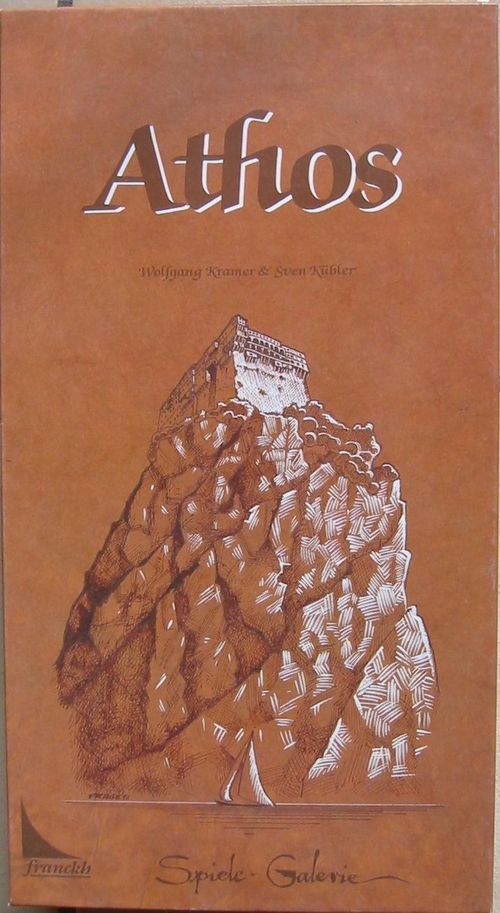
Athos
Athos Rulebook
Table of Contents
Table of Contents
Content
- 1 gameboard
- 8 Athos pieces
- 12 monks in 4 colors
- 80 terrain tiles for blocking, 16 of each color
Object of the Game
Move your monks onto the top of the Athos mountain. The player who moves his three monks onto the top first is the winner.
Setup
Each player chooses a color, takes the matching monks and places them in a starting area. Which spaces are possible starting areas depends on the number of players (see illustration in the rules):
| Number of players | Areas |
|---|---|
| 2 | B and D |
| 3 | A, C and D |
| 4 | A, B, D and E |
Source note: the French text lists the 3-player starting areas as "A, C et E" where the English lists "A, C and D". The English is transcribed as printed; the discrepancy has not been resolved.
Each player takes two Athos pieces and keeps them open on the table. The terrain tiles are sorted by color and stacked next to the gameboard. The colors define on which part of the gameboard the terrain tiles can be placed. Each tile has an unpassable side with landslides and a side which shows all paths open.
The youngest player starts. The others follow in clockwise order.
A player's turn consists of the following phases:
- Move the monks 6 spaces (and/or turn over terrain tiles).
- May place one of his two Athos pieces.
- Block spaces by placing terrain tiles.
The phases have to be performed in this order.
Source note: the English text says "one of his three Athos pieces" here, but the setup and the Content list both give each player two pieces (8 pieces for 4 players). The French text reads "une de ses deux pièces Athos". "Two" is used here as a correction of the source error.
Movement of the Monks
A player has up to 6 movement points for all of his monks together. Each point moves a monk one space. The movement points may be distributed between the monks in any denomination.
Example: One monk moves 1 space, the 2nd one 2 spaces and the third one 3 spaces. Or one monk moves 6 spaces while the other two don't move.
A player doesn't have to use up all the 6 movement points.
Monks may move in any direction and through any terrain color. It is possible to move through occupied spaces, but it still costs one movement point. In any space there may be only one monk at the end of a turn. It is allowed to move through starting areas. They count as one space.
It is not allowed to move into or through spaces which are blocked by a landslide.
Placing Terrain Tiles
After a player has moved his monks, he takes terrain tiles from the stacks next to the gameboard. How many tiles he may take, and the maximum number of tiles per color, is written in the table on the gameboard:
| Players | Tiles per turn | Max. tiles per color |
|---|---|---|
| 2 | 8 | 2 |
| 3 | 5 | 2 |
| 4 | 4 | 1 |
Example: With 3 players participating in a game, each may place 5 terrain tiles per turn, but not more than 2 of the same color.
A player may place fewer tiles than listed in the table if he wants to.
Tiles are always placed with the blocking side up on any space of a matching color. It is not allowed to place terrain tiles on a start space.
No monk may be completely cut off from a path to the top. There must always be a way for every monk to reach the top, no matter how long it is. The path to the top may be traced through opposing start spaces.
If all tiles of a certain color are placed, it isn't possible to place any new blockades there. If all tiles are placed, the player simply skips this phase.
After a player has placed terrain tiles, his turn is over. There are, however, some other activities he may perform during his turn:
- Turn tiles over
- Place Athos pieces
Turning Tiles Over
By turning over a blocking tile on the gameboard, a player may remove a landslide. The blocked space is passable again. To turn over a tile, a player has to spend 4 of his 6 movement points during his movement phase. He may move his monks only two spaces further. Removed landslides may be reestablished by turning over the tile again. This costs 4 movement points again. It is not allowed to turn over a tile which is occupied by a monk.
Tactical hint: If a new path to the top is opened by removing a landslide, it may be possible to block another path.
Place Athos Pieces
If a player decides to place an Athos piece, he has some additional possibilities during his turn. He may place his Athos piece only after he has moved his monks and before the terrain tiles are placed.
The player placing an Athos piece first moves a terrain tile already on the board to any other free location on the board. It may even be moved to an area which has a different color than the tile. A tile which is occupied by a monk may not be moved. A tile may not be turned over while moving it. All monks must still have a possible path to the top of Athos.
The player then places his Athos piece on any one terrain tile on the board, which may now not be altered during the further game. It doesn't matter if this tile is blocking or passable, or if a monk currently occupies it. The piece may be placed onto the tile just moved.
A player may only place one Athos piece during his turn. Once placed, an Athos piece may not be moved again during the game.
Arrival on the Athos Mountain
The first monk reaching the top of Athos is put onto the 1st space of the table labelled "Im Ziel". The controlling player immediately receives 3 extra movement points, which he has to expend immediately. As written in the table, the next 4 arriving monks get additional movement points too. The 6th monk arriving on the top doesn't get any bonus movement points.
Note: Use only one of the "Im Ziel" tables to place the monks on. The other one is just printed for a better overview.
Source note: the bonus values in the "Im Ziel" table for the 2nd to 5th arriving monks are not in the source text, which describes them only as "additional movement points" in the table. They are not supplied here and must be taken from the printed table. The French text says the 3 bonus points need not be spent, and that unspent points are lost; the English says they "have to" be expended immediately. The English is transcribed as printed.
End of the Game
When the first player has moved his 3rd monk onto the top, the current round is finished, so every player has had the same number of turns during the game. If several players moved all their monks onto the top during the last round, the player who used the least movement points during his last turn is the winner.
Variants
Team Play
Players may form 2-player teams. They start on starting spaces next to each other (Team 1: A+B, Team 2: D+E). The two players of a team sit down on opposing sides of the table, so the teams move in alternating order. The team which moves all six of its monks onto the top first is the winning team.
Handicap Rule
If a player has more experience with the game than another, the weaker-rated player gets a free placement of two tiles (or more) at the beginning of the game. He may place these tiles either blocking or as landslides.
Athos Piece
In this variant the Athos piece may also be placed on a space which doesn't contain a terrain tile so far. It is not allowed to place a tile there during the rest of the game.