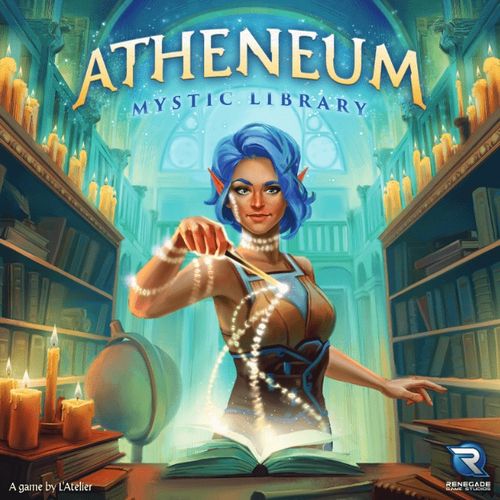
Atheneum: Mystic Library
Atheneum: Mystic Library Rulebook
Table of Contents
Table of Contents
Components
- 1 Library Board
- 30 Magic Wands (6 per color)
- 5 Student Pawns (1 per color)
- 1 Cloth Bag
- 2 Library Carts
- 5 Main Shelves
- 10 Side Shelves
- 160 Book Tokens (32 per color)
- 60 Study Cards (30 "A" Cards, 30 "B" Cards)
- 35 Objective Cards
- 40 Bonus Tokens
- 35 Spider Tokens
Game Setup
- Place the library board in the center of the table.
- Place the side shelves and spider tokens to form a supply near the library board, within reach of all players.
- Sort the book tokens by color and place them in the included book bins, with all the book tokens of one color in each bin. Note: You will need to assemble the book bins before your first game.
- Put the bonus tokens into the cloth bag, then shake the bag to ensure that they are thoroughly randomized. Set the bag off to the side for now.
- Sort the study cards into "A" and "B" decks. Shuffle each deck separately and place these two decks off to the side for now, with room for two discard piles.
- Shuffle the deck of objective cards. Draw four cards from the top of the deck and place them face up in the four slots along the bottom edge of the library board. Place the rest of the deck face down on the library board.
- Each player takes the main shelf in their chosen color (noted by the subject icon in the upper right corner) and places it in their own play area, oriented so that it is upright from their perspective.
- Each player takes five spider tokens from the supply and places them on their main shelf, with one spider token in each compartment.
- Each player takes the student pawn in their chosen color and places it on the "0" space of the score track that runs around the library board.
- Each player takes the magic wands in their chosen color, then keeps two in their own play area and places the rest to form a supply on the library board.
Book Subjects
- Folklore & Fanfiction
- Beastly Textbooks
- Paranormal Publications
- Biographies & Memoirs
- Rare Manuscripts
Goal of the Game
Study for the exam while cleaning up the library! During the game, you can score points for objectives by placing books on your shelves in specific configurations. At the end of the game, you will score points for full shelf compartments, decorative candles, and shelved books of your favorite subject.
Game Sequence
The game is played across two phases: the "A" phase and the "B" phase.
At the start of each phase, deal each player a hand of six study cards from the matching deck, face down. For the "A" phase, deal cards from the "A" deck. For the "B" phase, deal cards from the "B" deck.
Each phase has five turns. On each turn, each player will select one card from their hand and play it, then pass the remaining cards to one of their neighbors.
Each turn has four steps, which occur in sequential order.
- Step 1: Playing Cards
- Step 2: Resolving Benefits
- Step 3: Scoring Objectives
- Step 4: Cleanup
Step 1: Playing Cards
Each player picks up their hand of cards and looks at it, then secretly chooses one card to play. Once all players have chosen which card to play, they all reveal their chosen cards at the same time, flipping them face up.
After all cards have been revealed, each player passes their hand of remaining cards face down to the player seated on their right or left. Players cannot look at their new hands yet! The passing direction changes with the phases of the game: During the "A" phase, players pass to the left. During the "B" phase, players pass to the right.
On the fifth turn of each phase, the single card remaining in each player's hand is not passed. Instead, these cards are placed in the discard pile, face up.
Step 2: Resolving Benefits
Each player resolves the benefits that are available to them, based on the cards played by themselves and their two neighbors:
- Each player receives the benefits in the yellow section of the card they played.
- Each player receives the benefits in the blue section of the card played by the player seated to their left.
- Each player receives the benefits in the green section of the card played by the player seated to their right.
Note: In a two-player game, each player counts as their opponent's right-hand neighbor and left-hand neighbor! Therefore, each player receives the benefits in the blue and green sections of the card played by their opponent.
You decide the order in which to resolve your own benefits. Because of this, it is useful to first collect any physical items that you receive this turn (e.g., book tokens, bonus tokens, etc.) and place them in front of you before you begin.
Benefits are always optional. You may decide, for each benefit, whether to use some, all, or none of it. However, any book tokens, bonus tokens, or reshelving opportunities that are not used by the end of the turn are lost.
Step 3: Scoring Objectives
All players may score any of the available objectives that they have completed. Each player may score every objective once per game, regardless of whether other players have scored that objective, as long it is currently available in the row.
Each objective requires a specific configuration of shelved books. If your shelf meets the requirement for an available objective, and you haven't scored it already, you can score it now. You can even score multiple objectives on the same turn!
To score an objective that you have completed, you must have a magic wand available. Place your magic wand on the objective card and immediately score the indicated number of points, advancing your student pawn on the score track accordingly.
Some objectives also give you a magic wand from the supply as a reward. If you receive a magic wand as a reward for scoring one objective, you can even use that magic wand to score another objective on the same turn.
Step 4: Cleanup
Discard the objective card that is in the rightmost slot at the end of the row and return to the supply (not to the players!) any magic wands that were on it.
Slide each of the other three objective cards in the row one slot to the right. Draw a new objective card from the top of the deck and place it face up in the now empty slot at the left end of the row.
Gather up all of the study cards that were played this turn and place them face up in the corresponding discard pile.
End of the Game
After 10 turns have been played, the game ends and final scoring occurs. During final scoring, each player scores additional points in four categories. Advance the student pawns on the score track accordingly.
- Favorite Subject: Score one point for each book on your shelves that matches the subject icon in the upper right corner of your main shelf. However, you only score for books of your subject that are adjacent to at least one other book of the same subject. Note: Diagonals do not count as adjacent.
- Filled Compartments: Score points for each compartment of your shelves that is filled with books. Each filled compartment is worth the number of points printed next to that compartment (ranging from two to seven points).
- Candles: Score points for the candles placed on your shelves. Each candle is worth the number of points printed in that candle space (ranging from one to four points).
- Magic Wands: Score one point for each unused magic wand in your possession.
The player with the highest total score wins the game!
In the case of a tie, the victory goes to the tied player with the most shelved books. If there is still a tie, the victory goes to the tied player with the most shelved books of their favorite subject. Otherwise, the tied players share the victory.
Giles scored 34 points during the game. He adds 9 points for books of his favorite subject, 17 points for filled compartments, 9 points for candles, and 1 point for an unused magic wand. His final score is 34 + 9 + 17 + 9 + 1 = 70 points.
- Giles has 3 candles worth 4, 3, and 2 points. He scores 9 points.
- Giles has 9 pink books touching. He scores 9 points.
- Giles has 4 compartments full of books. He scores 17 points (3 + 6 + 6 + 2).
- Giles scores 1 point for an unused magic wand.
Study Cards
Every player will play 10 study cards over the course of the game. Each study card has three distinct sections, which are color coded:
- Green Section (left): When you play this card, the player to your left receives the benefits shown here.
- Yellow Section (bottom): When you play this card, you receive the benefits shown here.
- Blue Section (right): When you play this card, the player to your right receives the benefits shown here.
There are seven different types of benefits that appear on the study cards. Many cards have sections that provide multiple benefits to the same player, which might be of the same type or of different types.
- Take a book of the indicated color from the supply. You may shelve it in a compartment of your choice. (Gray books are "wild." For each gray book, you may choose a book of any color.)
- Take a book of any color from the supply. You may shelve it in the indicated compartment only. (If the compartment is full, you cannot shelve the book unless you first remove a book to make room.)
- Remove the indicated number of books from any compartments. You may then reshelve those books in any compartments. (You may choose to remove fewer books than the indicated number.)
- Take a side shelf from the supply and place it on either side of your main shelf. Place a spider token in the compartment.
- Take a magic wand of your color from the supply.
- Draw a random bonus token from the cloth bag. Then decide which side of the token you would like to use.
- Immediately score the indicated number of points, advancing your student pawn on the score track accordingly.
The two decks are different in terms of the rarity of certain benefits. The "A" deck has a proportionally greater number of books. The "B" deck has a proportionally greater number of reshelving opportunities.
Objective Cards
Each objective card shows (a) the configuration required in order to complete the objective and (b) how many points a player scores when they do so. Note: Some objectives also provide a magic wand as a reward upon completion.
There are three different types of configurations:
- These configurations may be assembled in any one compartment. The books must match the colors and positions exactly.
- These configurations must be assembled in the exact compartment shown (or in any of the depicted ones). The books must match the colors and positions exactly.
- These configurations must be assembled in the exact compartments shown. The books must match the positions exactly, but their colors do not matter.
Note: What is in the spaces surrounding the configuration does not matter. Those spaces may be empty or may contain books. Configurations do not have to begin on the bottom level either; they may be assembled anywhere within the compartment.
Barbara has met the requirements for this objective, which can only be assembled in the upper-right compartment. She places one of her magic wands on the objective card and immediately scores seven points.
Book Tokens
Books may only be shelved vertically and only in empty spaces. Every compartment has grid lines to indicate the spaces. In addition, when you are shelving books, the following three rules must be respected at all times.
- Support Rule: Each compartment has multiple spaces. A book cannot be shelved in a given space unless there is support on at least one side. The only things that provide support are (a) another book or (b) the compartment wall.
In the left example, the teal book has support from the compartment wall. In the center example, the purple book has support from the teal book. In the right example, the purple book has no support at all.
- Stacking Rule: Some compartments have multiple levels. In these compartments, a book cannot be shelved on a higher level unless there is a book directly below it on the previous level. However, the support rule still applies.
In the left example, the pink book has support and a book below it. In the center example, the black book has a book below it but no support. In the right example, the pink book has support, but no book below it.
- Transition Rule: When you remove a book in order to reshelve it elsewhere, you cannot do so if it would cause any other books within that compartment to violate either of the previous rules.
In the left example, removing the black book is legal. In the right example, removing the purple book is illegal because it would cause the green book to violate the support rule and the black book to violate the stacking rule.
At the end of every turn, any remaining books in your player area that you did not shelve are returned to the supply.
Spider Tokens
Each shelf (both main shelves and side shelves) enters the game with one spider in each compartment. The exact location of the spider within a given compartment does not matter; simply shift it around as needed when shelving books.
When you completely fill a compartment with a spider in it, you capture the spider and return it to the supply. Capturing a spider grants you a special benefit of your choice, which you may use at any time before the end of the current turn.
These special benefits, which are listed below, are also shown on the library board for ease of reference. Choose one of these benefits each time you capture a spider:
- a magic wand
- a bonus token
- a book of any color
- a side shelf
Flynn just shelved a book in this compartment, completely filling it. He captures the spider and decides to take a teal book (his favorite subject) as the benefit. He may shelve this book at any time before the end of the current turn.
Bonus Tokens
When you gain a bonus token, reach into the cloth bag and draw one at random. Once you have drawn it, you have until the end of the current turn to decide how you would like to use it. Each bonus token has two possible uses:
- a magic wand -OR- a candle
- a paired set of books -OR- a candle
- a book of any color -OR- a candle
- reshelve up to four books -OR- a candle
- a side shelf -OR- a candle
If you wish to use a bonus token for its candle side, place it in any empty candle space on top of your shelves. Each main shelf has three candle spaces and each side shelf adds two more candle spaces. Candles are worth points at the end of the game.
If you wish to use a bonus token for its benefit side, resolve the benefit as normal and then discard the bonus token to the game box.
Evelyn drew a bonus token with a paired set of books (green and purple). Those books don't help her with the available objectives, and neither matches her favorite subject (black), so she decides to place the token as a candle instead.
Note: For bonus tokens that are a paired set of books, two special rules apply. First, you may shelve it in either vertical orientation (i.e., the spines may be "upside down"). Second, reshelving the set later uses up two reshelving opportunities.
Clarifications
Do the book titles have any gameplay significance? No. The book titles are just for flavor. The only gameplay information that matters is the color (i.e., subject) of the book.
What if the tokens run out during the game? If the book tokens run out, find a suitable replacement to use. If the bonus tokens run out, put all of the discarded bonus tokens back into the bag.
What if there are no magic wands of my color available? There are only six magic wands per player. If you would gain a magic wand when there are none of your color currently in the supply, the benefit is lost.
How many side shelves can I have? Each player can only have two side shelves at maximum. If you would gain another side shelf when you already have two, that benefit is lost.
Can I capture multiple spiders in the same compartment? No. If you remove books from a filled compartment and then fill that compartment back up with books again, you do not get to capture another spider.
When do I score points for filled compartments? Only at the end of the game. If you remove books from a filled compartment and then fail to fill it back up again before the game ends, you will not score it.