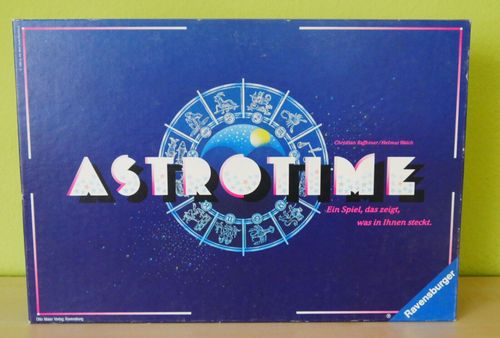
Astrotime
Astrotime Rulebook
Table of Contents
Table of Contents
Components
Contenu, as printed on the rulebook's components page.
- 1 turn-counter pawn (pion compte-tours)
- 6 individual pawns (pions individuels)
- 1 game board (plan de jeu)
- 36 value tokens (jetons-valeur), 6 per colour
- 384 short stories, the situations (histoires courtes)
- 6 game boards (tables de jeu), plastic
- 2 erasable red pens (stylos rouge effaçables)
- 12 zodiac sign cards (cartes signes du zodiaque)
- 1 "Book of the Stars" (Livre des astres)
Goal
Thanks to the gifts of the stars, as well as a good dose of personal assessment, which player will best master the situations encountered? Each situation you triumph over rewards you with value tokens. The player who has received the greatest number has won.
At the end of the game, and according to the position of the value tokens, the Book of the Stars gives each player the image of their personality, revealed for the length of a game!
Preparation
a) The astrological year begins with Aries. The large turn-counter pawn (black speckled) is therefore placed on the Aries square (21/03 – 20/04) at the centre of the game board. After each turn, this pawn is moved one square, following the counter-clockwise direction.
b) Each player chooses a coloured pawn, takes a plastic game board, and slides into it the card of their astral sign. The 10 characteristics that appear in yellow represent the typical positive points of the astral sign.
c) In turn, each player takes the red felt-tip pen. They colour in the 10 yellow points of the ten qualities assigned on their plastic game board: they thus obtain 10 red points. They also choose, from the remaining 30 points, four additional qualities that they consider most in keeping with their personality. They thus obtain 4 other red points, indicating new qualities or doubling the accuracy of these (example: this player considers themselves particularly ambitious and sincere, which is why they doubled these qualities; see balance no. 2 and 5). These 4 additional red points are very important, because they are the reflection of your own personality. They allow you to recognise yourself better in the game situations.
d) At the end of this preparation, the astral sign cards are put back in the box. Players only play with the game boards.
Qualities on the Game Board
The plastic game board lists the qualities in two columns, in pairs: the first column on the left and the second on the right. The yellow entries are the typical positive points of the astral sign chosen by the player. The printed rules refer to "14 qualities" in the introduction, while the board lists the qualities below. Names marked "(partly illegible)" are hard to read in the scanned copy and should be checked against a physical board.
- Actif / Créatif
- Ambitieux / Éloquent
- Courageux / Social
- Gagnant / Diplomate
- Sincère / Charmeur
- Persévérant / Sentimental
- Objectif / Fantaisie
- Loyal / Solidaire
- Méticuleux (partly illegible) / Idéaliste (partly illegible)
- Confiant / Tolérant
Course of Play
The game begins. If you do not yet know the rules, play step by step, as the rules unfold.
1. Designate a game leader who, apart from taking part in the game, manages as they go the distribution and use of the game materials.
2. To begin, the game leader takes 3 situation cards. They read them aloud, then, keeping the back of the card face down, place each one on squares A, B and C, located in the middle of the game board.
3. Each situation card tells a short story which requires a certain number of necessary qualities in order to master the situation described successfully. Each player, in turn, evaluates in which of these situations they will be best able to succeed, then expresses their choice by placing their pawn on the corresponding square A, B or C, above the situation card on the game board.
4. As soon as all players have expressed their choice, the count is made. The players whose choice fell on the card of square A take that card, in turn, and slide it into their plastic game board (the text being on the back). They count the red points obtained; these reveal the number of necessary qualities they have to master situation A as well as possible. Depending on the card and the square chosen (A, B or C), each player does the same and places their pawn on the numbered circle corresponding to the number of points or qualities obtained.
5. The player who totals the most points for a situation wins it (one winner for situation A, one for B and one for C). When, for the same situation card (A, B or C), several players have totalled the same number of points, they are declared co-winners. At least 5 points must be totalled to win the value tokens, whose colour corresponds to the coloured squares printed at the top of the back of the chosen situation card.
6. Each value token obtained is then placed on the game board at the location of the points table belonging to each player. Attention, use the points table facing which you are seated, and place your token, starting from the bottom and moving upwards.
7. Once the value tokens are distributed, the game leader removes from the board the three situation cards used. The first turn is thus finished.
8. The game then continues in the same way, sign by sign (Aries, Taurus, Gemini ...): the turn-counter pawn is moved to the next sign, Taurus. At each turn, and each time a player wins a value token of a colour they already have (yellow, red, green, violet, grey or blue), they move their corresponding value token one square up on their points board.
9. After 12 rounds, one for each sign of the zodiac, the game is over. The winner is the player who totals the most points.
End of Game
Calculating the Points
To find the winner of the game, the total of points is made by multiplying the number of value points won by the number of colours present on the player's points board.
Example (from the printed rulebook): the example board shows red = 4, yellow = 3, green = 2, blue = 5, grey = 4 and violet = 1, for 19 value points across 6 colours. Total points: 19 × 6 colours = 114.
The Six Colours and Life Axes
Each colour symbolises one of the six axes of life:
- Red: consideration and social recognition
- Yellow: authority and influence
- Green: work and money
- Blue: friendship and sympathy
- Grey: family and harmony
- Violet: knowledge and learning
At the end of the game, each player can read in the Book of the Stars the entry for their most represented colour, as well as the one for their least represented colour. For each player, for the length of one game, each colour means:
- the life axis best achieved (maximum points), and
- the life axis least achieved (minimum points).
With each new game, you will thus discover other aspects of your personality.
The Book of the Stars (Le livre des astres)
The Book of the Stars is the separate interpretation booklet packed with the game. Its introduction and its instructions for reading results are transcribed here; the sign-by-sign commentary pages that follow it are not transcribed (see the note below).
The game ASTROTIME has allowed you to exercise your talents of objectivity and of self-assessment while having fun. The final position of the value tokens on the points board depends above all on the choices made by all the players, as well as on chance in the distribution of the cards. This game has no other goal than to amuse you while revealing certain positive aspects of your personality. However, a grain of truth cannot be entirely involuntary, nor without intention...
How to Use the Results
The position of the value tokens at the end of the game reveals an aspect of each player's character. The player expresses here their goals in life and how they wish to achieve them.
To discover it, each player looks at the value token that has reached the highest rung (maximum) on their points board. Then they look at the value token on the lowest rung (minimum), provided there is one. If the player has obtained an equal number for the maximum or the minimum, they may choose whichever one they like.
The game leader consults the Book of the Stars at the page for the astrological sign of each player (one after the other), and reads the commentary.
- On the left are explanations concerning the goal in life for which the player has gathered the greatest number of value points (maximum).
- On the right are explanations concerning the goal in life for which the player has gathered the fewest value points, or for which they have none (minimum).
We hope you will have a lot of fun interpreting your personal results.
Example
Example from the printed booklet (a Taurus player):
Taurus maximum: Work and Money. On a journey toward prosperity, you pack your main qualities in your luggage: resistance, objectivity, loyalty. As a general rule, you are not in much of a hurry. You know very well that you will reach your goals. When you have succeeded in your ascent, you know how to savour the fruits of your labour.
Taurus minimum: Friendship and Sympathy. It is clear that a bull can see red when the situation justifies it. But then he loses all sense of the reality of things, and knocks down the fences he would have done better to leave where they were. And so a friendship can be broken. So, a little restraint, please!
Note on omitted content: the Book of the Stars then gives a sign-by-sign commentary (twelve signs, each with maximum and minimum entries for the six colours) that is interpretive personality text rather than game rules. It is not transcribed here.