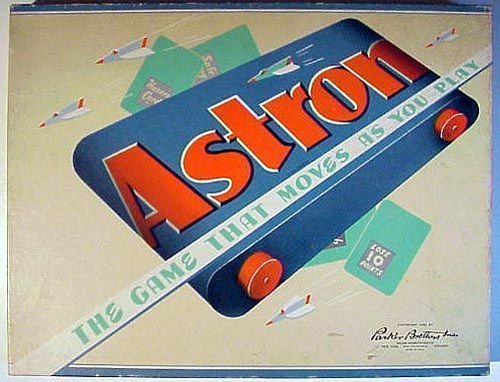
Astron
Astron Rulebook
Table of Contents
Table of Contents
Equipment
The game consists of a playing surface under which a map of the world, marked off in rectangular spaces, is moved by turning the knobs at either end of the box; ASTRON cards which control the movement of the planes and the movement of the map; Airport Cards which score points; Hazard Cards which deduct points; and six attractive airplanes.
Object of the Game
The object of the game is to score the most points by landing on airports and by avoiding hazards while navigating planes around the world.
Preparation
A player is chosen to deal. The dealer moves the map until the word "START" appears at the edge of the playing surface. He then shuffles, separately, the Hazard Cards and the Airport Cards and places them face down in two piles in front of him. He shuffles the ASTRON cards and deals five cards face down to each player. These cards are called the hands. Each player picks up his own hand without disclosing it to the other players. The remaining cards are placed face down within easy reach of all the players to form the Draw Pile. The spaces numbered 1 through 6 which are one space ahead of the word "START" are the Starting Spaces. The player to the left of the dealer places his plane on Starting Space No. 1. The next player to the left places his plane on Starting Space No. 2, etc.
The Play
The player to the left of the dealer plays first. He selects one of the five cards from his hand and places it face up alongside the Draw Pile to start a Discard Pile. He then moves his plane, the map, or both his plane and the map according to the directions on the card which he has just played. If a card indicates a plane move and a map move, the plane is always moved first.
After the player has completed his play, he takes a card from the Draw Pile and puts it in his hand to replace the card that he has played, and his turn ends. Other players follow in turn in a similar manner, first playing to the Discard Pile, moving, and drawing a new card to complete their hands.
Planes must be moved in accordance with the instructions on the card. In sideways moves, the player has the choice of moving either to the right or to the left. In diagonal moves, he has the choice of moving in any one of the four diagonal directions. In making these moves, he may not land on a space already occupied by another plane but may pass over other planes.
A player cannot play a card which either directs him to land on a space already occupied by another player or moves him off the ends or sides of the playing surface, but must select one of the other cards in his hand which will allow him to land on an unoccupied space. If none of the cards in his hand is playable, he loses his turn but discards one of the cards in his hand and replaces it with a card from the Draw Pile.
There must always be one vacant space in front of and behind each plane. Should a plane land on a space directly behind or directly ahead of another plane, the plane to the rear must move back one space. If the rear plane should be located on a space at the back edge of the playing area, it is moved one space to the right or to the left, according to the choice of the player whose turn it is.
Scoring
On the map there are eleven Airports, colored red and numbered from 1 to 11. There are also twenty-one Hazards which are the dark areas marked "Tornadoes," "High Winds," "Mountains," etc. Whenever a plane comes to rest on any one of the Airports at the end of any turn, whether on his own turn or as a result of a movement of the map by another player, the player owning that plane is entitled to an Airport Card. Similarly, should a plane come to rest on a Hazard Space, the player owning that plane must receive a Hazard Card. Both the Airport Cards and the Hazard Cards are retained until the end of the game and the points, won or lost, should not be disclosed to the other players until the end of the game.
Airport and Hazard Cards are given out to players whose planes rest on Airports or Hazards, only at the end of a complete turn. If a plane lands on an Airport or a Hazard after a move of the plane, but is moved off by the turning of the map on the same turn, the owner does not collect a card. Planes may land on the same Airport or Hazard more than once but they must either move off or be moved off by the movement of the map between landings in order to get additional cards.
Winning the Game
The game ends when the words "GAME OVER" appear at the edge of the playing area, regardless of the positions of the planes at that time. The player whose turn it is completes his play and any planes resting on Airport or Hazard spaces as a result of that play are given the proper cards.
Each player adds up the total number of points on the Airport Cards that he has collected and subtracts from them the total number of points on his Hazard Cards. The player with the highest net score is the winner.