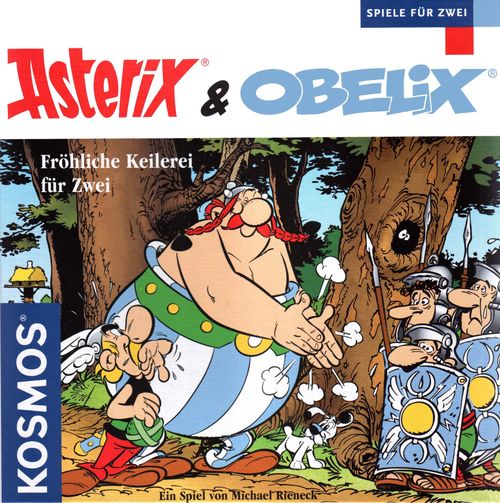
Asterix & Obelix
Asterix & Obelix Rulebook
Table of Contents
Table of Contents
Goal of the Game
Whoever has the most victory points at the end of the game, by defeating the Romans, the pirates or the traitor, is the winner.
Components
- 30 fight cards (15 for Asterix and 15 for Obelix)
- 40 Roman cards (25 legionaries, 5 centurions, 3 pirates, 1 traitor, 1 wild boar, 5 village feasts)
- 2 playing figures with feet
- 7 victory point tokens
Setup
- Before the first game, carefully punch all parts out of the cardboard and place Asterix and Obelix in the feet of the matching colour (Asterix = red, Obelix = blue).
- Each player chooses a playing figure and takes the 15 fight cards that belong to that figure. Each player then shuffles their cards and places them as a face-down draw pile in front of them. Finally, each player draws 5 hand cards.
- From the 40 Roman cards (the cards with a shield on the back), first pick out the 5 village feast cards. From the remaining cards, form 2 piles of roughly equal size.
- Now mix three village feast cards into one pile and two into the other. Then place the pile that contains only two village feast cards on top of the other pile.
- Next, lay out a "tortoise" formation of 4 x 4 face-down cards between the players, so that the cards can easily be turned over later. There are then 4 vertical and 4 horizontal rows of 4 cards each. The remaining cards are set aside as a face-down supply pile.
- Set the seven victory point tokens aside. They are used for scoring at the end of the game.
(The setup diagram showing the playing area layout is not reproduced.)
Playing the Game
- The strongest player starts.
- After that, the players take their turns (= attacks) alternately.
- During an attack, a player turns over the cards in one row one by one and may defeat them with the correct hand cards.
- During their attack, a player may only attack the cards in the chosen row.
Course of an Attack
-
Place your playing figure in front of a row At the start of each attack, the player must decide which row they want to attack. To do so, they place their playing figure in front of the first card of the chosen row.
-
Turn over card(s) and beat the Romans The player turns over the first card next to their figure.
a) Successful attack
- If it is a Roman soldier (legionary or centurion), the player must then discard a fight card of the same colour from their hand to defeat it. Roman soldiers come in five different colours: red, blue, yellow, green and purple. The player always has three fight cards per colour. Tip: If the card is not a Roman soldier, please read the meaning of the cards on page 5.
- When the player defeats the card, it stays face up for the time being.
- Now the player must decide whether they also want to turn over the next card in the chosen row. To do so, they move their figure onto the card they have already defeated. It is not permitted to deviate with the playing figure during a turn (i.e. the figure may not change direction).
- Only when a player voluntarily ends their attack, i.e. no longer wants to turn over another card, do they secure the cards they defeated during this attack.
- Players collect secured cards in a face-down pile in front of them. Only these cards are scored at the end of the game. Players may look at the cards in their pile at any time.
b) Attack fails
- If the player has no matching fight card in their hand, their attack ends immediately and the card is turned face down again.
- Then all cards already defeated during this attack that lie face up are removed from the game and returned to the box. The card on which the attack failed is turned face down again.
The Roman Cards
Although all cards with the Roman shield on the back are called "Roman cards", there are still some special card types among them.
The pirates (3x) A pirate is easy to defeat. It is sufficient to discard a fight card of any colour.
The traitor (1x) The traitor Moraalelastix is not so easy to catch. To defeat him, two cards of the same colour (any colour) must be discarded.
Important: The same applies to defeated pirates and the traitor: only when the player's own attack has been voluntarily ended are these cards secured.
The wild boar (1x) How can a Gaul always be diverted from a fight with the Romans? Indeed: with a wild boar! When a player turns over the wild boar during their attack, the attack ends immediately. The wild boar is removed from the game. The cards defeated in this turn are certainly not lost. The player places them on the pile of their secured cards.
The village feast (5x)
- There are five cards in the game that show a picture of the village feast. When such a card is turned over during an attack, the player does not have to discard a fight card. They may continue their attack. At the end of the attack, all village feast cards that were turned over are placed face up next to the formation.
- When the fifth village feast card is turned over during an attack, the game ends immediately and goes to scoring. The player may not continue their attack. Cards that were already defeated in the current attack may still be kept.
End of the Game and Distribution of the Victory Point Tokens
- At the end of the game (after the fifth village feast card has been turned over), the victory point tokens are distributed. Only the cards that the players were able to secure and collect in front of them are counted.
- The player who has the traitor among their collected cards receives the victory point token with the copper cauldron.
- The victory point token with the pirate flag goes to the player with the majority of pirate cards. In case of a tie, nobody receives this victory point.
- For the majority of Roman cards of each colour, a player receives the victory point token in the matching colour (red, blue, yellow, green or purple) showing the Roman helmet. A centurion counts as a normal Roman card. In case of a tie, the player who holds the centurion of that colour receives the victory point. If there is a tie and nobody holds that centurion, the corresponding victory point is not awarded.
- Whoever now has the most victory points wins. In case of a tie, the winner is whoever has collected more victory point tokens showing a Roman helmet. If this is also tied, the winner is whoever has won the most cards.
Further Rules
Looking at a Card
- Before their attack, in the row where they have placed their playing figure, a player may look secretly at the last card. To do so, they must first place any one hand card on their discard pile. The player therefore begins their attack with only four cards.
- The player then places the card they looked at, which remains the same card, face down back in the formation.
- A player may of course also decline to "look at a card".
Formation Broken
- When a player manages to defeat, respectively turn over (village feast), all 4 cards in the attacked row during their attack, they receive a further, complete attack. That is, they place their playing figure again in front of another row and top up their hand cards to 5.
- Defeated cards then remain face up in the formation. Here too, they are only won when the player voluntarily ends their attack. Village feast cards that were turned over are also only placed face up next to the formation after the end of the attack.
- When the fourth card of a row turned over is the wild boar, the formation is indeed broken, but the player does not receive an additional attack.
- The formation only counts as broken when the player has actually defeated or turned over four cards. If they decide to attack a row in their further attack in which fewer than four face-down cards lie, they cannot win a new attack.
- As soon as the formation can no longer be filled completely, the possibility of winning a further attack lapses.