Asterion
Asterion Rulebook
Table of Contents
Material
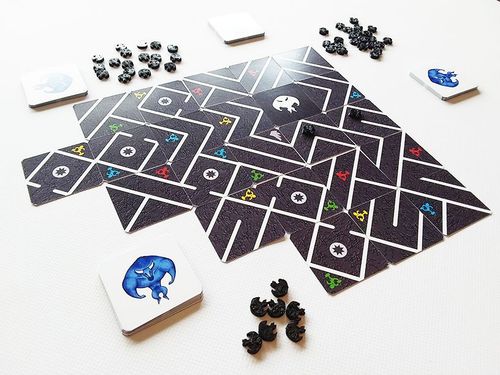
The Asterion set contains 64 labyrinth tiles (16 for each player), 1 minotaur tile and a few black counters.
Footnote 1: 17 cards per player were used in the previous version.
Setup
Each player chooses a colour and takes all 16 labyrinth tiles that have prisoners of that colour.
Each player shuffles her tiles face-down to create a draw deck, then draws her topmost tile without showing it to the other players.
Place the Asterion tile in the middle of the table.
The player with horns starts. In case of several players (or none of them) having horns, determine the starting player by any peaceful means.
Play
Players take turns in anticlockwise order placing their tile on the table so that:
a) It aligns with an imaginary square grid and is orthogonally adjacent to at least one previously placed tile.
b) Asterion has at least one continuous path that connects him to the outside of the labyrinth (the playing surface). This is, it is forbidden to ‘trap’ the Minotaur.
[Diagram: Correct placement / Incorrect placement]
If, after the tile placement, one or more prisoners get connected to Asterion by a continuous path, place a black counter on all of them. They’ve been impaled by Asterion. The player in turn scores as many points as opponent prisoners are impaled minus the number of her own prisoners killed.
Footnote 2: For a less ‘confrontational’ game you can agree on not scoring for this.
Example: Yellow’s tile placement has connected two prisoners (blue and green) to the Minotaur, so they are immediately killed.
Optionally, and instead of placing a tile, you can do any one of these actions on your turn, but you must discard your tile as payment:
a) Rotate an already-placed tile with an alive prisoner of your colour that has at least one free side (that is, surrounded by 3 tiles at most).
b) Swap two already-placed tiles with alive prisoners of your colour that have at least one free side (that is, surrounded by 3 tiles at most).
c) Move an already-placed tile with an alive prisoner of your colour that has at least one free side (that is, surrounded by 3 tiles at most) somewhere else.
Footnote 3: These actions are rarelly used, but thay have saved the day sometimes.
In any case, killed prisoners remain dead and it is forbidden to ‘trap’ the Minotaur. If, as a result of this action, some prisoners get impaled by Asterion then cover them and score as usual.
At the end of your turn, draw a new tile from your deck.
Game End
The game ends when the last tile has been played. To determine your score, count the number of prisoners of your colour that are connected to at least one treasure chest (coin) and also to either the outside of the labyrinth or at least two wings (they need two to fly). These prisoners manage to escape the labyrinth with part of the treasure and score 1 point for each coin to which they are connected. Also add the points that you scored previously (opponents killed by Asterion minus your own). The player with the highest score wins the game. In case of a tie, the player with more prisoners escaping the labyrinth (without coins) wins. If the tie persists then play again.
Endgame example for a 4-player game:
Asterion has captured 22 prisoners.
Two coins are connected to the outside of the labyrinth (and not to Asterion).
Two coins are not connected to the outside, but are connected to two wings.
[Diagram of the finished 4-player labyrinth omitted.]
Scores (not including the killings made during the game)
Yellow scores 1 + 1 + 4 + 4 = 10 Blue scores 1 + 1 + 3 + 3 = 8 Red scores 4 + 4 = 8 Green scores 5 + 5 = 10