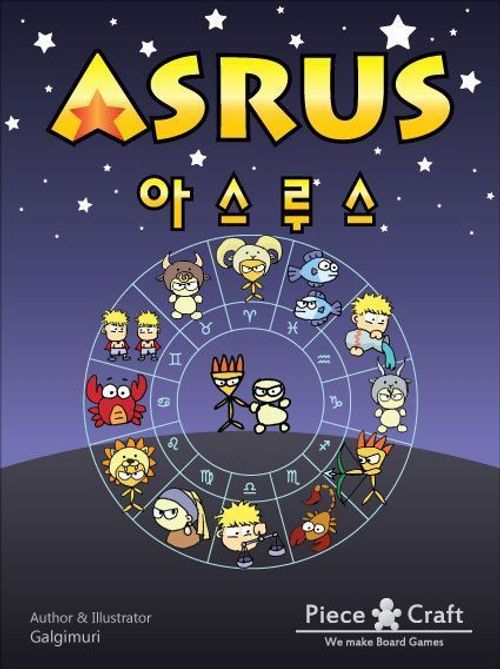
Asrus
Asrus Rulebook
Table of Contents
Table of Contents
Contents
77 cards:
- Number cards (64 cards)
- Special cards (10 cards)
- Joker cards (3 cards)
100 glass stones in 3 colors:
- Blue (50 stones): 1 point per stone
- Green (20 stones): 5 points per stone
- Red (30 stones): 10 points per stone
Also included: a portable pouch and a rule booklet in English.
Number Cards
| Number | Name | Quantity |
|---|---|---|
| 1 | Sun | 1 |
| 2 | Aries | 2 |
| 3 | Taurus | 3 |
| 4 | Gemini | 4 |
| 5 | Cancer | 5 |
| 6 | Leo | 6 |
| 7 | Virgo | 7 |
| 8 | Earth | 8 |
| 9 | Libra |
Special Cards
| Specialty | Name | Quantity |
|---|---|---|
| Close (C) | Mercury | 2 |
| Blackhole (B) | Venus | 2 |
| Double (D) | Mars | 2 |
| Majority (M) | Jupiter | 2 |
| Retrograde (R) | Saturn | 2 |
Joker Cards
| Name | Quantity |
|---|---|
| Uranus | 1 |
| Neptune | 1 |
| Pluto | 1 |
Preparation
Separate the number cards and special cards. After shuffling, each deck is dealt out to all players according to the number of players as follows. The cards should be dealt hidden. The joker cards are not used in the regular rules (see the use of joker cards below). The glass stones are also dealt out to all players as follows.
| Players | Number cards | Special cards | Blue stones | Green stones | Red stones |
|---|---|---|---|---|---|
| 3 to 5 | 12 | 2 | 10 | 4 | 6 |
| 6 | 10 | 1 | 8 | 3 | 5 |
| 7 | 9 | 1 | 7 | 2 | 4 |
| 8 | 8 | 1 | 6 | 2 | 3 |
| 9 |
After dealing, make two piles with the remaining number cards and special cards, and lay them hidden (back upward). Choose one card from the number card pile and open it to all. This opened number card is the Destination. When 8 players play the game, choose number 8 as the destination (but there is no card on the table).
When 3 or 4 players play the game, you can deal more number cards (over 12) and more glass stones. Otherwise, if you think there are so many cards, you can reduce the number cards (reduce pairs from the center, like number 4, 8, 12).
Playing the Game
Basic Rule: Play a number card whose distance is the closest to the destination and is not duplicated with others, and get points (glass stones). The object is to get the most points.
Distance means the difference of number between the destination and the number card played by a player. The condition to get points can be changed by the use of special cards.
The process of playing the game is as follows.
- All persons play one number card hidden, without order. It is better to predict others' cards and play the proper card, but the same card as the destination has no effect because the distance is 0. A person can play one special card hidden, depending on the need. The use of special cards is optional, so it does not matter if they are unused until the round ends.
- After all persons play cards, open them at the same time.
- If there are special cards, apply the instructions. Calculate the distance of each number card from the destination, and determine a winner (who satisfies the basic rule or the condition with special cards). The winner's distance is the points, and the winner takes glass stones as many as the points from each player.
- Now the winner's number card is the new destination. Add all other opened cards, hidden, to the number card pile and special card pile.
- The process from 1 to 4 is a turn. Go on to the next turn with the new destination. When all number cards are used up by continuing turns, a round ends.
- According to the conditions for victory, a game may end after one round or more rounds. When a new game starts, do the preparation again. But just when a new round starts, re-deal only the cards.
Draws and Deposits
At process 3, in case no card satisfies the basic rule or the condition with special cards, that turn is a draw. In this case, all players should deposit points as much as the closest distance to the destination. Deposit means to lay glass stones beside the destination. Because there is no winner, the destination does not change. Go on to the next turn, then the winner gets points and deposits too.
Example 1: Number card 8 colored with blue is the destination. All number cards opened are as shown: 9 and 7 are the closest with distance 1, but they are duplicated and so they are excluded. Next, 6 makes distance 2 and 12 makes distance 4. Therefore 6 is now the closest and unique card, and the winner is the player who played 6. The winner gets a total of 8 points (bringing 2 points from each of the 4 other players), otherwise each other player loses 2 points. Go on to the next turn with number card 6 as the new destination.
Example 2: Number cards 4 and 8 are the closest with distance 2, but they are duplicated and so they are excluded. Next, 3 and 9 are duplicated with distance 3 and they are excluded too. This turn is a draw, so all players deposit 2 points as the closest distance, and a total of 10 points are deposited. Number card 6 is still the destination, and go on to the next turn with this destination.
When there are deposits at the end of a round, make the winner by this way: shuffle the number card pile, and each player chooses one card from the pile. The player who chose the lowest number gets the deposits.
Use of Special Cards
Special cards change the condition to get points. Each effect is as follows.
- C - Close: reduce the distance by 0.5 (if win, get points as much as the original distance).
- B - Blackhole: deposit the points a winner gets (the winner of the next turn will get the deposits).
- D - Double: if win, get the points by double.
- M - Majority: win when a player's number card is major (the most among opened cards).
- R - Retrograde: reverse the basic rule, so a number card whose distance is the farthest and is not duplicated wins.
Example 3: In the case of Example 2, number card 8 with special card C makes distance 1.5. This is the closest and unique, so it wins. The winner gets a total of 8 points (bringing 2 points as much as the original distance from each of the 4 other players). The new destination is number card 8.
Example 4: In the case of Example 1, number card 9 is the most among the opened cards. Therefore 9 is major and wins with special card M. The winner gets a total of 4 points (bringing 1 point from each of the 4 other players). The new destination is number card 9. Majority is prior to distance. When 2 players use this on the same number card, it has no effect.
Example 5: In the case of Example 1, by special card R the reverse rule applies. Number card 12 wins, for it is the farthest and unique. The winner gets a total of 16 points (bringing 4 points from each of the 4 other players), and the new destination is number card 12. The winner is regardless of whether or not playing special card R.
Example 6: In the case of Example 1, number card 6 wins and gets points by double with special card D. The winner gets a total of 16 points (bringing 2 x 2 points from each of the 4 other players) and the new destination is number card 6. But special card B is played by another player, so the winner cannot get points and must deposit them (16 points).
Additional Rule
If you win with number card 1 or 15, get points by double. And if you win with number card 1 or 15 and special card D, get points by 4 times.
Use of Joker Cards
If needed, joker cards can be used like special cards. Use one as the same kind of a certain special card, or as a new specialty. For examples of new specialties: Explosion (no one gets points; draw and no deposit), Triple (if win, get the points by triple), and so on.
Game End
At the end of the game may vary according to conditions for victory. In case of fix the number of round, the game ends at the end of last round and who has the most points is victorious. In case of set the victory condition to reach certain points, check players' points after every round and when any player reaches that points the game ends, and that player is victorious. For excitement of the game, if some players (generally 1/4 of all) lose all stones, the game ends and at that time who has the most points is victorious.
Tips for Game
To enjoy the game more funny, the player who has the most points can give a instruction to the last man after every round. In addition to these rules written in the rule booklet, make the house rules depending on the needs and enjoy the game more exciting.
To ask about rules or share your own rules, please visit the publisher's website: www.piececraft.com.
Properties of Zodiac
The properties of the zodiac are not used in the rule booklet, but there is a new game using these properties on the publisher's website.
Each sign (constellation) of the zodiac has one element and one quality from the list. For example, in the case of Libra (shown on page 1), the element is Fire and the quality is Cardinal. The back of the card indicates the astrological rulership. For the details, please visit the website.
4 Elements:
- Red: Fire
- Brown: Earth
- Green: Air
- Blue: Water
3 Qualities:
- Cardinal
- Fixed
- Mutable