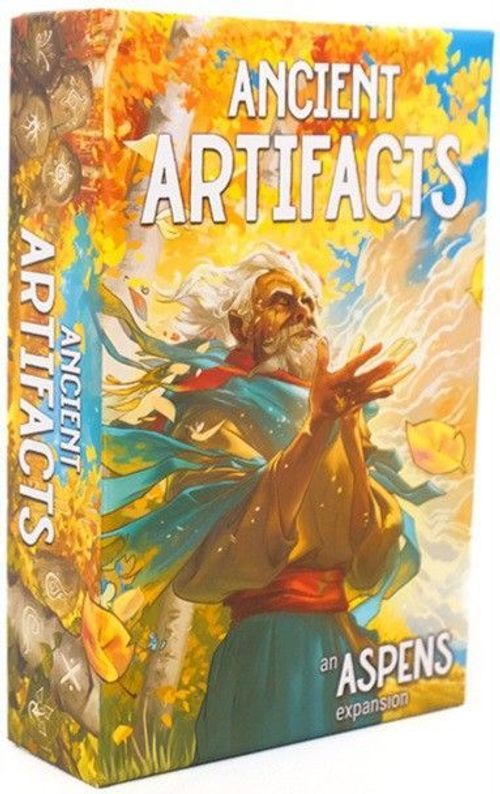
Aspens: Ancient Artifacts
Aspens: Ancient Artifacts Rulebook
Table of Contents
Table of Contents
Ancient Artifacts Overview
In the "Ancient Artifacts" expansion, players compete to collect lost relics, which are randomly distributed across the board at the start of the game.
Each relic contains the essence of a particular ancient god and its unique power.
When you collect a relic, you gain a unique, single-use ability that you can use in a future round to gain a strategic advantage.
Which relics you pursue, and when and how you use them, determines your strategy and whether you win or not.
Goal and Scoring
The goal and the course of play are the same as in the base game.
- All rules of the base game apply unchanged, unless they are expressly overridden or changed by one of this expansion's abilities.
Setup
1. Set Up the Board
Build the game board and place the water tiles according to the base game rules. Then, before you plant your starting forests, complete the expansion setup shown on the following pages.
2. Prepare Relics and Gods
A. All 16 relic discs go into the bag.
B. Draw six discs from the bag at random, one after another, and place each on the space shown for it.
Example: the discs are placed on the spaces numbered 1 to 6 on the board.
For each of the six placed relic discs, take the card of the corresponding ancient god and place it near the game board, within reach of both players.
- If Drought and Stone are in play, the two drought tiles are placed as well.
It is normal and to be expected that two copies of some gods/relics appear in a single game.
The god cards themselves contain short descriptions of the abilities that are sufficient to get into the game. The rules for each god on the following pages serve only to clarify them, where necessary.
3. Sow and Grow Starting Forests
Once the relic discs and god cards are placed, you can continue the setup (see the base game rulebook) by sowing and growing your starting forests.
When you have done so, the setup is complete and you can begin the game.
The board should look exactly as it does in a normal game, except that the six additional relic discs are on it and the god cards lie beside it.
Relics and Abilities
The first player who places four of their trees next to a relic disc takes that disc and the corresponding god card and places them in front of them immediately. They thereby gain the ability.
- By collecting a relic you gain the ability of that god, which you can use in a FUTURE round. This is explained on the following pages.
The four trees may stand in any arrangement on any spaces, as long as all four border the disc. They can be four trees on one adjacent space, or four trees spread across several adjacent spaces. In both cases the player receives the disc.
Spaces with relic discs are NOT PLAYABLE until the disc has been claimed and the space is empty. This means you can never place a tree on a space that holds a relic disc.
Collecting Relics with Cascades
When a player creates a "cascade" that results in four or more of their trees being next to the disc, the player receives the disc immediately.
Spaces with relic discs do NOT count as "borders" and cannot be used to create a cascade. That is, if a player encloses an area using a space with a relic disc as part of the border, NO cascade is created.
Example: the enclosed area is bordered partly by a space with a relic disc, so no cascade is created.
Playing an Ability
All abilities are single-use. To activate an ability, discard the corresponding disc and card, then carry out the ability's effect.
- You may only use abilities during YOUR turn.
- You cannot use an ability in the same round in which you collected it.
- All abilities can be used at any time during your turn. That means before or after the sun or wind roll, and before or after placing any number of trees. As long as you are still on your turn (you have not yet handed over the dice), you may use an ability if it still applies.
- You may use several abilities in a single round.
- Using an ability does not count as your turn. You carry out all steps of your turn as usual.
The Abilities in Detail
The Sun
Set the value of the sun die to any number of your choice.
Then carry out the "receive trees" step. Both players generate trees as if that were the rolled number.
You may do this before the sun die is rolled, or immediately after it has been rolled, in order to "change" the rolled value.
Example: the rolled value is changed to X (any value).
The Wind
Set the value of the wind die to any direction of your choice.
Then continue your turn with the "plant trees" step, and plant trees as if that were the rolled wind direction.
You may do this at any time before you have planted your first tree in your turn; also after the wind die has been rolled and after you have received trees.
Example: the rolled direction is changed to X (any direction).
Spring Waters
Take two free bonus trees from your bag. You may plant them in your turn as usual.
You may do this at ANY point during your turn.
New Growth
During the "plant trees" step of your turn, plant one of your trees on ANY EMPTY space.
It does not have to border your existing spaces, and it does not have to follow the wind.
The Wither
Remove all of your opponent's trees from a single space.
- This space may not border a water tile.
- The trees you remove return to your opponent's bag. They may not take them into hand.
Example: the Aspen player removes the trees from the Pine player's space, clearing a path so that it is no longer cut off.
Wandering Roots
During the "plant trees" step of your turn, plant a single one of your trees two spaces away from a space you control (instead of one space away, as usual).
- You must still follow the valid wind directions based on the wind die.
- When planting this tree, you may take into account two different valid wind directions (see example).
- During this turn you may also move "through" your opponent's spaces (see example).
Example: the wind is SE, and the tree is planted two spaces away, using the valid directions SW and SE.
Drought & Stone
Take the two drought tiles and place them on two arbitrary empty spaces on the board. These spaces are then no longer playable for the rest of the game.
- The two tiles do not need to lie next to each other.
Note: you may place the tiles on ANY empty space.
Because spaces with drought tiles are permanently unplayable, they count as "borders" and may be used to create cascades.
Example: a cascade is created using a space with a drought tile as part of the border.
Fertile Breeze
Plant a single tree an arbitrary number of spaces away from a space you control, following a single valid wind direction.
- Unlike some other abilities, with this ability you may not use several wind directions to plant your tree.
Example: the wind is NE. The tree is planted along a single valid direction. The space marked X cannot be reached by combining the E and NE directions.
Components
- 16 god cards
- 16 relic discs
- 2 drought tiles
- 1 bag with drawstring
Overview of the Abilities
- The Sun: Set the value of the sun die.
- The Wind: Set the value of the wind die.
- Spring Waters: Immediately receive 2 trees free of charge.
- The Wither: Remove some of your opponent's trees.
- Drought & Stone: Block 2 spaces permanently.
- New Growth: Plant a tree on any space.
- Wandering Roots: When planting, leave one space free.
- Fertile Breeze: Plant a tree at any distance in one direction.