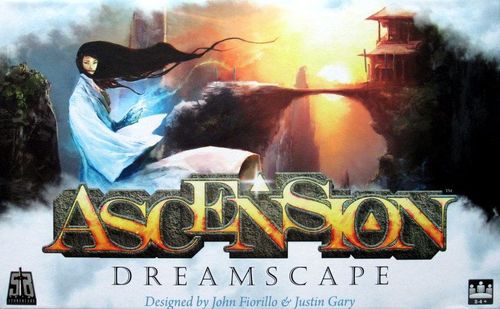
Ascension: Dreamscape
Ascension: Dreamscape Rulebook
Table of Contents
Table of Contents
Overview
In Ascension: Dreamscape, players compete to learn the secrets of the Dreamscape. Starting with a small group of loyal but untrained followers, you acquire mighty Heroes and powerful Constructs to aid you in your quest to defeat evil Monsters and achieve victory.
Each turn, you will play cards to gain resources. These resources will allow you to acquire new Heroes and Constructs for your deck and defeat Monsters to earn rewards. At the end of the game, the player with the most Honor from cards they have acquired and Monster rewards is the winner.
Contents & Setup
Contents
- 1 Game board
- 25 Clear 1-Honor tokens
- 25 Red 5-Honor tokens
- 10 Large 5-Insight tokens
- 20 Small 1-Insight tokens
- 98 Center deck cards
- 35 Dream deck cards
- 4 Personal 10-card starting decks (8 Apprentice & 2 Militia)
- 41 Always available cards: 1 Cultist, 20 Mystic & 20 Heavy Infantry
Setup
Ascension: Dreamscape can be played with 2-4 players on its own and can support up to 6 players with additional expansions. Team and single-player variant rules can be found under Gameplay Variants below.
Each player has a white-bordered starting deck consisting of eight Apprentices and two Militias. Everyone shuffles their starting deck and draws five cards (leaving five cards in their deck).
Take the silver-bordered Heavy Infantry, Mystic and Cultist cards and set them to the side in reach of all players. These cards represent characters in your kingdom and are always available to be acquired or defeated on your turn.
After players have selected their Dreamscape cards (see Dreamscape & Dream Deck, below), shuffle the remaining gold-bordered cards together to create the Dream deck, and set it to the side so that all players can access it.
Shuffle all of the black-bordered cards face down to form the center deck. From the center deck, flip six cards face up in a row between all players. This forms the center row. Place the center deck on one side of the center row, and reserve a space next to it for the void. When a Monster in the center row is defeated or any other card is banished, it goes to the void.
Place 30 Honor tokens in the Honor pool for each player. Randomly determine which player goes first and proceed clockwise from there.
| Number of Players | 2 | 3 | 4 |
|---|---|---|---|
| Total Honor Tokens | 60 | 90 | 120 |
Game Layout
The play area consists of:
- Dream Deck — the shuffled set of unclaimed Dream cards, kept to the side for easy access during the game.
- Always Available Cards (Mystic, Heavy Infantry & Cultist) — set beside the center row, always available to acquire or defeat.
- Center Row — six face-up cards drawn from the center deck.
- Center Deck — placed on one side of the center row.
- Void — where defeated Monsters and banished cards are placed.
- Honor Pool — the shared supply of Honor tokens.
- Insight Tokens — the shared supply of Insight tokens.
- Personal Deck (10 cards: 8 Apprentice & 2 Militia) — after shuffling and drawing, this is the Starting Hand (5 cards) and the Starting Deck (remaining 5 cards).
- Your Dreamscape — your own three chosen Dream cards, kept hidden from other players.
New in Ascension: Dreamscape
Dreamscape & Dream Deck
The biggest new feature in Ascension: Dreamscape is the Dreamscape — a hidden set of cards players have access to during the game. Unlike center row cards, each player's Dreamscape cards are purchasable only by that player. These cards are purchasable during the game with a new resource called Insight.
At the beginning of the game, each player is dealt five Dream cards from the Dream deck, from which they will choose three that they then add to their personal Dreamscape. The two remaining unchosen cards should be kept hidden from the other players and are shuffled back into the Dream deck. Set the Dream deck aside for easy access during the game.
The Dream deck includes Heroes, Constructs, and Visions (see Vision Cards, below). In addition to unique frames, Dream cards can also be identified by their gold borders.
Each player has their own Dreamscape that should be placed face down in front of them. Players may look at the cards in their Dreamscape at any time, but it should be kept hidden from everyone else. Players may purchase cards from their own Dreamscape during their turn at any time they could normally acquire cards from the center row.
Insight
Insight is gained through various card effects and Dreamborn cards (see below). Unlike other resources, you do not lose unspent Insight at the end of your turn.
Dreamborn Cards
Dreamborn cards are new types of Heroes and Constructs that have an effect when they enter the center row and when they are acquired.
Whenever a Dreamborn card enters the center row, EACH player gains 1 Insight. Also, whenever a Dreamborn card is acquired, the player that acquired that card gains 1 Insight.
Vision Cards
Visions are a new card type found in the Dream deck in Ascension: Dreamscape. When a Vision is acquired from a player's Dreamscape, it isn't added to that player's deck. Instead, the card has an immediate effect on the game. Resolve the effect on the card, then banish it unless it has an Ongoing effect. Visions with Ongoing effects stay face up in front of the player. That effect is considered to be in play for the rest of the game.
Anatomy of a Vision card (example: Cetra's Respite, a Lifebound Dream Vision costing 6 Insight, with the effect "Acquire a Hero in the center row without paying its cost."):
- Name — the card's name.
- Cost — Amount of Insight you must spend to acquire this card.
- Faction — There are four different factions: Enlightened, Lifebound, Mechana, and Void.
- Effect — What the card does when acquired or in play.
- Flavor Text — Flavor text has no game effect.
- Rarity & Set Icon — Each dot represents a copy of the card in the Dream deck.
Hero Cards
Heroes are the allies you acquire to aid you in your quest to protect the realm of New Vigil. You can play any number of Hero cards from your hand each turn. When you play a Hero from your hand, gain the effect listed on the card. It stays in front of you until the end of your turn, and then it goes to your discard pile.
Anatomy of a Hero card (example: Lua, Sleeping Dragon, an Enlightened Hero costing 6 Runes, worth 4 Honor, with the effect "Gain 1 Insight. Draw a card."):
- Name — the card's name.
- Cost — Number of Runes you must spend to acquire this card.
- Faction — There are four different factions: Enlightened, Lifebound, Mechana, and Void.
- Effect — What the card does when played or in play.
- Honor — How much Honor this card is worth.
- Flavor Text — Flavor text has no game effect.
- Rarity & Set Icon — Each dot represents a copy of the card in the center deck.
Construct Cards
Constructs are the many weapons, magical items, and fantastical devices you may acquire to use in your battles. Unlike Heroes, when you play a Construct, it stays in play and continues to help you turn after turn. However, they can also be destroyed by card effects (usually on Monster cards). When a Construct is destroyed, it is placed into your discard pile from play.
Anatomy of a Construct card (example: Inquarry Hydra, a Mechana Construct costing 7 Runes, worth 7 Honor, with the effect "Once per turn, gain 1 Power for each Mechana Construct you control (including this one)."):
- Name — the card's name.
- Cost — Number of Runes you must spend to acquire this card.
- Faction — There are four different factions: Enlightened, Lifebound, Mechana, and Void.
- Effect — What the card does when played or in play.
- Honor — How much Honor this card is worth.
- Flavor Text — Flavor text has no game effect.
- Rarity & Set Icon — Each dot represents a copy of the card in the center deck.
Monster Cards
Monsters represent the forces of evil that are trying to destroy the world of New Vigil. Whenever you defeat a Monster, banish it to the void and you get its reward immediately.
Defeating Monsters gives you rewards, including Honor, which is the victory condition of Ascension: Dreamscape. When you earn Honor for defeating a Monster, simply collect the appropriate number of Honor tokens from the Honor pool and place them in front of you.
Anatomy of a Monster card (example: Engulfing Kraken, a Monster requiring 7 Power to defeat, with the reward "Gain 1 Honor. Take a card at random from each opponent's Dreamscape, and add them to your Dreamscape."):
- Name — the card's name.
- Cost — Amount of Power you must spend to defeat this card.
- Reward — What this monster does when defeated.
- Flavor Text — Flavor text has no game effect.
- Rarity & Set Icon — Each dot represents a copy of the card in the center deck.
Gameplay
General Rules
At any time, if your personal deck is empty and you need to draw a card or reveal a card from the top of your deck, reshuffle your discard pile to replenish your deck. If the center deck runs out, reshuffle the void to replenish it.
Hero cards played during your turn go into the discard pile at the end of your turn. (In other words, don't reshuffle Hero cards you've played this turn if you need to reshuffle your discard pile in the middle of your turn.)
Cards you acquire during your turn are placed in your discard pile.
Whenever a card leaves the center row, replace it immediately from the center deck. This happens before anything else occurs. Any time a player is making a decision, the center row should be full.
Many cards will have text that contradicts these rules. If card text ever contradicts the rules, follow the card text instead.
Turn Breakdown
- Play cards from your hand to gain Runes, Power, Insight, and Honor. Acquire Heroes and Constructs, and put them in your discard pile for future turns. Defeat Monsters for rewards and Honor. Spend Insight to acquire cards from your Dreamscape.
- Place played Hero cards and cards in your hand in your discard pile at the end of your turn.
- Draw five cards from your personal deck.
To play a Hero card from your hand, simply place the card face up in front of you, announce its effect, and follow the instructions on the card. Any choices required by the card must be made at that time and any conditionals must be met for additional effects, though any Runes or Power generated can be spent until the end of your turn. You do not have to pay any costs to play Heroes from your hand.
Example: Caustic Conjurer says, "Gain 1 Insight. You may banish a card in your hand or discard pile." When you play Caustic Conjurer, you decide whether to banish a card and gain the 1 Insight immediately, but you do not have to spend your Insight.
Constructs are played just like Heroes, except Constructs remain in play and can be used every turn. If a Construct has multiple abilities, each one may be used.
Example: Dreamwillow says, "Once per turn, gain 1 Rune. The first time you play a Lifebound Hero each turn, gain 1 Insight." You may choose to gain 1 Rune at the beginning of your turn, and still gain 1 Insight from playing a Lifebound Hero later that same turn.
Acquiring Heroes and Constructs
You need Runes to acquire Heroes and Constructs. Runes come from Heroes played from your hand or from Constructs you have in play. You may acquire any number of cards as long as you have enough Runes. To find out how many Runes you get from a card, look in the text box of the card. If a card provides Runes, there will be a Rune icon with a number.
Lunar Pack costs 4 Runes to acquire. You gain 2 Runes by playing it, from a Lifebound Hero whose text box reads "Gain 2 Runes."
You may acquire any Hero or Construct in the center row as well as Mystics and Heavy Infantry, which are always available. When you acquire a card, place it in your discard pile and replace the card in the center row with the top card of the center deck.
Defeating Monsters
To defeat a Monster, a player must have enough Power (generated by cards with a Power icon in their text box — e.g., Heavy Infantry). The amount of Power a card generates is found in its game text box, represented by the Power icon with a number.
The Defeat Cost of a Monster is listed in the upper-right corner of the card. This cost has a Power icon behind it.
When you defeat a Monster, you gain a Reward. Most rewards include Honor, and how much Honor you gain is equal to the number indicated on the Honor symbol. If the Monster has another effect as part of its reward, that effect occurs immediately after the card is replaced in the center row.
After defeating a Monster, place it in the void and replace it in the center row. You may defeat any number of Monsters as long as you have enough Power.
The Cultist is always available to defeat and is never banished to the void. There is no limit to how many times you can defeat the Cultist in one turn.
Rust Gremlin requires 2 Power to defeat. Heavy Infantry generates 2 Power.
Banishing Cards
Some cards allow you to banish cards in either the center row or your own deck. When a card tells you to banish from the center row, put the card into the void, then place the top card of the center deck into the center row. If a card instructs you to banish multiple cards from the center row, place all of those cards into the void, then put that many cards from the center deck into the center row.
When a card tells you to banish a card in your hand and/or your discard pile, you may put a card from that zone into the void. If a card allows you to banish a card in your hand, you may not banish a card that you've already played that turn, as that card is no longer in your hand. Banishing your weaker cards allows you to draw your more powerful cards more frequently, so make sure to banish your Apprentice and Militia cards whenever you get the opportunity.
Ending Your Turn
After you are done playing cards from your hand, acquiring Heroes and Constructs, and defeating Monsters, place any remaining cards in your hand and any Heroes played during your turn into your discard pile. You lose all unspent Runes and Power.
Draw five cards to replenish your hand. If you run out of cards in your deck and need to draw more, simply reshuffle your discard pile into your deck. When you end your turn, play passes clockwise around the table.
Game End
The game ends when a certain amount of Honor has been earned, based on the number of players.
| Number of Players | 2 | 3 | 4 |
|---|---|---|---|
| Total Honor Tokens | 60 | 90 | 120 |
Set this much Honor aside in Honor tokens before starting the game. When the final Honor token is earned, the game ends at the end of the current round (after the last player to start the game takes a turn). Thus, each player will play the same number of turns during the course of the game. Players can still gain Honor even when the set number of Honor tokens is gone. Use additional Honor tokens left over to track any Honor earned by players before the game ends.
Cards in each player's deck are also worth Honor, indicated by the number in the Honor symbol on the bottom left corner of the card. When the game is over, count the Honor from Heroes and Constructs (this includes your hand, deck, discard pile, and played Constructs), along with all Honor tokens acquired during the game. The player with the most total Honor is the winner!
If multiple players have the same number of Honor Points, the last player to start wins (i.e., the starting player loses all ties, the second player loses to third and fourth, etc.).
Gameplay Variants
Team Rules
4-6 Players in teams of 2
- Set aside 30 Honor tokens per player.
- Teammates sit across from one other.
- Your teammate is not harmed by the rewards from any Monsters you defeat (e.g. if you kill a Hulking Crab, your teammate does not have to destroy a Construct they control).
- You may spend one additional Rune when you acquire a card to add that card to your teammate's deck instead of yours.
- At the end of the game, combine your Honor total with that of your teammate's to determine the winning team!
Solitaire Rules
1 Player
- Set aside 50 Honor tokens.
- Lay out the center row as normal, but whenever a card leaves the center row, the replacement card always enters on the left-hand side and the remaining cards slide over to the right.
- You take the first turn of the game. At the end of each of your turns, the Cult is considered to acquire or defeat the two cards furthest to the right in the center row.
- All cards acquired by the Cult are set aside and only used to determine its Honor total at the end of the game.
- Any Monsters defeated by the Cult go to the void, and the Cult receives any Honor from their reward. All other effects are ignored.
- Continue playing this way until the last Honor token is gone, then compare your score to the total Honor earned by the Cult. If you have more Honor, you win!
F.A.Q.
Q: I defeated Puppetmaster (Reward: Gain 4 Honor. Take 1 Insight from each opponent.), and my opponent had no Insight. A Dreamborn card entered the center row when I defeated the Puppetmaster. When does a player get the Insight exactly?
A: Players don't gain the Insight from a Dreamborn card until after any effects, such as Monster rewards, are finished resolving. So in this case, you wouldn't get Insight from the Puppetmaster's reward effect since your opponent didn't have any when the effect resolved.
Q: I have an Aura of the Askara in my Dreamscape. If I copy the effect of an Enlightened Hero played this turn, would that count as playing two Enlightened Heroes with the same name and allow me to acquire Aura of the Askara without paying its cost?
A: No. Copying the effect of a Hero doesn't count as actually playing that Hero. You must actually play two physical cards with the same name.
Q: I have Nairi's Blessing in play and then played a Lifebound Hero. Would that then count as playing a second Lifebound Hero in the turn for cards that count the amount you've played?
A: Yes, it does! The effect of Nairi's Blessing counts as one, and the hero you played would count as a second Lifebound Hero that turn.
Q: I am playing Ascension: Dreamscape, with older sets of Ascension. Some cards, such as Druids of the Stone Circle ("Acquire a hero with cost 4 or less and put it on top of your deck"), allow players to acquire heroes without paying their cost. Can I use them to acquire cards from my Dreamscape?
A: No. You can only interact with the Dreamscape with cards that specify that they can do so.
Have questions about Ascension strategies and gameplay? Wondering what happens when you combine this set with other cards and expansions? Check out the official Ascension F.A.Q. at www.AscensionGame.com/FAQ.
Glossary
Banish: When a card is banished, it is placed in the void pile. Always Available cards and starting deck cards do not go to the void when banished. Starting deck cards are set aside outside the game and always available cards are put back in their appropriate Always Available zone when banished.
Constructs: Constructs are the many weapons, magical items, and fantastical devices you may acquire to use in your battles. After you play a Construct from your hand, you can gain an effect from it every turn it remains in play.
Destroy: Destroy means to put into the discard pile from play and generally refers to Constructs.
Heroes: Heroes are the allies you can acquire to aid you in your quest to save the realm of New Vigil. When you play a Hero from your hand, you gain the effect listed on the card, and then it goes to your discard pile at the end of your turn.
Honor: Honor is the key to victory in Ascension. Whoever earns the most Honor wins the game.
Insight: Insight is a new resource used to acquire cards from your Dreamscape and activate other card effects. Unlike other resources, you do not lose unspent Insight at the end of your turn.
Monsters: Monsters are the minions of Deofol that are trying to conquer New Vigil. Defeating Monsters gives you rewards, including Honor that wins you the game.
Ongoing: After a card with Ongoing is acquired or defeated, it remains in front of you and its effect is permanent unless banished.
Power: Power is one of the two main resources in the world of Ascension. Power is used to defeat Monsters and earn rewards.
Runes: Runes are one of the two main resources in the world of Ascension. Runes are used to acquire Heroes and Constructs so you can add them to your deck.
Unite: Cards with the Unite keyword have additional effects that occur if you play them in the same turn as other Heroes that share the same faction.