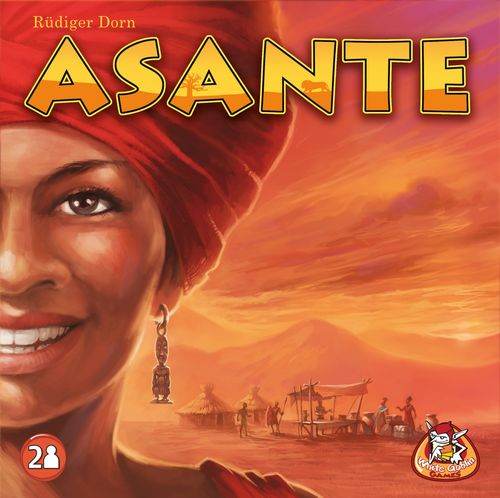
Asante
Asante Rulebook
Table of Contents
Table of Contents
Goal of the Game
At the end of the game, the player with the most gold wins.
Game Components
112 Cards:
- 35 Ware cards
- 14 Artifact cards
- 34 Person cards
- 14 Animal cards
- 15 Holy Place cards
46 Gold tokens:
- 25 x 5 gold
- 21 x 1 gold
2 Market stands
5 Action markers
48 Wares:
- 8x Jewelry
- 8x Pelt
- 8x Tea
- 8x Silk
- 8x Fruits
- 8x Salt
Example cards, for reference:
- Pottery (Ware card): Place 1/2/3/4/5/6 different types of wares from your market stand into the supply. In return, take 1/3/6/10/15/20 gold, respectively, from the supply.
- Tracker (Person card): Draw cards one at a time and place them directly in the discard pile until you draw an Animal. Then decide whether to play the Animal immediately without spending an action or add it to your hand.
- Cape Buffalo (Animal card): Choose 1 Artifact in play (yours or your opponent's) and place it in the discard pile. You may immediately (and only once) use this Artifact without spending one or more action markers.
Game Setup
- Before the first game, carefully remove the market stands, wares, gold and action markers from their sheets.
- Each player receives 1 market stand and places it in front of themselves.
- Shuffle the 15 Holy Place cards separately from the other playing cards to form a face down Holy Place draw pile and set it to one side of the playing area. From this draw pile, draw three cards and place them face up in the middle of the table so that they lie evenly between the players.
- Shuffle the remaining playing cards (Ware, Artifact, Person, and Animal cards) to form a face down draw pile. Set this draw pile to the opposite side of the playing area. Each player receives 5 cards as a starting hand.
- Place the wares within easy reach of both players to form a ware supply.
- Each player receives gold valuing 20 (five 1-gold tokens and three 5-gold tokens). Place the remaining gold tokens within easy reach of both players to form a gold supply.
- The player who has the most loose change in their pockets receives the 5 action markers and begins the game.
Game Play
Note for your first game: "Asante" thrives on clever usage of its numerous cards, and knowing when exactly to play them. It will take time to get to know the different functions of the cards, and so your first play will take a little longer. Your following games will go much quicker.
Game Overview
Each player owns a market stand, at which they offer a variety of wares. By playing Ware cards, players purchase wares from the supply and place them in a free space on their market stand. Likewise, a player sells their wares by playing Ware cards, sending their wares back to the supply and receiving gold in return. The prices a player pays or receives for these wares are both featured on each Ware card. Persons, Animals and Holy Places are cards that a player can use once, either to aid themselves or to impede their opponent. Artifacts, however, are cards that remain in play and can be used each turn.
General idea: A player's turn consists of 2 phases that must occur in the following order:
- Draw cards
- Play cards
Each turn consists of up to 5 separate actions. Players should use the 5 provided action markers to keep track of their own actions or those of their opponent. For every action taken, slide one action marker to the middle of the table.
Important bonus: If a player ends their turn with 2 or more action markers remaining, they gain 1 gold as a reward.
Phase 1: Draw Cards
- The active player draws a card, looks at it and either adds it to their hand or discards it. This costs one action.
- If the player discards the card, they may proceed to the second phase or they may draw another card, which they may then add to their hand or discard (allowing them to, again, draw another card). Each card drawn in this way costs the player one action.
- The player may, in this way, draw and discard as many cards as they have actions to spend doing so. A player may only keep a single card drawn in this way, and only the card which was most recently drawn. To be clear, a player may spend all 5 of their actions drawing and discarding cards, if they choose to do so.
- If the player adds the card to their hand, they proceed immediately to the second phase, where they may begin playing cards. Once the second phase has begun, a player may not spend actions to draw cards, unless the text on a card allows them to do so.
- A player may also choose not to draw a card, skipping phase 1 and proceeding directly to phase 2, so that they have 5 actions with which to play cards and use Artifacts.
Please note: In most cases, it is recommended that a player spends one or more actions during phase 1 in order to add a card to their hand.
Phase 2: Play Cards
General idea: It costs an action to play a card! Certain cards are an exception to this rule.
Important: Playing a Holy Place card does not cost an action.
There are five different card types, which may be used in different ways and played in any order.
- Ware cards
- Artifacts
- Persons
- Animals
- Holy Places
The Cards in Detail
Ware Cards
Ware cards can be used to buy or sell wares, and are placed in the discard pile after use. Each Ware card depicts between 1 and 4 wares.
On several Ware cards 1 or 2 packages are depicted. A package indicates that the player may choose to buy or sell the ware of their choice. If 2 packages are depicted, the wares the player buys or sells must be of the same type.
To buy the wares depicted on a Ware card, the player pays an amount of gold equal to that found on the left hand side of the card and takes all of the depicted wares from the supply. Each ware is immediately placed on a free space on the player's own market stand.
- A player's market stand has space for 6 wares. If a player does not have enough space for all the wares depicted on a Ware card, they may not play it.
- Likewise, a player may not play a Ware card if the ware supply does not contain the depicted wares. In other words, a player may never choose to take less than all depicted wares.
To sell the wares depicted on a Ware card, the player places the ware tokens matching the depicted wares into the supply and receives an amount of gold equal to that found on the right side of the card.
- A player may not sell less or different wares than those depicted on a Ware card.
Artifacts
- When a player plays an Artifact, they place it on their side of the play area in front of one of the three Holy Places. The active player's opponent then receives that Holy Place card. Another Holy Place card is drawn to replace the taken one, so that there are again 3 Holy Places. If a player plays a 4th Artifact to replace one they already have in play (i.e. they already have an Artifact in front of each Holy Place), they gain the Holy Place instead of their opponent. A player may have any number Holy Place cards. For further explanation of Holy Places, see below.
- Artifacts are not placed in the discard pile after being played.
- A player may make use of any of their displayed Artifacts – even on the turn in which they were played.
- Important: Each use of an Artifact costs 1 action, unless otherwise specified.
- Each Artifact may only be used once per turn, even on the turn on which they were played. To indicate an Artifact has been used, the player should rotate it sideways.
- A player may never have more than 3 Artifacts. A player may only discard an existing Artifact (regardless of whether or not it had been used that turn) in order to play a new one.
- A player may have duplicate copies of the same Artifact. Each of these Artifacts may be used once a turn, independently of each other.
- At the end of a turn, a player should refresh all Artifacts to their upright position so that they are available to be used on the following turn.
Persons
Upon playing a Person, the card's text is executed immediately. The card is then placed in the discard pile.
Animals
Upon playing an animal, the card's text is executed immediately. The card is then placed in the discard pile.
A player may play the "Animalist" card in response to an opponent's Person or Animal card. The "Animalist" is played out of turn (it does not cost an action) and cancels the effect of the opponent's Person or Animal card. The Animalist is then placed in the discard pile.
Holy Places
Once during a player's turn, they may play one Holy Place card to perform the depicted action. This does not cost an action. The Holy Place card is then placed in the Holy Place discard pile.
The Holy Place cards are as follows:
- Rwenzori Mountains: Draw a card.
- Victoria Waterfalls: Take a gold from the supply.
- Okavango Delta: Retrieve a spent action marker.
- Ngorongoro Crater: Return 1 ware from your market stand to the supply; take any 1 ware from the supply and place it on your market stand.
- Kilimanjaro: Perform one of the above Holy Place actions.
Important: The more cards of a particular Holy Place a player has, the stronger its effect will be when played. If a player has 2 or even all 3 cards of a particular Holy Place, they may perform the depicted action 2 or even 3 times, respectively, by playing a single copy of that Holy Place card.
Two examples:
- The player plays one of her two "Rwenzori Mountains" cards, which allows a player to draw 1 card. Because she possessed two copies of "Rwenzori Mountains" at the time she played the card, she may draw a total of 2 cards. Had she possessed all three copies of "Rwenzori Mountains", she would have drawn a total of 3 cards by playing a single "Rwenzori Mountains" card.
- The player plays one of his two "Kilimanjaro" cards. Therefore, he may perform two actions of his choice. He takes 1 gold from the supply and exchanges 1 ware between his market stand and the supply.
Game End
If a player ends their turn with 60 gold or more, the game end is triggered. Their opponent receives one full turn. Then, the game ends. The player with the most gold wins. In case of a tie, the player who took the final turn (i.e. the "opponent" of the player who triggered the game end) wins.
Additional Rules
- A player may hold as many cards as they wish.
- Holy Places are not held in hand. They are kept face up in front of the player who owns them.
- A player's gold must always be visible. A player may not perform an action that would cost more gold than they currently have.
- If a player receives wares through the effect of a Person or Animal card, they may decide which wares to place in their market stand and which to return to the supply. This is different from the rules for Ware cards.
- Should a draw pile be exhausted, its associated discard pile should be shuffled to create a new draw pile.
Additional Details for Some Cards
Boatman: If the player wishes to obtain three wares, for example, they must discard 6 cards (1+2+3). The played Boatman card may not count as a discarded card.
Cape Buffalo: Using the Cape Buffalo, a player can use their own Artifact twice in one turn. Once, as normal, and a second time using the Cape Buffalo.
Dyer: All the goods that the players placed into the supply must be of the same type. All the goods that the player takes from the supply must be of different types, and different from the traded type. For example: The player places 3 Silk into the supply, then takes 1 Fruits, 1 Salt and 1 Tea from the supply; taking 2 Fruits and 1 Tea in return would not be allowed.
Haggler: This card may not be used with Ware cards depicting packages.
Healer: The player may not choose to take the Healer from the discard pile.
Map / Cartographer: The effect of the Holy Place only occurs once. This means: When using the Map, a player may not improve the effectiveness of the chosen Holy Place with their own Holy Place cards. When using the Cartographer, multiple identical Holy Place cards do not improve each other. For example: 2 "Victoria Waterfalls" cards (take 1 gold) give the player 1 gold each for a total of 2 gold.
Nomad: This card may even be used when you have no wares in your market stand.
Shango Figurine: Using the Shango Figurine costs at least 2 actions: 1 action to activate the Shango Figurine and 1 action to draw 3 cards for the first time. If the player chooses not to keep one of these cards, they may spend another action to draw another three cards to choose from (the player does not need to spend another action to activate the Shango Figurine again). The Cape Buffalo and the Tortoise may not be used with the Shango Figurine.
Tracker: If the player chooses to play the Animal card found by the Tracker, their opponent may not play an Animalist to defend against it.
Tortoise: The owner of the Artifacts used through the Tortoise may not use these Artifacts on their own turn, as Artifact cards are only refreshed to their upright (unused) position at the end of their owning player's turn.
About the Author
The author: Rüdiger Dorn, born in 1969, lives with his wife and their three children in South Germany. The graduate commerce teacher has designed a range of games suitable for children, families and strategy gamers. He first explored the world of African merchants with his enormously successful game Jambo, which received a nomination for the coveted Spiel des Jahres. With Asante, which reinvents the ideas found in Jambo with new cards, he has come full circle.
Hint: If you own a copy of Jambo, you can freely mix the cards from Jambo with the cards from Asante.
Rules: TM-Spiele Illustration: Michael Menzel Graphic design: Pohl & Rick English version: Team Z-Man Games
The author and the publisher would like to thank all the playtesters and rules readers, most notably Mr. Adam Marostica.
© 2013 Franckh-Kosmos Verlags-GmbH & Co. KG. English Version © 2013 Z-Man Games Inc.