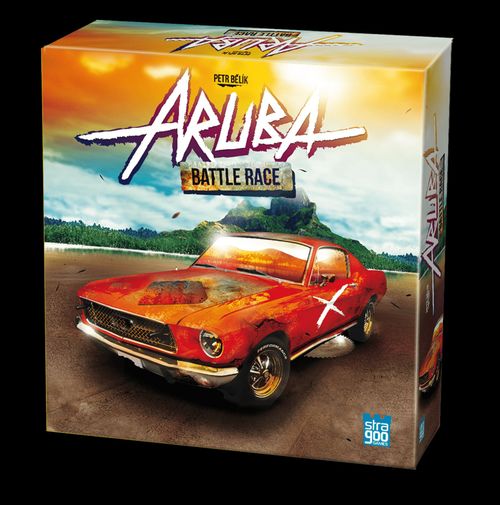
Aruba: Battle Race
Aruba: Battle Race Rulebook
Table of Contents
Table of Contents
Components
The box of ARUBA the board game contains:
- 1 game board
- 6 race cars
- 6 race car cards
- Action cards
- 33 victory point tokens
- Damage tokens (DT)
- 10 six-sided dice
- 1 rulebook
Game Setup
Place the game board in the middle of the play area. Place the victory point tokens and the Damage Tokens (DT) next to the game board. Randomly choose the starting player. Turn order is determined clockwise from the starting player. Each player chooses a race car and takes its associated car card. Each player places their car card in front of him/her. Each player places their race car piece on the track's starting position that matches their place in turn order (i.e. the starting player puts his/her car in the first starting position, the second player puts their car in the second starting position, and so on).
Shuffle all of the action cards together into one deck. Place the action card deck facedown next to the game board. Leave space for the action card discard pile next to the deck. Players do not begin a race with any cards in their hands.
Objective
The goal of the game is to be the player to accumulate the most points over a series of races. Depending on their speed and cunning, players may earn points after each race. To be successful, players must attack and hinder each other's progress by any means possible (within the rules of the game, of course!)
The player with the most points at the end of the third race is declared the victor.
Game Play
Each race begins with the starting player and proceeds clockwise. Players take turns until the first three cars have crossed the finish line and the race is over. A player's turn consists of two steps:
- Roll: The active player rolls 2-10 of the racing dice depending on how many Damage Tokens (DT) they have on their car card. A player rolls 1 less die, from the 10 possible, for each Damage Token they have. Example: There are 4 Damage Tokens on a player's car card. The player may roll 6 dice (10 possible − 4 DTs = 6 dice). Any or all of the dice may be re-rolled twice (for a total of 3 rolls).
- Combo: The player creates combinations with the rolled dice and executes their effects, which are summarized in the table below. Although multiple dice combinations may be played in a player's turn, each die may be allocated to only one combination. A player is not obligated to use all of the rolled dice on their turn.
Dice Combination Table
| Combination | Effect | Type |
|---|---|---|
| Straight: 1→'X' | Move a maximum of 'X' spaces | Movement |
| Pair: Any | Fire: Blast +1 DT / Small Repair: −2 DT | Attack/Repair |
| Three of a Kind: Any | +2 action cards | Cards |
| Four of a Kind: Any | Turbo: Move +2 spaces | Movement |
| All Odd | Complete car repairs | Repair |
| All Even | Boost: Move 6 spaces | Movement |
Straight: 1→'X'. Move a Maximum of 'X' Spaces (Movement)
This combination may only be used up to once per turn. To move their race car a maximum of 'X' spaces on the race track, a player must have a continuous sequence of dice (or straight) that starts with '1' and ends with 'X'. A player may move their race car a maximum of 6 spaces if a straight of 1, 2, 3, 4, 5, and 6 is rolled (in this instance, 'X' equals '6'). Also, a single die result of 1, singular 'straight', may be used to move one space.
Example: A player rolled a 1, 2, 4, 5, and a 6. S/he may advance his/her car by 2 spaces since the longest continuous sequence that starts with a '1' ends with a '2'. The 4, 5, 6 straight does not start with a '1' and cannot be used for this purpose.
Pair: Any Number. Shoot / Small Repair (Attack/Repair)
Provided the active player has the dice to do so, this dice combination may be used multiple times in a turn. A player may choose to use this dice combination in one of two ways:
- Shoot another race car: The target car must be directly in front of the firing player's race car. The target car receives one Damage Token (DT), which is placed on its car card. Timing: A player may shoot at the beginning or at the end of their movement, but never in between.
- Small repair: A player may remove up to 2 Damage Tokens (DTs) from their own car card.
Three of a Kind: Any Number. +2 Action Cards
A player draws 2 action cards into their hand. Provided the active player has the dice to do so, this dice combination may be used multiple times in a turn. Timing: This must be the last action on a player's turn; a player must wait until their next turn to use any of the cards drawn. (See also Action Cards.)
Example: A player rolled 3, 3, 3, 4, 5, 5, 5 so he may spend triple 3 and triple 5 to gain 4 action cards.
Four of a Kind: Any Number. Turbo (Movement)
A player may increase their race car's movement by 2 additional spaces. This dice combination may be used in conjunction with any other movement combination or on its own (a race car's basic movement is 0).
All Odd: Complete Car Repairs (Repair)
Translated from the German text of the same rulebook, as the English paragraph is missing from the printed page: A player may remove all Damage Tokens from their race car if all of their dice show an odd result after the Roll step of their turn. This dice combination is possible for any number of available dice – even 2 (when the race car bears the maximum of 8 Damage Tokens).
All Even. Boost (Movement)
A player may move their race car up to 6 spaces if all of their dice are even after the Roll step of their turn. This dice combination is possible for any number of available dice – even 2 (when the race car bears the maximum of 8 Damage Tokens).
Car Movement
Race cars may only move forward (directly or diagonally) on the track. Race cars may never move sideways, backwards or in between another two cars (see the picture).
Lead Car
If a player's race car is alone in the lead at the beginning of its movement, their movement is reduced by 1 space. Nothing happens if a movement dice combination is not used. If two or more race cars share the lead, this rule does not apply. If the lead car has already crossed the finish line (and won the race), this rule is ignored for the remainder of the current race.
Cornering
If a race car starts its movement on a red space, its movement is decreased by 1 space. If a player's race car moves through a red space without stopping, nothing happens.
Note: If the lead race car starts its movement on a red space, its movement is decreased by 2 (1 for being in the lead and 1 for starting in a red space).
Collision
A player may crash their race car into another player's race car that is directly in front of them on the track. Collisions cannot be instigated by diagonal movement. A player must end their movement on the space directly behind the target race car with at least one movement point left, which will be used for the collision. If the active player has more than one movement point left, it is lost and is not used.
The player who causes the collision moves their race car into the space occupied by the car just hit (the 'target' car). As a result the target car is bumped one space directly forward and receives 1 Damage Token. If there is another car occupying this space, it also receives one Damage Token and is bumped one space forward (and so on). It is possible to have chain reaction collisions.
Note: If any of the race cars involved in the collision have front and/or rear bumpers, these benefits are applied as usual (see action cards).
Damage Tokens (DT)
Damage Tokens are placed on the racing car cards to keep track of how much damage the racing car receives during the race.
The maximum number of Damage Tokens that a single racing car may have is 8. If a racing car receives a 9th Damage Token, it is destroyed and does not finish the current race. The racing car's debris remains on the race track – indicated by putting the race car on its side on the space where it received the 9th (and final) Damage Token.
Action Cards
Action cards are used in various situations and may be obtained by rolling the 3 of a kind dice combination (see Dice Combination Table) or by stealing them from other players. Regardless of the method in which they are obtained, action cards may never be played on the turn that they are received. Generally, Action Cards may be used as a QUICK FIX or as an ACTION EFFECT.
Quick Fix
Players may remove one Damage Token from their race car card for every Action Card discarded from their hand. Players are allowed to do this at ANY time during the race (even not on own turn).
Action Effects
Each Action Card may be used for a specific effect.
Bomb: At the beginning or at the end of their movement (but not during) a player may drop a bomb on the space immediately behind their race car. The blast zone includes all spaces adjacent to the space where the bomb was dropped (see picture). Each car in the blast zone receives 1 Damage Token.
Hook: The Hook action card is played and resolved on another player's turn; it is the only action card to do so. It allows a player to 'hook' (or attach) their race car, which must be in the space immediately behind the active player's car, onto the active player's car. Both cars remain attached for the duration of the active player's movement; the back car copies the movement of the active player's race car. Timing: The Hook action card must be played after the active player has rolled their dice (Step 1) but before they make combos (Step 2).
Extra die: This action card is used as an extra die, with a result of the active player's choosing, during the Roll step of their turn after the very first roll. Players are not restricted as to how many of these action cards they may play at one time.
Die change: During the Roll step of their turn, the active player may change any rolled die to a different result of their choosing. Players are not restricted as to how many of these action cards they may play at one time.
Larceny: The active player may steal two random action cards from another player's hand if their race cars are immediately adjacent to each other (in any direction). Stolen action cards may only be used after the active player's turn is over. To keep track, the active player may want to keep any stolen action cards to the side until their turn is over – then they may add them to their hand. Multiple Larceny action cards may be played on the same or different opponents in a turn.
Nitro: For every Nitro card played, the active player may increase their race car's movement by 2 additional spaces. This action card may be used in conjunction with any other movement combination or on its own (a race car's basic movement is 0).
Re-Roll: During the Roll step of their, turn the active player may re-roll any number of dice as an extra re-roll. Players are not restricted as to how many of these action cards they may play at one time.
Repair: The active player may remove up to 2 Damage Tokens from their race car for every Repair card played.
Bumper: Bumpers are used in collisions. They may either increase the damage inflicted on other race cars if placed in front (FRONT BUMPER), or protect a player's race car if placed on the back (if a car has a REAR BUMPER and is hit in a collision, it receives no DT). At the beginning of their turn the active player may place the Bumper action card in the front or back position of their own racing car card. Only one bumper may be placed in each position at a time. The bumper's position may not be changed after its initial placement. The FRONT BUMPER adds one additional Damage Token to any race car targeted in a collision. The target race car receives a total of 2 Damage Tokens (1 from the collision and 1 from the front bumper). The front bumper remains attached to a race car until it collides with another car that has a REAR BUMPER; neither car receives any Damage Tokens but both the front bumper (from the rear car) and the back bumper (from the front car) are removed; the Bumper action cards are discarded.
Saw: When equipped with the Saw, a race car inflicts 1 Damage Token to any laterally adjacent race car that is on the same side as the saw. The damage is inflicted at any time (while passing another race car, when being passed by another race car, or at the end of the movement) when this situation occurs. At the beginning of their turn the active player may place the Saw card in the left or right position on their own racing car card. The saw's position may not be changed after its initial placement. The saw remains attached to a race car until it hits the saw of another race car (i.e. both race cars are laterally adjacent to each other and have their respective saws facing each other). Neither car receives any Damage Tokens but both saws are removed; the Saw action cards are discarded.
End of the Race
The first player to cross the finish line on the track wins the race! The race continues until the second and third place finishers are determined. The victor becomes the starting player for the following (2nd or 3rd) race and puts his/her race car in the first starting position. Turn order is determined clockwise from the starting player; each player places their race car piece on the track's starting position that matches their place in turn order.
Remove all Damage Tokens and equipment (bumpers or saws) from all race car cards. Re-shuffle all of the action cards together in one deck (as done at the beginning of the game).
Scoring
At the end of each race the top 3 finishers are awarded the following victory points (players who finished behind 3rd place are not awarded any victory points):
- 1st place = 6 victory points
- 2nd place = 4 victory points
- 3rd place = 2 victory points
End of Game
The player with the most cumulative points at the end of the third race is declared the victor.
In the case of a tie, the player who placed better in the 3rd (and final) race is the winner.
Three Player Variant
In a three player game each player controls two race cars that may work together on the race track. The game turn order progresses as normal with one exception: players must alternate the race car that they control from turn to turn. If one of a player's race cars is eliminated from the race (because it received too many Damage Tokens), the player's turn is skipped when the eliminated race car is supposed to be played.
Action cards may be played for either of a player's race cars, but only on the appropriate turn (and respecting all common rules).
During the setup and cleanup, each player places one of their race car pieces on the track's starting position that matches their place in turn order (as normal). The starting player then places his/her second race car in the fourth starting position, followed by the 2nd and 3rd players who fill the 5th and 6th start positions (respectively) with their second cars.
Points are awarded as normal after each race; players may receive some for both cars.