Artisans of the Taj Mahal
Artisans of the Taj Mahal Rulebook
Table of Contents
Table of Contents
Aim of the Game
Recruit craftspeople, construct the iconic mausoleum and maintain the monument's beautiful gardens. Erect towering domes, intricate minarets and enormous archways to earn the most points and be declared Master Architect!
Setting Up
Each player will need a printed player sheet and a pen or pencil. You will also need 2 six-sided dice that can be seen by all of the players (if you are playing via video call, you can share your screen and use a pair of virtual dice).
Playing the Game
In Artisans of the Taj Mahal, all players take their turns at the same time. On every turn, one player rolls both of the dice once (any player can do this) and then every player must:
- Use one dice result to select a feature, and then
- Use the other dice result to add a value to the selected feature.
In addition, players can alter dice results and should be mindful of watering the garden's fruit trees.
Selecting a feature
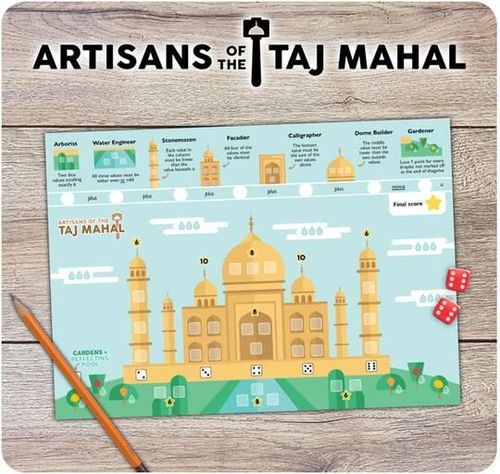
The Taj Mahal and its grounds comprise multiple features divided into 6 groups. Each of these 'feature groups' corresponds to a dice value, shown towards the bottom of the player sheet. Feature group 1 covers the Gardens and Canals, whereas feature groups 2 to 6 cover features of the mausoleum. Feature groups 1 and 4 contain more than one feature.
Players use one of the dice results rolled to select a feature group that they will add to in the next step.
For example, 4 + 6 are rolled. A player uses the 4 result to select the mausoleum's central feature group containing the Archway and Dome (A).
Adding a value to a feature
Players use the remaining dice result to write the corresponding value into any empty box available in the feature group selected earlier (don't forget to consider the scoring conditions!)
For example, the same player uses the remaining 6 to write '6' into a blank box on the Dome feature (B). Instead, they could have chosen to add to the Archway feature below as it is also part of the 4 feature group.
If players are unable (or unwilling) to add a value, they must mark off one raindrop but do not receive its benefit (see 'Altering dice results' below for more about raindrops).
Altering dice results
A refreshing downpour offers some welcome relief from the heat of the day. Players may alter dice results by marking off the raindrops found in clouds on the player sheet. For each raindrop marked off, they may add or subtract 1 from a dice result. Alterations only affect them.
For example, the player above could have chosen to mark off one raindrop to alter the 4 result to a 5 (+1) or 3 (-1).
Players may mark off multiple raindrops in the same turn and may alter the result of both dice so long as they mark a raindrop for each individual alteration made. A result can only be altered to a value that exists on the dice (i.e. 1 to 6). A maximum of 15 alterations can be made per game, but raindrops are also required to water the garden's fruit trees, so be careful!
Watering fruit trees
Whenever a player adds a value to a feature in the 1 (Gardens and Canals) group, they may also mark off 1 raindrop to water a fruit tree, filling in the symbol below the tree to signify that it has been watered. Neglected fruit trees will lead to lost points at the end of the game, so look after them!
End of the Game
The game ends when any player fills the final empty box on their player sheet or uses the last of their raindrops. All other players finish their turn and then scoring takes place.
Scoring
Players earn points equal to the star value of every completed feature fulfilling the conditions shown at the top of the player sheet. They lose 1 point for every unwatered fruit tree. The player with the highest score is declared Master Architect! In a tie, the player with the most unused raindrops wins. If the tie persists, the youngest player wins.
Scoring Conditions
Below you will find additional details about each feature's scoring conditions (also found at the top of the player sheet).
A feature with any empty boxes at the end of the game does not score any points.
- Arborist (2 available): The two values must total exactly 6.
- Waterway Engineer: All three of the values in this feature must be either even or odd (i.e. no mixing of even and odd numbers).
- Stonemason (2 available): Each value in the minaret (column) must be lower than the value beneath it (i.e. values must get smaller from the bottom of the column to the top). Values cannot be equal.
- Facade Sculptor (2 available): Each value in this feature must be identical (e.g. 4 x the same die value).
- Calligrapher: The bottom value in this feature must be the sum of the two values above it.
- Dome Builder: The middle value in this feature must be lower than the two values either side.
- Gardener: At the end of the game, players lose 1 point for each fruit tree with an unfilled symbol.