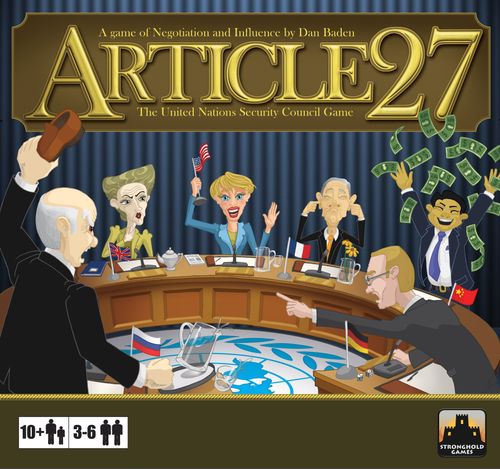
Article 27: The UN Security Council Game
Article 27: The UN Security Council Game Rulebook
Table of Contents
Table of Contents
Contents
- 6 Player Boards
- 6 Player Screens
- 1 Main Board, divided into four areas:
- The Secret Agenda Scoring Chart
- Five Issue Areas
- The Table
- The Floor
- 108 Influence Point Tokens (63 "1s", 27 "5s" and 18 "10s")
- 36 Player Marker Tokens (6 per player)
- 12 Voting Tokens (6 "Yes" and 6 "Veto")
- 6 Secret Agenda Assignment Tokens
- 30 Issue Drawing Tokens (6 per color)
- 30 Wooden Issue Disks (6 per color)
- Plus: 1 Wooden Gavel, 1 Timer, 1 Sticker Sheet, 1 Cloth Bag and this Rulebook
Before Your First Game
Included in the game box is a sticker sheet and 30 Wooden Disks. These disks are the Issue Tokens (not to be confused with the larger cardboard Issue Drawing Tokens). To create the issue tokens, affix all the secret agenda stickers to one side of the Tokens. Each color has matching colored stickers. Place one sticker of a matching color onto each disk.
Game Setup
Place the Main Board in the center of the table within the reach of all players.
Each player selects one Player Screen and one Player Board. Assemble the Screen to the Board using the cutouts provided.
Give each player one random Secret Agenda Assignment Token that they look at and place behind their player screen. Players may look at their Secret Agenda icon, but should keep this secret from the other players. If playing with 4 or 5 players, reveal the Secret Agenda of the unused tokens and remove all of the the wooden Issue Tokens which have corresponding Secret Agenda symbols on them and place them back in the box. With 6 players, there will be no Tokens that need to be removed, of course.
IMPORTANT: In a 3 player game, do not reveal the unused Tokens and do not discard any unused Tokens back into the box. Set the unused Secret Agenda Assignment Tokens aside without revealing them, and play with all the wooden Issue Tokens as if playing a 6 player game.
Sort the remaining wooden Issue Tokens by their color and be sure to keep the Secret Agenda side face-down before shuffling each color. Once shuffling is complete, place all Tokens blank side-up onto their corresponding areas on the Main Board -- one Token per circle.
Place tokens starting nearest to the center of the board first, and only use the outer spaces in a 4, 5, or 3/6 player game (as marked on the game board).
IMPORTANT: For a 3 player game, use all of the wooden Issue tokens as if setting up for a 6 player game. This ensures that each player gets to be the Secretary General twice per game.
Give each player 12 Influence Point Tokens to start the game. These are kept behind the screen, or in a location where they cannot be easily seen by other players. The remaining Influence Point Tokens are placed near the Main Board and form the Bank.
Each player receives all 6 Player Marker tokens of their nation for later use. They also receive one "Yes" and one "Veto" Voting Token.
Finally, take all 36 Issue Drawing Tokens (They show the Issue symbols on one side, and the U.N. symbol on the other side) and place them into the Cloth Bag, mixing them up well.
Playing the Game
In Article 27 each player will have exactly one chance to act as the Secretary General ("the leader") of the U.N. Security Council (except in a 3 player game where each player will get 2 opportunities). On a player's turn acting as the Secretary General he makes a Proposal using the five wooden Issue Tokens available each round.
In order to get a Proposal to pass, the Secretary General must receive the approval of the majority of players. However, any player can choose to Veto the Proposal, and no matter how many of the other players support the Proposal, it will fail. Vetoes come at a high cost, however, so they must be used sparingly.
The goal of Article 27 is to be the player with the most Influence Tokens/Points at the end of the game. These can be collected in one of four ways:
- Passing a Proposal when you are the Secretary General
- Collecting points for the Issues included in a Proposal which has been passed.
- Completing Secret Agendas
- Receiving Influence Bribes
The Game Round
Each round is divided into the following phases:
i) Setup and Change Secretary General ii) Negotiation iii) The Vote iv) Influence Payouts
After the completion of each round, if there are players who have not yet had a turn (or 2 turns if playing with 3 players) as Secretary General, the game continues with a new round. Once all players have had a chance to be the Secretary General the game ends and the final score determined.
The Game Phases in Detail
Setup and Change Secretary General
First, pass the gavel to the next player in a clockwise direction. If this is the first round of the game, the gavel starts with the player who last made a public speech. Alternatively, players may select the starting player randomly.
Now, in player order starting with the current Secretary General, each player takes the Cloth Bag and draws out 5 Issue Drawing Tokens one-by-one. Players place each Token one at a time behind their player screen onto each of the point scoring spaces. The tokens are placed from left to right, in the exact order in which they are drawn, with one Token placed in each space. The placement of these tokens shows the value of each Issue to the player for that round.
EXAMPLE: In this example, Mike has drawn a red Token in the +3 space. If the Proposal passes this round and it includes the red Issue, Mike will receive 3 Influence Points. Mike has also received a blue Token in both the +1 and -4 spaces. If the Proposal passes this round and it includes the blue Issue, Mike will lose a total of 3 Influence Points.
Next, from each Issue Area on the Main Board, flip over one wooden Issue Token of each colour/Issue (one-by-one) and place this token so that it sits on the circular Table in front of each area. This issue is now "tabled". Since the Token has been flipped, it will also reveal the Secret Agenda associated with that Issue for this round.
It is okay if two different Tokens show the same Secret Agenda Icon during a round. If a third Secret Agenda of the same type is revealed however, return it to its Issue Area and draw the next Token. Now shuffle the returned Issue Token with the Tokens remaining in the Issue Area so that nobody can know which Issue Token will be flipped in the next round.
It is important to take note when the revealed Secret Agendas match with your own Secret Agenda Assignment Token. These Tokens will score a bonus at the end of the game (see "Influence Payouts" and "Final Game Scoring" later in the rules for more details).
IMPORTANT: On the final round of the game, it may be possible that a Secret Agenda icon is displayed 3 or more times. In this case, since there will be no other Tokens to replace it with, play this round ignoring the normal replacement rule.
Finally, place a 5 point Influence Token in the center of the Floor Area of the Main Board. This is a "Success Bonus" paid to the Secretary General if the Proposal passes successfully.
Negotiation
Once the setup phase is complete, the new Secretary General begins the negotiation round by tapping his gavel in an official fashion, and immediately starting the timer. It is not permitted to negotiate before the gavel is struck and the timer started.
During the Negotiation Round, the Secretary General (and only the Secretary General) drags wooden Issue Tokens which are "tabled" and places them in the middle of the game board (the Floor). These Issues are now considered to be included in the current Proposal or "on the floor". Issues which are "tabled" are not part of the current Proposal, although the Secretary General may make any desired changes as long as the timer has not expired.
Of course, most players will want certain Issues included or excluded depending on their corresponding point values. This is where bribery may be used. In order to bribe, a player makes an offer to any other player (including the Secretary General). This offer may be for anything, though often it's for including or not including an Issue, or for supporting or not supporting an issue.
If an offer is made, the player receiving the offer may choose to accept or reject it or even propose a different arrangement (a larger bribe, for example). Once a deal is struck the bribe is "recorded".
To record a bribe, a player places the appropriate Influence Tokens onto the receiving player's Player Mat and places a Player Marker Token on top of the stack of tokens so that it is clear who offered the bribe. Multiple players may offer similar bribes during a round, so it is important to use the Player Marker Tokens to avoid confusion. In the event a player wishes to offer more than 6 bribes in a given round, find another suitable marker to denote additional bribes (a penny, for example). Each Player Mat allows for the easy tracking of the bribes that have been received from other players.
The Player Mat has four bribe-recording areas, one per Voting Token / U.N. symbol icon, plus the Issue Area rows themselves:
- Abstain area: A bribe placed here means the player has agreed to ABSTAIN during the vote.
- Yes area: A bribe placed here means the player has agreed to vote YES on the Proposal.
- Veto area: A bribe placed here means the player has agreed to VETO the Proposal.
- "?" (complex deal) area: Bribes placed in this area are for deals which are too complicated to be placed anywhere else, or for deals which have multiple conditions.
- Lower row of the Issues: A bribe placed here means that the player (the Secretary General) has agreed to LEAVE THIS ISSUE OUT OF THE PROPOSAL.
- Upper row of the Issues: A bribe placed here means that the player (the Secretary General) has agreed to INCLUDE THIS ISSUE IN THE PROPOSAL.
If a player agrees to a deal, but later during the negotiation changes his mind, he immediately returns the bribe to its owner as indicated by the Player Marker Token. This is also normally the case if the player who has accepted a bribe accepts another bribe for the opposite condition. For example, if the Secretary General agreed to include the red Issue in the Proposal (and has placed it "on the Floor") but later agrees with a different player to not include the red Issue in the Proposal (and has "Tabled" the red Issue), the former player would normally receive his bribe back immediately, since the Secretary General has made it impossible to carry out the original deal. However, at the agreement of both players involved, the bribe may be allowed to remain on the receiving player's Player Mat (though it should be clear that the receiving player will certainly not be able to keep both deals).
It is important to remember that all deals are non-binding. A player may accept a bribe but may then not follow through on the agreement. Though this means the player will not be allowed to collect the bribe, it can trick players into a false sense of security. For example, a player may accept a bribe to vote "yes" on a Proposal, and choose instead to Abstain. In this case, the bribe would be returned after the vote has been taken.
The Secretary General may end the Negotiation Round at any time, including immediately after starting the Negotiation Round by tapping the gavel a second time and calling "Vote!". After this point, no adjustments to the current Proposal may be made. However, in order to end the Negotiation Round, there must be at least one Issue in the Proposal ("on the Floor").
If the timer expires before the Secretary General taps the gavel a second time, the Secretary General must proceed with the vote without any further adjustments to the Proposal.
In the event that there are no Issues which are currently in the Proposal (no Issues "on the Floor"), first return the 5 point "Success Bonus" to the Bank and then the Secretary General may pick one and only one Issue to place "on the Floor". After this a Vote is held.
Voting
To Vote, each player selects a Voting Token from behind their screen and places it into their closed hand. If a player wishes to Abstain, however, no Token is placed into their hand, and instead the player pretends to be holding a Token.
Once everyone is ready, all players simultaneously open their hand to reveal their Voting Token.
In order for a Proposal to pass...
- 2 players in a 3 player game or
- 3 players in a 4 or 5 player game or
- 4 players in a 6 player game
... must vote "Yes" by revealing the "Yes" Token in their hand. However, the Vote still fails if any player played the Veto Token.
It is possible that more than one player plays a Veto Token. A Veto takes effect over any other Vote outcome, so even if all other players Abstain and only one player chooses Veto, the Vote is considered to have ended in a Veto, even though the player has "wasted" his Veto power. A player may never Veto if he does not have at least 5 Influence Points to pay for the Veto.
If a player has Abstained by not placing any Voting Token into their hand, it does not count as a "Yes". However, it is not a Veto either. That player has simply chosen to not support the proposal and so the required number of "Yes" votes must be found elsewhere.
A player who Abstains does not modify the number of "Yes" votes which are required, nor should players treat the Vote as having a different number of players involved.
EXAMPLE: In a 4-player game, 1 player has Abstained. Looking around the table, all 3 of the remaining players have voted "Yes" and so the Proposal passes with the needed 3 "Yes" votes. If the Abstaining player had chosen to Veto instead, the Vote would have failed.
Collecting Bribes
Immediately after tallying the Vote, each player looks at his own Player Mat and determines which bribes may be collected and which need to be returned.
Any bribe for which the receiving player carried out his end of the deal is collected by the receiving player, even if the Vote result did not end the way the offering player intended. It is important to note the bribes in the "Other" area of the Player Mat. Often these deals are more complicated, and the receiving player must have carried out the deal exactly as intended in order to collect these bribes.
Any bribe for which the receiving player failed to completely carry out his end of the deal is returned.
Be specific with your bribes, and place each one carefully into its proper location on the receiving player's Mat. It is the responsibility of the offering player to ensure that the bribe is placed correctly.
EXAMPLE: Mike (the Secretary General) has a received a bribe to include the red Issue in the Proposal. He does so, and calls for a Vote. The Vote is defeated when Rich uses a Veto (nice one, Rich!). However, since Mike has carried out his part of the deal, he collects this bribe.
On the other hand, Stephanie bribed Mike to include Red in the Proposal and have the Proposal pass as part of the same bribe. This bribe was placed in the "Other" area of the Player Mat, and Mike must return this bribe as he failed to get the Proposal to pass.
Influence Payouts
If the Vote ended with any Vetos, those players who vetoed pay 5 Influence Points to the Bank. All Issue Drawing Tokens behind each Player Screen are returned to the Cloth Bag. After Secret Agenda Scoring is completed a new Round begins.
IMPORTANT: Vetos cost 5 Influence which is a big portion of your points. Only Veto if you must; it's far better to threaten to Veto and allow other players to bribe you not to do so.
If the Vote ended with not enough "Yes" votes to pass and no player chose "Veto", then there are no points to be scored. All Issue Drawing Tokens behind each Player Screen are returned to the Cloth Bag. After Secret Agenda Scoring is completed a new Round begins.
If the Vote ended with enough "Yes" votes to pass and no player chose "Veto", each player (including those who chose "Abstain") adds up their points behind their Player Screen. To calculate a player's score, disregard any Issue colors which were not included in the Proposal. For Issues which were included in the Proposal, the player receives the corresponding amount of Influence from the Bank. It is possible to have a negative score, in which case the player must pay points into the bank. If the player does not have enough points left to pay this negative score, they must pay all that they have. The Secretary General also collects the 5 Influence Point bonus from the center of the Main Board.
IMPORTANT: In order to ensure accuracy, each player must show his score to the player on his left, being careful not to reveal his Secret Agenda Token. Once the score is confirmed, the player collects this amount of Influence from the Bank and discards the Issue Drawing Tokens from behind his screen. Then Secret Agenda scoring is completed and a new Round begins.
Secret Agenda Scoring
No matter what the result of the Vote, Secret Agenda Scoring takes place.
For any Issue which was included in a successful Proposal (must have been "on the floor"), take that wooden Issue Token and place it Secret Agenda side-up on the corresponding row of the Secret Agenda Track on the Main Board. A successful issue Token goes to the leftmost available space (starting with the green arrow space). Each space on the Secret Agenda Track holds only one Token. Any additional successful Issues collected during this, or a later Proposal, continue to be placed in the leftmost available space.
Successfully scored tokens are placed agenda side up from left to right. Unsuccessful tokens are placed face-down from right to left.
EXAMPLE: at the end of the fourth round of a 6-player game, the Prestige, Justice and Peace agendas have only scored 1 point so far. The Wealth agenda is scoring 3 points, while the Supremacy agenda has managed 6 points. Note that only the Power agenda still has the chance at achieving a perfect score of 15 points.
For any issue which was part of an unsuccessful Proposal (not enough "Yes" votes or a "Veto" was called), or for an Issue which was not included in a successful Proposal (it remained "tabled") take those corresponding Issue Tokens and place them Issue side-up on the row of the Secret Agenda Track that corresponds to the Secret Agenda on the Token. These tokens are placed in the rightmost space starting with the red arrow. Any additional unsuccessful Issue Tokens are placed in the rightmost available space.
Game End and Scoring
After each player has acted as the Secretary General once (twice in a 3 player game) the game ends.
The players first refer to the Secret Agenda Track on the Main Board. The players score Influence Points equal to the number in the rightmost column that contains a successful Issue token (one showing their Secret Agenda Icon). So, a player who has had 4 successful Secret Agendas pass and failed only 1 will score a total of 10 Influence Points.
To this total, players add in the Influence Points held behind their Player Screen.
The player with the most Influence Points is the winner. In the case of a tie, the player from amongst the tied players who scored the fewest points on the Secret Agenda Track wins. If there is still a tie, the player from amongst those who are still tied who was the Secretary General for a successful Proposal is the winner. If there is still a tie, rejoice in a shared victory (and play again?).
The Issues
Article 27 allows players to have fun and perhaps even talk with a funny accent too! However, the Issues presented in this game are based on real issues faced by the U.N. Security Council. For added enjoyment while playing Article 27, players can refer to the Issues by name instead of by color.
- Peacekeeping (blue): Deploy Peacekeeping Force. Send troops to a country to maintain peace.
- Trade Sanctions (green): Block the sale of sanctioned goods from one country to another.
- Diplomatic Sanctions (black): Take Diplomatic Action: for example, close an Embassy or issue an official condemnation.
- Humanitarian Concerns (yellow): Call for Improved Human Rights.
- Nuclear Non-Proliferation (red): Demand a country stop producing nuclear weapons.
The Secret Agendas
What would a game of politics be without a Secret Agenda? Very often, politics can be motivated by someone's secret objectives!
- Wealth: This player will support any idea that is profitable.
- Peace: This player wants to end wars and pointless squabbles.
- Prestige: This player cares only for the legacy of his nation. Glory at any cost!
- Innovation: This player desires technological advancement at any cost.
- Justice: This player only cares for what is fair and just.
- Power: This player cares only about crushing opposing delegates.
Variants
Easy Come, Easy Go
For those who want a game where Vetos are easier to afford and therefore the Secretary General has to work extra hard to get a successful Proposal: Each player can start the game with 20 Influence Points instead of 12.
Lie, Cheat, and Steal
This variant is for experienced players. In this variant, players no longer show their score to their left neighbour at the end of a Vote. Instead, starting with the Secretary General and proceeding clockwise, each player announces their score, and they are allowed to say any score that they want. If no player choose to immediately announce "Challenge!", the player collects this score from the Bank and discards their Issue Drawing Tokens as per normal.
However, if any other player chooses to challenge, the player being challenged must show his score to the player on his left as per normal. Only one player may challenge, and if multiple players call a challenge at the same moment, the players who called the challenge must decide who called it first. If the announced score is found to be accurate, the player who challenged pays 3 Influence Points to the player he challenged. If the announced score is found to be inaccurate, the player who was challenged pays the difference between the actual score and the announced score to the challenging player, up to a maximum of 5 Influence Points.
EXAMPLE: Mike has announced a score of 7. Rich calls out "Challenge!" and Mike is forced to show his score to Stephanie who is sitting on his left. Stephanie announces that the true score was -1, and so the difference is 8. However, there is a maximum of 5 Influence Points and so Mike pays 5 Influence Points to Rich.
NOTE: A player may not call for a challenge unless they have at least 3 Influence Points. A player being challenged may go bankrupt. In this case, any remaining amount which is due to be paid to the challenging player is paid from the Bank instead.
Of course, since the maximum score possible in any given round is 9, players should immediately challenge any player who claims to have score 10 or more!