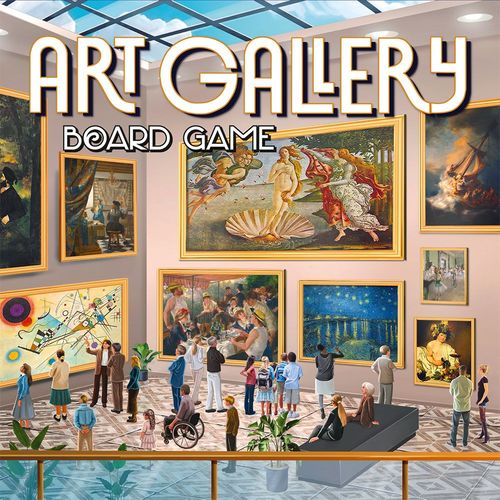
Art Gallery
Art Gallery Rulebook
Table of Contents
Table of Contents
Contents
- 48 painting cards
- 48 painting tiles
- 54 action cards, 6 cards each with the values 0 to 8
- 1 start card
- 6 game pieces, in six colours
- 24 markers, four markers each in six colours
- 1 modular board, consisting of four parts (A-D)
- 1 scoring block
- 1 game manual
Aim of the Game
The aim is to collect the most points. To do this, you have to move your game piece skilfully through the museum and use the action cards wisely to end up with the most valuable souvenirs and long rows of symbols on the painting cards you have collected.
Preparation
Before the first game, carefully press the pieces out of the perforated sheets.
- Depending on how many are playing, take the corresponding board pieces, put them together in the right order and place them in the middle of the table:
- When two or three are playing, you need board parts A + D.
- When four are playing, you need board parts A + B + D.
- When five or six are playing, you need board parts A + B + C + D.
- Shuffle the painting cards and then place one card face up on each of the marked painting spaces on the board. Put the remaining painting cards face down in a pile next to the board.
- Shuffle all the painting tiles and make four piles, which you place on the marked Shop spaces on the board. Note the different number of tiles per stack:
- Place 18 tiles on the space next to the "1" mark.
- Place 14 tiles on the space next to the "3" mark.
- Place 10 tiles on the space next to the "5" mark.
- Place 6 tiles on the space next to the "7" mark.
- Take 1 game piece each and the 4 markers in the same colour. Place the game pieces on the black bench in the Shop on the board. Put the markers in front of you.
- Take one action card per value so you have all 9 cards in your hand.
- Put the game pieces, markers and action cards you don't need back in the box.
- Choose who is to start. They get the start card.
Explanation of the Board Areas
The board always consists of the Shop area and four to eight Gallery areas.
- The Shop area has four spaces for the painting tiles (marked with the numbers 1, 3, 5 and 7) as well as a marker bar (consisting of six spaces, numbered I. to VI.), a bench and an action space.
- A Gallery area has a painting space, a marker bar (consisting of six spaces, numbered I. to VI.), a bench and an action space.
Rules
A game consists of several rounds.
In each round you have four turns and always carry out the following two actions in order:
- Move your game piece
- Place a bid
At the end of each round the paintings are distributed.
1. Move Your Game Piece
Play any 1 action card from your hand face up in front of you and move your piece on the board as many benches as the card value indicates. Important: You may move your game piece clockwise or anticlockwise, but you may not change direction in the same movement. You must move exactly the value indicated on the card. There can be any number of game pieces on a bench.
2. Place a Bid
Place any 1 action card from your hand face down on the action space belonging to the Gallery or Shop area where your piece is sitting on the bench. If there are already other action cards on this action space, simply place your card on top. Then place your own marker on the space with the lowest number still visible on the marker bar in the corresponding area.
N.B.: The first marker is always placed on the light field with the number I. The maximum number of markers per marker bar is six.
Then it's the next person's turn, going clockwise.
Carry out these actions three more times in turn until all people have had four turns and played 8 action cards. Now compare the card value of the last card in your hand with each other. The person with the highest card value gets the start card. In the event of a tie, the start card is given to the person sitting clockwise next to the person who had the start card in the previous round.
Distribution
Then distribute the painting tiles and cards on the table and the action cards that have been played.
Important: Always start the distribution in the Shop area and then go clockwise through the Gallery areas in order.
Painting Tiles in the Shop Area
-
Turn all the action cards that are on the action space in the Shop area face down, without changing the order.
N.B.: The markers used indicate the order of the action cards played. The card at the bottom corresponds to the marker placed on space I. on the marker bar.
-
The player who placed their marker on the space with the lowest number starts and may take 1 or 2 painting tiles from the four piles first. The action card's card value indicates which spaces the top painting tile on the pile may be taken from. The card value may also be divided between two different spaces. You are not allowed to take 2 tiles from the pile on the same space! You cannot use any remaining card values.
After that, the person whose marker is on space II. on the marker bar may choose a painting tile next, and so on until all players have taken painting tiles.
N.B.: Any player who placed several markers (incl. action cards) in the Shop area may take painting tiles more often. You are not allowed to add several action cards' values together.
-
Once the painting tiles have been distributed, the action cards that have been played are distributed: The player who placed their marker on the space with the lowest number on the marker bar, may choose and pick up any 1 action card first. Then that person takes back their inserted marker from the marker bar and places it in front of them.
Then the last but one person follows, and so on, until all the action cards and markers are distributed. Consequently, each person gets back 1 action card per inserted marker.
Example: Bianca played an action card with the value 6 and has the following options:
- She may take the top tile off the pile from space 1, 3, or 5, but any remaining values cannot be used.
- She may take the top tile off the pile from space 1 and 3, but any remaining values cannot be used.
- She may take the top tile off the pile from space 1 and 5.
Painting Cards in the Gallery Areas
-
Each Gallery area is valued individually. Turn all the action cards that are on the action space in the relevant Gallery area face down, without changing the order.
N.B.: The markers used indicate the order of the action cards played. The card at the bottom corresponds to the marker placed on space I. on the marker bar.
-
The player who played the card with the highest value may take the area's painting card that is on the table and place it face up in front of them in their collection. Important: If someone played more than 1 marker – and consequently several action cards – the card values are added together! In the event of a tie, the person who has the painting tile that goes with it gets the painting card. If no one has this painting tile, the person whose marker is on the space with the lower number on the marker bar gets the painting card.
-
Once the painting card has been awarded, the action cards that have been played are distributed: The player who placed their marker on the space with the lowest number on the marker bar, may choose and pick up any 1 action card first. Then that person takes back their inserted marker from the marker bar and places it in front of them.
Then the last but one person follows, and so on, until all the action cards and markers are distributed. Consequently, each person gets back 1 action card per inserted marker.
Correctly Displaying the Collected Paintings
- Always place the painting cards in your collection face up in front of you.
- If you have already collected painting cards, place all the others overlapping to the right of them.
- Important: The order of the collected paintings must not be changed at any time!
End of the Round
-
Refill the empty painting spaces with painting cards from the pile.
-
The game pieces remain on the benches they are currently on.
-
Pick up all the action cards played in front of you that you used to move the game piece and identify the start card, and add them to your hand again. Check whether you all have 9 cards each in your hand again.
N.B.: It is quite possible that you now have a different distribution of card values in your hand.
-
The new round starts with the person using the start card.
End of the Game & Final Score
The game ends as soon as at the end of the round there are
a) not enough painting cards left in the pile to fill all the empty painting spaces, or
b) in the Shop area
- when two or three are playing, 2 piles
- when four, five or six are playing, 3 piles
of painting tiles are used up from any spaces.
Now take the scoring pad and do the final scoring:
- Rows of symbols on the painting cards: Score each row of symbols in your collection separately. Find the most valuable connected chain of identical symbols in each row. The chain must not be broken by a missing symbol on a card! Then add up the values next to the corresponding symbols and enter the results as points.
- Souvenir: For each painting tile you have in your possession that matches a painting card in your own collection (= same number) you receive 3 points. For each painting tile that does not match a painting card in your own collection, you receive 1 point.
- Action cards: Add up the values of the cards in your hand and divide the total by 4 (rounded down). Enter the result as points.
- Start card: The player holding the start card receives 3 points.
The player with highest points total wins. In the event of a tie, the person with the most painting tiles wins. If there is also a tie here, all the players who are tied share the victory.
Glossary
- Sandro Botticelli: The Birth of Venus (c. 1485/86), Uffizi Florence, 172.5 x 278.5 cm.
- Domenico Ghirlandaio: Portrait of Giovanna Tornabuoni (1489-90), Museum Thyssen-Bornemisza Madrid, 77 x 49 cm.
- Albrecht Dürer: Young Hare (1502), Albertina Vienna, 25.1 x 22.6 cm.
- Albrecht Dürer: Great Piece of Turf (1503), Albertina Vienna, 40.8 x 31.5 cm.
- Leonardo Da Vinci: Mona Lisa (1503-06), Louvre Paris, 77 x 53 cm.
- Raphael: Madonna of the Goldfinch (1506-07), Uffizi Florence, 107 x 77.2 cm.
- Albrecht Altdorfer: Battle of Alexander (1528-29), Alte Pinakothek Munich, 158 x 120 cm.
- Hans Holbein the Younger: Portrait of Henry VIII. (1536/37), Museum Thyssen-Bornemisza Madrid, 28 x 20 cm.
- Giuseppe Arcimboldo: Summer (1563), Kunsthistorisches Museum Vienna, 78 x 63.5 cm.
- Pieter Bruegel the Elder: The Tower of Babel (Viennese version, 1563), Kunsthistorisches Museum Vienna, 114 x 155 cm.
- Pieter Bruegel the Elder: The Hunters in the Snow (1565), Kunsthistorisches Museum Vienna, 117 x 162 cm.
- Michelangelo Merisi da Caravaggio: Bacchus (c. 1598), Uffizi Florence, 95 x 85 cm.
- Rembrandt van Rijn: Christ in the Storm on the Sea of Galilee (1633), stolen, 160 x 128 cm.
- Diego Velázquez: Las Meninas (1656), Museo del Prado Madrid, 318 x 276 cm.
- Jan Vermeer: Girl with a Pearl Earring (1665), Mauritshuis Den Haag, 45 x 40 cm.
- Jan Vermeer: The Art of Painting (c. 1666-68), Kunsthistorisches Museum Vienna, 120 x 100 cm.
- Antoine Watteau: Pierrot, called Gilles (1718-19), Louvre Paris, 184.5 x 149 cm.
- Antoine Watteau: Mezzetino (1718-20), Metropolitan Museum of Art New York, 55.2 x 43.2 cm.
- Jean-Étienne Liotard: The Chocolate Girl (1743-45), Old Masters Picture Gallery Dresden, 83 x 53 cm.
- Jean-Honoré Fragonard: The Swing (1767-68), Wallace Collection London, 81 x 64 cm.
- Francisco de Goya: The Parasol (1777), Museo del Prado Madrid, 104 x 152 cm.
- Joseph Turner: Fisherman at Sea (1796), Tate Gallery London, 91 x 122 cm.
- Caspar David Friedrich: The Monk by the Sea (1808-10), Old National Gallery Berlin, 110 x 171.5 cm.
- Caspar David Friedrich: Chalk Cliffs on Rügen (1818), Kunst Museum Winterthur - Reinhart am Stadtgarten, 90.5 x 71 cm.
- Caspar David Friedrich: (c. 1818), Hamburg Kunsthalle, 94.8 x 74.8 cm.