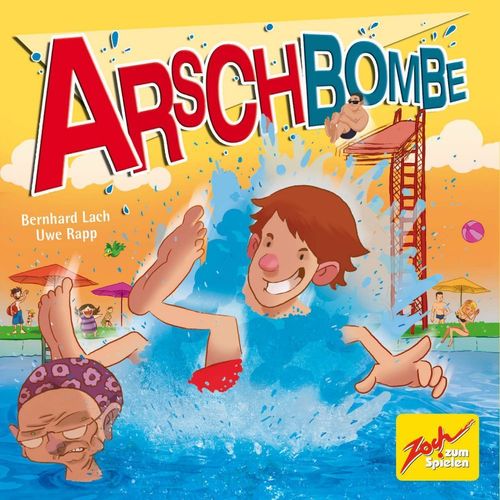
Arschbombe
Arschbombe Rulebook
Table of Contents
Table of Contents
Idea and Object of the Game
Each player lets 6 "swimmers" (playing cards) dive into a "swimming pool" made of cards. Whereas adept springboard divers land in still water far away from the crowd, rascals engage in high-splashing "cannonballs," aiming at the proximity of other swimmers. The player who manages to make the jumps that score the most, wins.
Game Materials and Set-up
Form a "swimming pool" with the pool-edge cards.
Each player receives all 6 jumper cards of one jumper: 3 rascals and 3 springboard divers, which are differentiated by the stance used right before the jump.
Each player places his scoring marker on the deck chair at the edge of the pool.
Throw the initial jumper into the pool so that he does not touch the edge of the pool.
In a two-player game, the edge of the pool consists of 18 edge-pool cards; in the three-player game, it consists of 20, and in the four-player game, all 24 cards are used.
Course of the Game
Players play in turn. The player who has not been in a swimming pool the longest, begins. On your turn, you first choose whether you let one of your rascals or one of your springboard divers "jump into the water." Then you decide whether you want to carry out a normal jump or a special jump, which gives you twice as many victory points as successful normal jumps.
If a rascal jumps, your left neighbor points out a completely uncovered swimmer card lying in the pool. This swimmer, then, is the one who is supposed to be splashed when the rascal lands. And the rascal is successful if he hits the playing card of the selected swimmer (example A, B and C, page 3).
A springboard diver has to land in the pool in such a way that he doesn't touch any other playing card (example D, page 3).
Illustration caption: These are the cards of the red player: 3 springboard divers, 3 rascals.
The Normal Jump
The player stands in an upright position. Then he holds the playing card at eye level over the pool, and lets it fall.
The Special Jump
- A rascal's special jump is a pool-edge splash. The player, while seated, throws the rascal into the pool. In doing so, the player's throwing hand has to stay outside the pool.
- A springboard diver's special jump is a jump from the 10-meter platform: The player stands upright; then he holds the playing card chosen high over the swimming pool so that the card is higher than his head. From there, he lets it fall into the pool.
Illustration caption: special jump: springboard diver.
Victory Points
The player who has executed the jump, moves his scoring marker on the pool edge one card ahead for each victory point earned (plus points clockwise, minus points anti-clockwise).
Successful normal jumps give you the following victory points:
-
For the normal jump of one of your rascals, you get:
- A: 3 points, if the rascal doesn't touch this swimmer but his playing card.
- B: 2 points, if he partly covers this swimmer.
- C: 1 point, if he covers this swimmer completely.
- D: 0 points, if he does not land on the playing card of the chosen swimmer.
-
For the normal jump of a springboard diver, you get:
- points only if this jumper does not touch any other card
- the more points the later you let this jumper jump into the pool:
- 1 victory point, if he is your first jumper,
- 2 victory points, if he is your second jumper ...
- ...
- 6 victory points, if he is your sixth jumper.
Successful special jumps score double.
Ouch, That Hurts ...
A jumper who touches the edge of the pool or lands next to the pool gets no victory points and is immediately removed from the pool (and also may not be thrown in again later). He is penalized:
- one minus point if it was a normal jump;
- two minus points if it was a special jump.
Special Case: Diving Under ...
If a jumper winds up lying (partly) under another card, the player gets no victory points—but minus points if he touches the edge of the pool (from underneath).
End of the Game
The game ends after all jumpers of all players have "jumped." The player who has the most points—that means the one who was able to move his scoring marker the furthest (clockwise) around the edge of the pool—wins the game.