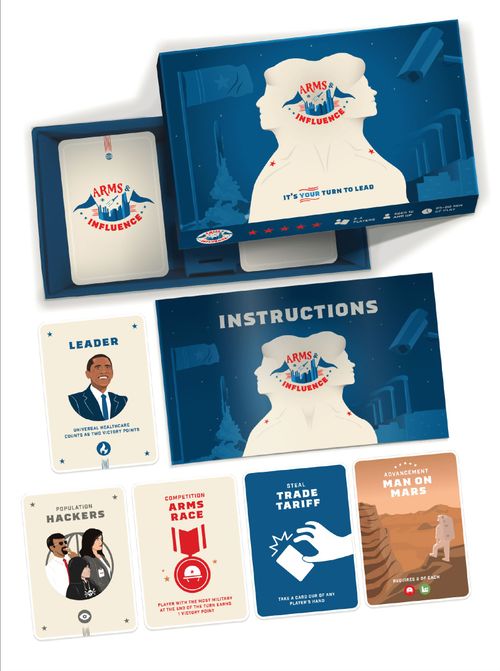
Arms & Influence
Arms & Influence Rulebook
Table of Contents
Table of Contents
Instructions
Setup
If you have the standard edition, remove the 3 modification cards from the 100 card deck to make it 97.
Sort the cards into the 2 following decks:
- The Society Deck: All Leader and Population cards. (For quick reference: Any cards with character art.)
- The Events Deck: All other cards. (Competitions, Actions, Advancements)
Shuffle both decks.
Deal the cards: Each player is dealt 5 cards, 3 cards from the Society deck and 2 cards from the Events deck.
Laying Out the Tabletop
- Place the Society deck and the Events deck in the center of the table.
- Next to the Society and Events decks, leave room for a Discard pile and a Played Action pile.
- In front of each player, leave open space for a player to build their social pyramid using Populations and Leaders.
- To the right of their social pyramid, players will amass the Advancements that they've earned and Competitions that they've won.
- Below is an example of what the game will look like after a few turns.
How to Play a Turn
Begin the game with the player to the left of the dealer and continue clockwise.
- Draw a total of 2 cards from the Society and Events deck. The player can choose to draw either 2 cards from the Society deck, or 2 cards from the Events deck, or 1 card from each.
- During a turn a player must take 2 actions, no more and no less. If no action can be taken, they must discard a card in their hand face up into the Discard pile (1 discard = 1 action).
What Constitutes an Action?
Using any card in your hand constitutes an action:
- Placing a new Population or Leader onto the table in your pyramid.*
- Playing an Action Card to the Played Actions pile.**
- Launching a Competition.***
- Placing an Advancement Card.
- Replacing a Population or Leader that was already established in your social pyramid if your pyramid is full.
* See Electing a Leader below.
** Applicable to Forced Trades, Steals and Skips. Block cards do not count as actions.
*** See Competition in Card Types below.
From the Ground Up: Your pyramid must be built from the ground up. That means 3 Populations at the bottom first, then 2 Populations above. Finally, only when 5 populations are placed may you elect a leader.
Electing a Leader
When you have 5 Populations in your pyramid, you may elect a Leader. You elect a Leader by simply placing it at the top of the pyramid. Doing so provides the following benefits:
- Gain the resource at the bottom of the card.
- Gain the Leader Bonus listed on the card if the conditions are met.
- The immediate opportunity to rearrange the Populations in your pyramid in an attempt to create Factions. (See Factions section) Only upon electing a Leader will you be able to rearrange your pyramid. Rearranging does not cost an action.
Full Pyramid?
Once you have a full pyramid (5 populations and 1 leader), you can replace a Population from your pyramid with one from your hand. When a Population is replaced, the card that is being replaced goes into the discard pile. The next player has the opportunity to take this Population from the discard pile, see below.
Discards
If the previous player discarded any cards, the top card on the discard pile is available to be picked up by the following player. This option is available instead of drawing a card from the Society and Events decks. However, after that turn the card can no longer be picked up, even if the last player chose to leave it. Be careful with what you discard!
Re-Election
So you don't like your leader, eh? Good news! You can replace your leader as one of your actions. In doing so, you are once again able to rearrange your populations. The leader that is replaced goes to the discard pile, where it can be picked up by the following player.
Out of Cards?
When both decks are out of cards, shuffle the Discard pile and the Played Actions pile together. The rest of the game is played drawing from this one deck.
Helpful Tips
- Your first few turns will be very simple as you work to build your social pyramid by placing Population cards.
- It may seem wise to load up on cards from the Society deck early on to build your pyramid, but the Events deck has many powerful cards that you may be leaving to your opponents. Take a balanced approach on your first playthrough. Develop your strategy as you learn more about the mechanics of Arms & Influence.
- Remember that what you discard can help your enemy to your left. Be thoughtful with your discard strategy.
- Remember that when you place a leader, you can rearrange your Population cards. This will allow you to create an Upper Class Faction and a Lower Class Faction, two ways to earn Victory Points.
- You can replace your old Leader during your turn for the opportunity to rearrange your Population Cards or to use a different Leader Bonus.
Resource Types
Each Population and Leader contributes Resources to your Society. There are 4 types of Resources.
- Production: Represented by the Green Smokestack, this resource will help you build your society on a strong economy.
- Equality: Represented by the Blue Flame, this resource will help you earn equitable advancements that benefit all citizens of your society.
- Military Strength: Represented by the Red Helmet, this resource will help you earn advancements that solidify your power through force.
- Espionage: Represented by the Gray Eye, this resource will allow you to control your society through advancements in surveillance and cybersecurity.
How to Win
Objective: The first player to earn 7 Victory Points is the winner.
As the architect of your new society you'll need to construct a social pyramid from the ground up, starting with Population Cards, before establishing your Leader. The resources provided by the pyramid will be used to earn Advancements and win Competitions. Building this social pyramid, earning Advancements, and winning Competitions all provide you with Victory Points.
There are two types of Victory Points, those that are permanent and those that can be lost as your social pyramid changes.
Impermanent Victory Points
These can be lost if your social pyramid changes.
- Complete Social Pyramid: Having a complete pyramid of 5 Populations and 1 Leader awards 1 Victory Point. If the Leader is removed, the Victory Point is no longer valid.
- Create Factions: A Faction is when a row of Populations all share a common resource.
- Lower Class Faction: If the bottom row of Populations all share a common resource, earn 1 Victory Point for creating a Lower Class Faction.
- Upper Class Faction: If the top row of Populations both share a common resource, earn 1 Victory Point for creating an Upper Class Faction.
This Victory Point is lost if the arrangement of the social pyramid changes and uniformity no longer exists.
Permanent Victory Points
These, once earned, cannot be lost.
- Advancements: Successfully placing an Advancement Card earns 1 Victory Point.
- Competitions: Winning a Competition earns 1 Victory Point.
Card Types
Population Cards
Population cards are the building blocks of your society, each contributing the Resource(s) denoted on the card.* Its Resource(s) can be used towards earning Advancement Cards and winning Competitions.
Each Population Card placed on the table to build your pyramid uses one action per turn. Once your Population is placed, its position in the pyramid cannot be changed until a Leader is elected.
* See Hybrid Populations under Additional Information for clarification on populations with 2 resources.
Leader Cards
Leader cards complete the creation of your society. Similar to Populations, its Resource can be used towards earning Advancement Cards and winning Competitions. A Leader card is placed atop your pyramid using one action.
- A Leader Card can only be placed once a player has built the foundation of their pyramid with 5 Populations.
- Upon placing a Leader Card, you can rearrange the Population Cards in your pyramid in order to build 'Class Factions' (see Create Factions section).
- Each pyramid can only have 1 Leader card on top, but you can depose your current leader by placing a new Leader in its place and discarding the defunct leader into the discard pile at the cost of one action per turn.
Advancement Cards
Advancements are the crowning achievement of your society. Using the Resources provided by the Populations and Leader in your pyramid, you can achieve powerful new technologies and policies.
You can place an Advancement Card once you have the required Resources listed on the card in your pyramid. An Advancement Card cannot be placed unless there is a full pyramid intact. Once earned, Advancements and their Victory Points are permanent.
Example: Man On Mars - Requires 2 Military Strength and 2 Production.
Competition Cards
Playing a Competition card sets in motion a competition among all players that lasts one complete turn. Players compete to have the most of the Resource listed on the Competition card in their pyramid.
The turn ends when play comes back around to the player who placed the card. Before they begin their turn, tally the results to determine the winner. The winner of the competition collects the card and gains a Victory Point.
If it is a tie, the competition goes for another full rotation. This continues until the Competition finds a winner. Multiple competitions can be in play at once.
Action Cards
These cards are your tools of international intrigue. Use them during your turn to help you steal, trade, or spy your way to victory. Each Action Card costs one action per turn. Follow the instructions on the card when playing.
Examples of an Action Card are:
- Steals
- Forced Trades
- Skips
Block Cards
Can be used at any time to block Action Cards used by another player. They do not count as an action on your turn and can be played out of turn. A Block Card can also be blocked by another Block Card. They are a powerful tool, so use them sparingly.
Additional Information
Hybrid Populations
Hybrid Populations may be used as either of the Resource types denoted on the card but can not be used as both at once.
For example:
- When using this card towards an Advancement, it can act as 1 of the 2 Resources on the card but not as both.
- When building Factions, it can be used as either of the Resource types on the card.
Modification Cards
The game comes with 3 Modification cards. These cards are not part of the Standard Game Rules. They allow players to make and test changes to the game, or play different game variations.
We encourage modification!
See ArmsAndInfluence.com/modifications for more details.