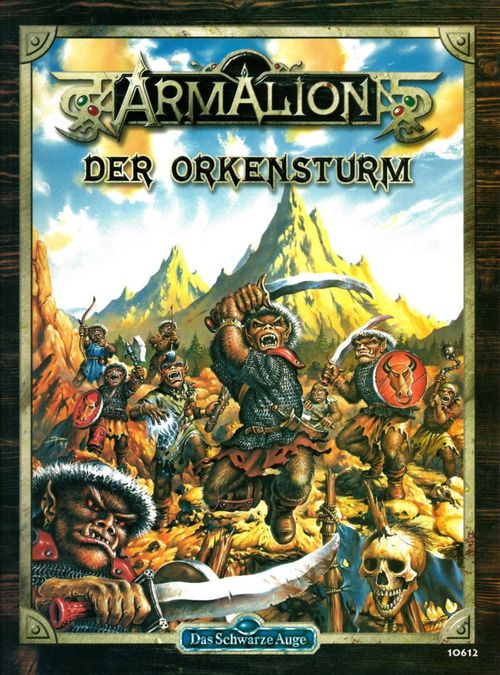
Armalion: Der Orkensturm
Official rulebook: Ulisses Spiele · PDF
Armalion: Der Orkensturm Rulebook
Table of Contents
Table of Contents
Components
- 1 game board. It is used to exercise influence on the characters, to track AP levels and the strength of Brin's troops (Imperial troops) and the troops of the Aikar (orc troops), to manage the Imperial Treasury, and to count down the remaining time until Brin's return. The board also shows the Timeline, the supply deck, the Advisor deck spaces, and the Orc Storm deck space.
- 16 game figures, two for each of the 8 colours.
- 4 counters: 1 red, 1 green, 1 violet and 1 yellow.
- 165 influence cards, divided as follows: 24 influence cards each in blue (Trade), yellow (Wealth), violet (Time) and white (Alliances); 33 red influence cards (Imperial troops); 36 green influence cards (orc troops).
- 8 loyalty cards: 4 for the players on Brin's side and 4 for the players on Answin's side.
- 14 Brin Advisor cards.
- 14 Answin Advisor cards.
- 18 event cards.
- 1 starting player marker.
- 1 display board for the remaining available influence cards (= Reserve) and the event cards.
Goal of the Game
The goal of the game is to accumulate the most Prestige Points (AP) through skilful alliances and by exercising influence over the course of the Orc Storm.
Setup
-
The players choose a starting player from among themselves in any manner they like. The starting player takes the starting player marker for this turn. Each player chooses a colour, places one game figure of the chosen colour on the "0" of the AP track, and places the other figure in front of them on the table.
-
Now assemble the supply deck: shuffle 12 influence cards of each colour and place this deck face down on the designated space of the game board. Sort the remaining influence cards by colour and place them on the display board; this is the Reserve. Each player receives 6 random cards from the supply deck (with 5–8 players, each player receives 7 random cards).
Important note: If at any point during the game the supply deck runs out of cards, take 6 influence cards from the Reserve (one of each colour), shuffle them, and form a new supply deck.
-
Shuffle Brin's Advisor cards and Answin's Advisor cards into two separate decks and place them face down on the designated spaces of the game board.
-
Now take the loyalty cards (with 3–4 players: 2 loyalty cards for Brin and 2 loyalty cards for Answin; with 5–6 players: 3 loyalty cards for Brin and 3 loyalty cards for Answin; with 7–8 players: all loyalty cards). Beginning with the starting player, all players decide clockwise whether they stand on Brin's side or Answin's side, by taking the corresponding loyalty card and placing it face up in front of them.
-
Then each player draws one Advisor card from the deck of their faction, reads it, and places it face down in front of them.
-
Now the Orc Storm deck must be assembled. Take the following cards from the Reserve to form this deck: 1 yellow, 1 violet, 1 blue and 1 white influence card. To these add the following:
- 2 red influence cards for each player who has chosen Answin's side;
- 2 green influence cards for each player who has chosen Brin's side.
Shuffle the Orc Storm deck and place it face down on the designated space of the game board.
-
Place the violet counter on space 12 of the Timeline (the violet spaces on the game board), the red counter on space 10 of the Imperial troops (the red spaces on the game board), the green counter on space 10 of the Orc troops (the green spaces on the game board), and the yellow counter on space 10 of the Imperial Treasury (the yellow spaces on the game board).
Important note: If during the game you need to divide numbers, always round any fraction up.
Optional Rule for Experienced Players: Event Cards
The event cards should be shuffled into one deck and placed face down on the designated space of the display board. We recommend playing this variant if you are experienced players or already know how to play this game.
Historia Aventurica: If you even want to recreate the historical course of the Orc Storm, do not shuffle the cards. Instead, take all the cards numbered with Roman numerals from I to VIII and stack them in order (with number I the top card and number VII the bottom card). Form a stack from the other ten cards without numbering and slide them individually or in pairs between the pre-sorted numbered events of the Orc Storm. Make sure that the card numbered I always lies on top, because the Orc Storm in the Empire begins with the advance of the orcs on Lowangen. The order of the events corresponds to the chronicle of the official Aventurian historiography, loosened up by some random events.
Source note: the printed text says the numbered cards run from I to VIII but then names VII as the bottom card; it is transcribed as printed.
Overview of the Turn
A game of Orc Storm is divided into turns. Each turn consists of several steps:
- Optional: If you are playing with the optional rules for event cards, the event for the current turn is revealed. Otherwise this step is skipped.
-
- The players compete for influence over the characters.
-
- The respective actions of the influenced characters are carried out.
-
- The players contribute to the outcome of the Orc Storm.
-
- The outcome of the Orc Storm (for the current turn) is determined.
- Optional: If you are playing with the optional rules for event cards, the effects of the current event are resolved. Otherwise this step is skipped.
-
- Cards played in the Orc Storm are sorted back into the Reserve.
When all players have had their turn, and the conditions for the end of the game have not yet been met, the starting player marker passes clockwise to the next player. This player is the starting player in the new turn.
The Turn in Detail
Optional: Revealing the Event
The starting player reveals the top card of the event card deck and reads it aloud.
1. Influencing the Characters – Positioning
Beginning with the starting player, each player places the game figure of their colour, clockwise, on an empty character space on the game board. A player cannot influence the same character that they influenced in the previous turn. The player who places their game figure last also draws 1 additional green or red influence card and 1 further card of a colour of their choice from the Reserve. This turn ends as soon as all players have placed their game figure.
2. Influencing the Characters – Resolving Actions
Beginning with the starting player, in clockwise order each player chooses one of the two possible actions of the character they are influencing this turn, and carries it out. Afterwards, each player moves their game figure from the character space to the exit of the character space. Here the figure remains until the next turn. This helps keep track of who influenced which character in the current turn, and who may not influence the same character again in the coming turn.
A precise listing of the actions of the influenceable characters can be found from page 5 onwards.
3. Contributing to the Outcome of the Orc Storm
Beginning with the starting player, in clockwise order each player chooses 2 influence cards from their hand and adds them to the Orc Storm deck. The colour of the influence cards stays secret, but participation is mandatory. If a player does not have enough cards to take part, they lose 1 AP for each card they cannot contribute.
Important note: Negative AP totals (below 0) are possible.
4. Determining the Outcome of the Orc Storm
It is time to find out how Brin of Gareth fares in the battle against the blackfurs!
The starting player shuffles the Orc Storm deck and reveals a number of cards face up on the table equal to twice the number of players (6 cards with 3 players, 8 cards with 4 players, 10 cards with 5 players, and so on, up to a maximum of 16 cards with 8 players).
Compare the number of cards of the Imperial troops (red) with the number of cards of the orc troops (green):
- If after counting there are more green cards than red, the Imperial troops are reduced by the difference, and the indicator on the game board is moved down by the corresponding number. In this case Brin has lost the battle.
- If after counting there are more red cards than green, the orc troops are reduced by the corresponding difference, and the change is shown on the game board. In this case Brin has won the battle.
- If after counting there are equal numbers of red and green cards, the battle ends in a draw and nothing changes for the troops of either army.
The time counter is moved 1 space further towards 0, which stands for Brin's return to Gareth.
Compare the number of cards for Time and Trade (violet and blue):
- If after counting there are more violet cards than blue, the counter on the Timeline is moved up by 1. In this case Brin's return has been delayed.
- If after counting there are more blue cards than violet, the counter on the Timeline is moved down by 1. In this case Brin's return has been hastened.
- If after counting there are equal numbers of violet and blue cards, there is no change and nothing else happens.
Compare the number of cards for Wealth and Alliances (yellow and white):
- If after counting there are more white cards than yellow, the Imperial Treasury is reduced by the corresponding difference, and the change is shown on the game board.
- If after counting there are more yellow cards than white, the Imperial Treasury is increased by the corresponding difference.
- If after counting there are equal numbers of yellow and white cards, there is no change to the counters.
Optional: Effects of the event card. The effect of the event card of this turn (the card drawn before Step 1) is resolved, taking into account the outcome of the Orc Storm (determined in Step 4). The card then goes to the discard pile.
5. Aftermath of the Orc Storm
The cards drawn in Step 4 must be placed back into the Reserve, the starting player marker passes clockwise to the next player, and the turn ends.
Meaning of the Card Colours
- Blue – Trade (Handel).
- Yellow – Wealth (Vermögen).
- Violet – Time (Zeit).
- White – Alliances (Bündnisse).
- Red – Imperial troops (Truppen des Mittelreichs).
- Green – orc troops (Truppen der Orks).
The pairs compared in the outcome step are: red against green (troops); violet against blue (Time and Trade); yellow against white (Wealth and Alliances).
Action Overview
Regent
-
Take 2 white influence cards from the Reserve and draw 1 influence card from the supply deck.
or
-
Place 6 cards of different colours into the Reserve and gain 5 AP. Draw the top 4 influence cards from the supply deck.
Merchant (Kaufherr)
-
Take 2 blue influence cards from the Reserve and draw the top influence card from the supply deck.
or
-
Place 2 blue influence cards and 2 white influence cards into the Reserve. Gain 3 AP and draw 2 random influence cards from the supply deck.
Tax Collector (Steuereintreiberin)
-
Take 2 yellow influence cards from the Reserve and draw the top influence card from the supply deck.
or
-
Announce a tax collection. Beginning with the player to the left of the player who performed the action, each player in clockwise order openly offers none, one, or more yellow influence cards. To do so, the respective player must lay their offered cards face up in front of them. A player must offer at least one yellow influence card in order to be able to receive AP from a tax collection at all.
The evaluation is then carried out:
- The player who offers the most cards receives 3 AP.
- The player who offered the next most cards after this player receives 1 AP.
- The remaining players receive nothing.
In case of a tie, all players with the same number of offered influence cards receive the same amount of AP. All offered cards, including those of the players who received no AP, are discarded and placed into the Reserve.
Magician (Magierin)
-
Draw the top 2 influence cards from the supply deck and take 1 influence card of a colour of your choice from the Reserve.
or
-
Draw 1 Advisor card from the deck of your side (either Brin or Answin) and take 1 influence card of a colour of your choice from the Reserve.
Important note: Advisor cards can only be used once in the game. Once an Advisor card has been revealed, do not return it to the Advisor deck.
Knight (Ritter)
-
Take 2 red influence cards from the Reserve and draw the top influence card from the supply deck.
or
-
Announce a Tjost. Each player secretly offers as many red influence cards as they wish. The cards should not be shown openly, but held in one hand under the table. For the evaluation, the offers are revealed simultaneously:
- The player who offers the most cards receives 3 AP.
- The player who offers the next most cards receives 1 AP.
- If the player who announced the Tjost is not the winner, they receive 1 AP (also in addition, if they end up in second place).
- All other players receive nothing.
In case of a tie, the player who announced the Tjost takes precedence; the next player in clockwise order after them is considered next. All offered cards, including those of the players who received no AP, are discarded and placed into the Reserve.
Inquisitor
-
Take 1 green and 1 violet influence card from the Reserve and then choose a player. The chosen player must show you their hand cards, and you receive AP equal to their green influence cards.
or
-
Place 2 green influence cards into the Reserve. Gain 1 AP and draw the top 3 influence cards from the supply deck.
Spy (Spion)
-
Take 1 violet and 1 green influence card from the Reserve and draw the top influence card from the supply deck.
or
-
Place 2 violet influence cards into the Reserve and then choose a player and a colour. The chosen player must show you their hand cards, and you receive AP equal to the number of their influence cards of the chosen colour. Draw the top influence card from the supply deck.
Aventurian Courier (Aventurischer Bote)
-
Place 1 influence card of your choice into the Reserve and gain 1 AP. Then take 1 white and 1 green influence card from the Reserve.
or
-
Place 1 influence card of your choice into the Reserve and gain 1 AP. Then take 1 red and 1 yellow influence card from the Reserve.
Important note: The Aventurian Courier cannot be influenced in a game with fewer than 6 players.
End of the Game
The game can end at the end of any turn. The game ends as soon as one of the following conditions is met. When evaluating, remember to round any divided AP figures up.
Victory Conditions
A. If the counter for the Imperial troops reaches 0, Brin falls in battle. The players who have taken Answin's side share 8 AP among themselves. If there is only one single player loyal to Answin, they receive 8 AP; if there are 2 players, both receive 4 AP; if there are 3, all receive 3 AP.
B. If the counter for the orc troops reaches 0, Brin is victorious and the Orc Storm comes to a halt. The players who have taken Brin's side share AP among themselves in the amount of the value of the Imperial Treasury.
C. If none of the two conditions above is met, but the counter on the Timeline reaches 0, Brin returns early to Gareth and has enough troops to reconquer his throne. The players who have taken Brin's side share AP among themselves in the amount of half the value of the Imperial Treasury.
D. If none of these three conditions is met, the Imperial Treasury falls to 0. Brin has spent his entire fortune. The battle against the orcs was so costly that he no longer has any chance to reconquer the throne, and he has plunged the Empire into deep crisis. Players who have taken Answin's side share 4 AP among themselves.
Each player also receives AP at the end of the game in the amount that their own Advisor cards bring them. The player with the most AP wins the game. If two or more players are tied for AP, the player(s) who took Answin's side win if condition A or D was met at the end of the turn. Alternatively, the player(s) who took Brin's side win if condition B or C was met at the end of the turn.
Once the game is decided, the starting player may read aloud the matching ending from the Epilog section (omitted here) depending on the outcome of the story.
Important Notes (Overview)
- A player cannot influence the same character that they influenced in the previous turn.
- If at any point during the game the supply deck runs out of cards, take 6 influence cards from the Reserve (one of each colour), shuffle them, and form a new supply deck.
- If you need to divide numbers during the game, always round any fraction up.
- Negative AP totals (below 0) are possible.
- Advisor cards can only be used once in the game. Once an Advisor card has been revealed, do not return it to the Advisor deck.
- The Aventurian Courier cannot be influenced in a game with fewer than 6 players.