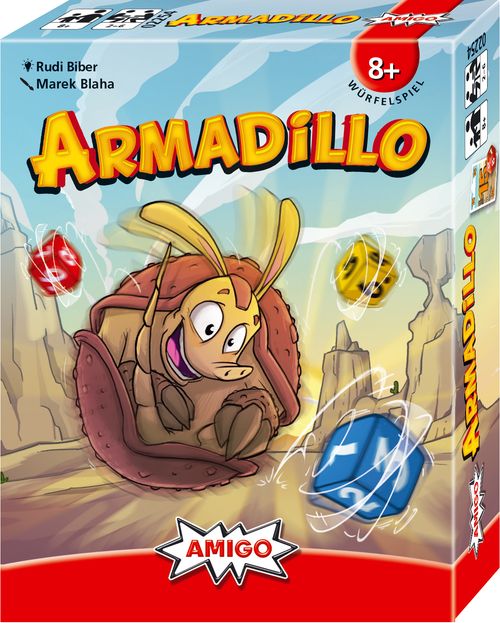
Armadillo
Armadillo Rulebook
Table of Contents
Table of Contents
Components
60 cards (3 each of values 1-20), 36 tokens, 6 dice (2 each showing the numbers 1/2/3, 4/5/6 and 7/8/9).
Setting Up the Game
Shuffle all the cards and deal ten cards to each player. Set aside any remaining cards, you'll need them for the next round. Write down your names on a piece of paper—this is where you'll note your points at the end of each round. Get the dice and tokens ready and leave some space in the middle of the playing area for the discard pile. Grab two tokens each and you're ready to play!
Playing the Game
The player who can count backwards from 10 the fastest goes first and starts off the first of three rounds. On your turn, carry out the following steps:
- Pick your dice and roll them
- Discard a card or take a token
Note that all players carry out the second step, not just you.
1. Pick Your Dice and Roll Them
You are trying to roll a number that matches the value of one of your cards. Look at your cards and try to figure out the best dice to roll so you can get a matching number. You can pick any number of dice of any colors you want to roll. Blue dice show the numbers 1, 2 and 3, yellow dice show the numbers 4, 5 and 6, red dice show the numbers 7, 8 and 9.
Take the dice you have chosen and roll them once. Add up the total of the values and say it out loud. This is the result that everyone has to work with.
Example: Peter picks two yellow dice and one blue die. He rolls them once and announces the result: "Eleven!"
2a. Discard a Card
Next, everyone looks at their cards. If one of your cards shows the same value as the dice roll's total, you may discard it.
Note that it's only the sum of all numbers on the dice that counts. After each roll of the dice, you can only discard one card, even if you have multiple cards showing the same value.
Example: Peter discards a card matching the result of the dice, an 11. He can't discard the other 11 or his 1, 4, or 6, though.
Using Tokens
You can spend up to three tokens you have to change the value of one of your cards so that it matches the result of the dice. For each token you spend, add 1 to the card's value or subtract 1 from it.
If you spend four tokens, you may discard any card.
Example: Although it wasn't Paul's turn to roll the dice, he still gets to discard a card that matches the result of the roll. He doesn't have an 11, but he can spend two of his tokens to discard his 13 (by subtracting 2 from its value) or to discard his 9 instead (by adding 2 to its value).
2b. Take a Token
If you can't discard a card or choose not to, take one token instead. You may have up to five tokens at a time. If you already have five, don't take another token.
Example: Mary doesn't have a matching card, even if she were to spend her two tokens. So, she takes one token from the supply instead.
Once all players have either discarded a card or taken a token, the next player going clockwise picks their dice and starts their turn.
The End of a Round
The round ends when at least one player has discarded all of their cards. Carry out the final turn all the way to the end: Every player still gets to discard a card or take a token. Any cards left in your hand now count as one negative point each. Write down your points for this round but keep your tokens for the next round.
Shuffle all the cards again and deal ten new cards to each player. The player who would have been next in line to roll the dice starts off the next round.
The End of the Game
The game ends after three rounds. The player with the fewest negative points wins. If there is a tie, the one who has more tokens left wins. If there's still a tie, all players involved share the victory.