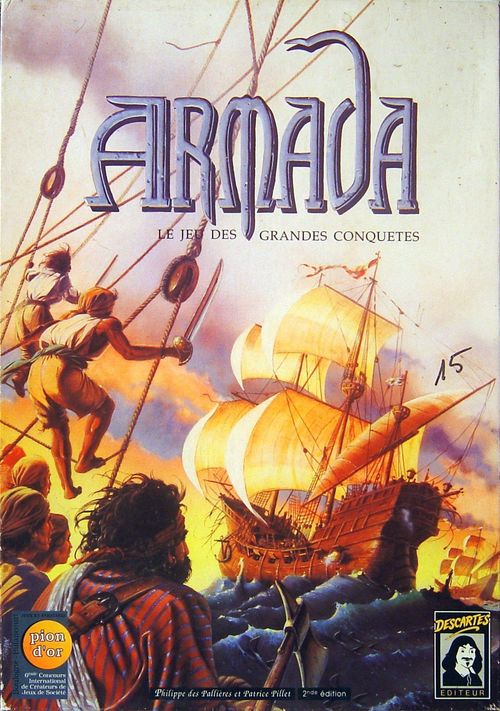
Armada (1986)
Armada (1986) Rulebook
Table of Contents
Table of Contents
Game Components
- 1 game board (see the end of the rules, "Game board")
- 8 metal two-masted ships
- 3 special six-sided dice:
- 1 white die called the combat die (cannon faces)
- 1 yellow die called the gold die (ingot faces)
- 1 brown die called the tribes die (spear faces)
- 50 plastic square pierced tokens in each of 4 colours (raspberry, green, orange, blue). Each represents one pirate band.
- 50 golden-yellow pierced tokens. They represent riches and are called gold.
- 50 brown unpierced tokens. They represent the native tribes.
- 5 sets of 30 round tokens (raspberry, green, orange, blue and brown). These represent flags.
- 55 cards:
- Back of all combat cards (the card backs are identical)
- 5 new attack weapons: "Lors du résultat d'une attaque" (when an attack is resolved), replace the combat die result with 2 cannons that fire (2 defenders eliminated)
- 5 new defence weapons: during a combat, replace the combat die result with two cannons that explode (eliminating pirate bands of the attacker). This card is played during the turn of the attacking opponent.
- 3 shipyard cards: your shipyards have built a new ship which you place on one of your cities. (A ship must have been sunk or scuttled and be available in the game box.)
Object of the Game
The aim of the game is to secure mastery of the archipelago. There are two ways to achieve this:
- Own a lair (control at least 4 of the territories of a lair) and control at least 3 trading posts of the central island (including the central trading post).
- Own a lair (control at least 4 of the territories of a lair) and have at least 4 cities spread across one or more opposing lairs.
To be declared master of the archipelago and winner of the game, a player must have satisfied one of these two victory conditions for 2 turns in a row. During play, when a player satisfies one of these conditions, they announce it and place a victory option card on the game board. At the end of the following turn, if the same pirate bands are still in a victory situation (even if the situation has changed), the player turns the card over, indicating Final Victory. Otherwise, they have failed and remove the card.
Start of the Game
Allocation and Turn Order
Colours are assigned by lot. Throughout the game, players take turns in the same fixed order: first the green pirate bands, then raspberry, then blue, and then orange.
Preliminary Turn
Each player, in turn order, takes 18 pirate bands of their colour along with 2 ships and places them on their lair. Ships must be placed on cities (one ship per city). Pirate bands may be freely distributed among the territories of the lair.
Play
In colour succession order, each player may perform a number of successive actions before passing the turn to the next player.
Action Budget
On their turn, each player has a budget of 10 actions, which they spend as they see fit. They may therefore carry out, in any order they choose, as many actions as their 10-action budget allows. A player is not obliged to spend all their actions, but any unspent actions cannot be carried over to the next turn.
The following each cost one action:
- Launching a ship (putting it into the water).
- Moving a pirate band or a group of pirate bands:
- from a territory to an adjacent territory;
- from a territory to a ship on an adjacent coastal space (loading a ship);
- from a ship on a coastal space to an adjacent territory (unloading a ship);
- from one ship to another ship (transhipment).
- Moving a ship from one sea space to another sea space.
- Exploring a territory (rolling the gold die and the tribes die).
- Combat (rolling the combat die).
- Scuttling a ship.
- Converting one gold (one action per gold).
Action-counter cards are provided to help players count actions: take a token and advance it one space each time an action is spent, so that you always know how many actions remain.
A simple, quick tip: announce each action aloud as you play it. For example: 1 I launch my ship; 2 I load my ship; 3-4 I move it; 5 I explore; 6 I fight; 7 I fight again; 8 I unload; 9 I reload the gold; 10 I move my ship.
Pirate Bands
Pirate bands are used to control and defend territories, to explore the territories of the central island, to fight (on land as well as at sea), and to move gold.
Maximum Number of Pirate Bands
The maximum number of pirate bands of one colour is 50. Pirate bands eliminated during play may be returned to the game by converting gold (see the section on Gold Conversion).
Moving Pirate Bands
Moving a pirate band (or a group of pirate bands placed on the same territory) to an adjacent territory costs one action. The destination territory must be free of enemy pirate bands, or already occupied by pirate bands of the same colour as the bands being moved. When moving, a pirate band may carry with it as much gold as it wishes.
Ships
Ships are the principal strength of the players: they allow distant raids, they allow gold to be transported, and they allow pirate bands to be moved to other fronts.
Launching. Launching a ship means placing it on a coastal space adjacent to the territory containing the city where it was placed during the preliminary turn. Launching costs one action.
Loading. Pirate bands and gold may be loaded onto a ship located on a coastal space, from an adjacent territory space. The tokens representing pirate bands and gold are threaded onto the masts of the ships. A ship can never hold more than 10 tokens (pirate bands or gold). Pirate bands of different colours may not be on the same ship. Loading a ship costs one action.
Movement. To be moved, a ship must carry at least one pirate band (which serves as its crew). Ships move only on sea spaces, and moving from one sea space to another costs one action. A ship may never pass through or stop on a sea space occupied by another ship (friendly or enemy).
Transhipment. This is loading a ship from another ship when both ships are on adjacent sea spaces (transhipment costs one action).
Unloading. Pirate bands and gold on a ship are unloaded to a territory adjacent to the coastal space where the ship is located. Unloading costs one action. In one action, as many gold and pirate bands as desired may be unloaded from the ship.
Exploration and Annexation of a Territory
Exploring the Central Island
If gold can be found on the central island and its two neighbouring islands, players will also encounter native tribes that must be defeated to seize their riches. Gold and native tribes exist in varying quantities depending on the territory, and this can only be determined by exploration.
Conditions for Exploration
To explore a territory of the central island or one of the two neighbouring islands, a player must have at least one pirate band:
- On a ship located on a sea space adjacent to the territory to be explored (which can only be a coastal territory or one of the 2 neighbouring islands of the central island).
- In a territory of the central island that has already been explored and is occupied, adjacent to the territory to be explored. This exploration does not require the exploring pirate band to move. Moving is only necessary if the player wants to invade the explored territory. Once explored, a territory remains explored until the end of the game.
Discovery of Gold and Natives
To explore a territory is to determine the number of gold and native tribes it contains. The player to whom the exploring pirate band(s) belong rolls the gold die (yellow) and the tribes die (brown) simultaneously. This action costs only one action. The number of ingots obtained with the gold die and of spears obtained with the tribes die indicates how many gold tokens (pierced yellow squares) and native tribe tokens (brown square tokens) must be placed on the territory. Each die has one blank face, indicating that no gold or no tribe is present in the explored territory.
Note: The Central Trading Post is difficult to access but has particular strategic importance. There are twice as many gold and native tribes there as in the other territories: the number of gold and native tribes discovered there is multiplied by 2.
At the same time as the gold and native tribes are placed, a brown flag is placed on the explored territory, indicating that the territory is the property of the native tribes and that it has been explored (this is especially important if there is neither gold nor tribe in the territory, to avoid a second exploration). Native tribes never attack. They only defend themselves if attacked.
Invasion and Occupation of a Territory
Invasion is carried out by moving one or more pirate bands into the territory. It costs one action. Only a territory free of native tribes and enemy pirate bands may be invaded. To eliminate any occupants of the territory, a combat must be fought. When a territory is invaded, the invader places a flag of their colour in place of the flag of the previous occupant or owner. This allows them to show their possession of the territory. This flag stays in place even if the occupying forces later leave the territory. It is removed only if it is replaced by the flag of another invader.
Note: a territory of the central island cannot be invaded until it has first been explored.
Note: at the start of the game, each player owns all the territories of their starting lair. This is shown by the coloured circles printed on the territories, which means players do not need to place flags there.
Combat
To attack enemy pirate bands or native tribes, a player must be able to commit at least 2 pirate bands to each combat round. These pirate bands must be located on the same territory, or on the same ship, adjacent to the territory or ship being attacked.
Conduct of Combat
Combat may continue, at the initiative of the attacker, as long as they have at least 2 pirate bands available to attack and actions to pay for their attacks. For each of their attacks, the attacking player rolls the combat die. This costs one action.
- The number of cannons obtained with this die indicates the number of defenders eliminated. The corresponding tokens are removed from the game.
- The number of crossed-out cannons indicates the number of attackers eliminated. The corresponding tokens are removed from the game.
Victory is achieved only when all the defenders have been eliminated by the attacks.
Victory over the Forces Occupying a Territory or a Ship
Gold that was in the attacked territory or on the attacked ship remains in place at the end of the combat. It becomes the property of the pirate bands that invade that territory or ship. Invading a territory or ship whose defenders have been eliminated is equivalent to a movement of pirate bands. This costs one action.
If a ship (which has not been launched) is located in the invaded territory, it becomes the property of the attacker. It may also be destroyed (this costs one action).
Note: it is possible to scuttle a ship (empty of pirate bands) if the player has at least one pirate band on a space adjacent to that ship. This counts as one action.
Gold Conversion
Gold is discovered on the central island and its two neighbouring islands. It may be converted into pirate bands.
Conditions of Conversion
Gold may only be converted in cities or trading posts. It must therefore be deposited there beforehand. To have the right to convert gold in a city, a player must own at least 2 of the cities of the lair where they are located. A player may only convert gold on the central island if they own at least 3 trading posts of that island. Only pirate bands can move gold, by moving themselves.
A pirate band may move with an unlimited quantity of gold, and carrying that gold does not, in itself, cost any action.
Placement of Pirate Bands
Converting one gold costs one action and may be done at any time during the turn. One gold may be converted into 4 pirate bands, which are placed on the city (or trading post) where the gold was converted.
Optional Rules
Recruitment
This rule may be adopted by agreement between the players. It offers a possibility whose tactical consequences are not negligible. When a player controls a certain number of territories, they may recruit pirate bands there. This is called recruitment (enrôlement). Only one recruitment is possible per turn.
When recruiting, a player receives:
- 1 pirate band per lair they control, that is, where they own at least 4 territories. The pirate band gained is placed on the lair where it was raised, in one of the territories owned by the player.
- 1 pirate band per set of 4 territories owned on the central island (with its neighbouring islands). The pirate bands gained are placed in one or more of the territories owned by the player, on the central island or on the neighbouring islands.
Recruitment costs, overall, only one action, regardless of the number of pirate bands raised and of where they were raised.
Example: The green player owns:
- 5 of the territories of their starting lair
- 2 territories of the blue lair
- 9 territories on the central island
They receive 3 pirate bands per recruitment: 1 to place in a territory of their lair, none on the blue lair, and two pirate bands to place on one or more territories they own on the central island. The recruitment of these 3 pirate bands costs them, in total, only one action.
3rd-Edition Variant
The game is supplied with cards whose use is optional. They are intended to add spice to games. At the start of the game, 2 cards drawn at random are dealt face down to each player. The remaining cards are placed in a pile beside the game board. To obtain new cards, at any time during the game, players may buy them at the price of 2 gold and at a cost of 2 actions per card.
Purchased cards are taken from the top of the pile. Players may play these cards during their turn (unless the card states otherwise). Playing a card does not cost an action (unless the card states otherwise).
Note: if during a surprise attack (coup de main) you place a victory option, and you are again in a victory situation on your own turn, you have won the game.
Two-Player Rule
Two-player games are faster and sharper. The slightest lapse is immediately exploited by the one and only opponent.
Starting Position
One of the players takes command of the green and blue pirate bands, the other of the raspberry and orange pirate bands. For each colour, the players take 18 pirate bands and 2 ships.
Object of the Game
For a player to be victorious, the pirate bands of one of their colours must, for 2 turns in a row, be in a victory condition (even a different one). The victory conditions are identical to those of the four-player rule.
Three-Player Rule
The colour that is not assigned to any player is drawn by lot.
Starting Position
On the empty lair corresponding to the unassigned colour, the following are placed:
- 3 pirate bands of the lair's colour on each of the cities.
- 1 pirate band on each of the other territories of that lair.
These pirate bands behave like native tribes and only defend the territories they occupy.
Each player receives 15 pirate bands and 2 ships. The player whose lair is furthest from the unassigned lair receives 5 additional pirate bands.
Object of the Game
The victory conditions are identical to those of the four-player rule.
Game Board
(Actual size 56 x 56 cm.)
The board shows:
- The central island of the archipelago and its two neighbouring islands. It is made up of 24 territories (including the two neighbouring islands), of which 5 contain a trading post: the central trading post and the 4 other trading posts, North, South, East and West.
- 4 pirate lairs, in the corners of the board. Each is divided into 7 territories spread over 3 islands. The coloured circles printed on them indicate that, at the start of the game, they belong to the pirate bands of the corresponding colour (so there is no need to place a flag there at the start of the game). 3 of these territories contain a city (represented by a group of buildings surrounded by a coloured circle, which plays the same role as the coloured circles).
- An ocean: it is divided into sea spaces. Those adjoining land are called coastal spaces; the others are called open-sea spaces.
Card Notes
The card texts below are reproduced from the card descriptions on the rules sheet.
- Coup de main! (Surprise Attack), 4 cards. This card must be played during the turn of another player. You interrupt their turn and play three actions in a row, before they resume their turn. You may play other special cards during the surprise attack.
- Découverte spéciale (Special Discovery), 2 cards. Before rolling the exploration dice (the gold die and the tribes die), you may decide to multiply their results by 2 (by 4 for the territory containing the central trading post).
- Recrutement de pirates (Pirate Recruitment), 1 card. Roll the tribes die once and place the corresponding number of pirate bands of your colour on one of your territories.
- Gros recrutement de pirates (Large Pirate Recruitment), 1 card. Roll the tribes die twice and, after each roll, add the corresponding number of pirate bands of your colour to two of your territories.
- Mobilisation indigène (Native Mobilisation), 1 card. Roll the tribes die once and place the corresponding number of native tribe tokens on one territory of the central island (or on one of the two neighbouring islands) that has already been explored and is unoccupied.
- Grand mobilisation indigène (Large Native Mobilisation), 1 card. Roll the tribes die twice and place the corresponding number of native tribe tokens on two territories of the central island (or of one of the two neighbouring islands) that have already been explored and are unoccupied.
- Grand stratège (Grand Strategist), 8 cards. At any moment during your turn, you may secretly look at the cards on top of the card reserve one by one until you find the one that suits you. You spend 1 action per card looked at. You do not have to pay 2 gold for the card you take, nor 2 actions. Reshuffle the reserve after putting back the cards you have looked at.
- Mine d'or (Gold Mine), 8 cards. Explore a new mine and find 3 additional gold, which you place in one of your territories.
Notes on the Source Sheet
This English text is a translation of the French rules sheet "Armada : règles". The following points are disclosed:
- The French sheet's typographical errors were read as the intended words and translated accordingly: "Dpoé" (Three Extra Actions card) as "Dopé"; "Cettes carte" as "Cette carte"; "évidement" as "evidently"; "Vous explorer" (Gold Mine card) as "explorez" (you explore); "peur" as "peut"; "Il deviennent" as "They become"; "Un bande" as "A band"; and the heading "LA CONVERTION DE L'OR" as "Gold Conversion".
- The sheet is titled "Armada" and refers to the "Variante de la 3ème édition" (3rd-edition variant), so the rules describe the third edition of the game. The sheet itself does not print a publication year and no publisher credit line appears in the text.
- The sheet does not print the card-by-card illustrations or the board artwork; only the text is transcribed.