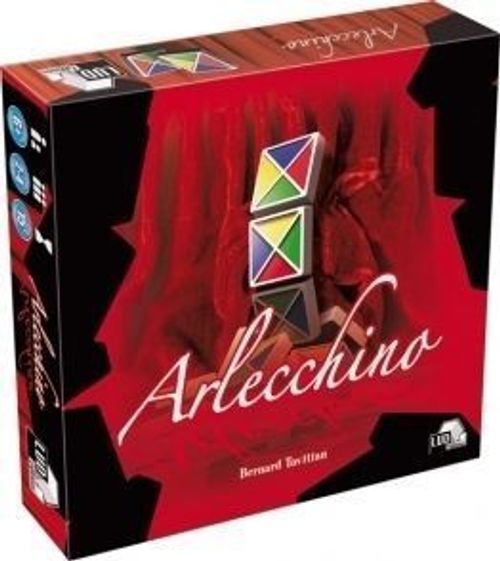
Arlecchino
Arlecchino Rulebook
Table of Contents
Table of Contents
1. Components
- 36 pieces divided into 4 colour zones;
- 1 board of 36 squares;
- 1 rules sheet.
2. Object of the Game
Each player has one colour. The goal is to keep as many zones of your colour as possible on the pieces remaining in play at the end of the game.
3. Setup
The 36 pieces are placed at random on the board, so each game is different from the others.
The black-and-white piece is then removed, creating a first "hole" on the board (Fig. 1).
4. Rules
Each player moves, in turn, one piece that shows at least one zone of their colour. (The turn order is determined by lot!)
Moving a piece consists of one or more movements.
If the piece being played shows several zones of the colour of the player moving it, that player may chain several movements. The maximum number of movements is the number of zones of the player's colour. For example, the player with "blue" can chain up to three movements with the blue-blue-blue-yellow piece.
Movements consist of:
- Moving one square horizontally or vertically (not diagonally) onto an adjacent free square;
- Jumping over an adjacent piece, horizontally or vertically but not diagonally, provided that the landing square beyond the jumped piece is free.
Any jumped piece is eliminated: it is removed from the board.
Movements may be chained in any order.
- In the example of Fig. 2, the blue-blue-blue-yellow piece makes a first jump, then a one-square move, then a second jump (3 movements in total). Both jumped pieces are eliminated.
- In the example of Fig. 3, the piece with four green zones makes a move, then a jump, then another move (by which it returns to the square of the piece it has just jumped). It may stop after 3 movements.
During his turn, every player must make at least one jump, that is, eliminate at least one piece. If a player cannot play in a way that eliminates a piece, he must pass his turn: it is forbidden to play by making only moves without a jump.
However, it is forbidden to pass your turn if you have a possibility of playing. This rule forces the opponent to capture a piece on which the opponent's own colour is in the majority, by taking away any possibility of making a jump elsewhere.
A piece may not be played in such a way that it ends its move on the square from which it started.
- For example, in Fig. 4, the red-red-red-blue piece, which has made a jump (movement 1) and then a one-square move (movement 2), may make a third movement by moving one square to the right (blue arrow), but not by returning to its starting square (pink arrow, movement forbidden).
The only exception to this rule concerns pieces that show four zones of the same colour, provided they make four jumps (Fig. 5).
5. End of the Game
When the pieces remaining on the board are too far apart for any jump to be possible for any player, the game ends.
Each player counts the number of zones of their colour that appear on the pieces remaining on the board, and the player who counts the most wins the game.
- For example, in Fig. 6, no jump is possible any more.
- The game ends with a win for the red player (9 zones, against 6 for blue, 3 for yellow and 2 for green).
6. Two Players or Two Teams
The first player or team takes the blue and red colours, the second takes the yellow and green colours, and play always proceeds in this order: blue, yellow, red, green.
The other rules are unchanged.
At the end of the game, the zones of blue and red are added together on one side, and yellow and green on the other, and the player or team with the highest total wins the game.
- Variant: at the end of the game, subtract the total of red zones from the total of blue zones to obtain the score of the first player or team, and subtract the total of green zones from the total of yellow zones to obtain the score of the second player or team.
7. Three Players
One of the colours, for example green, is "neutral", meaning it belongs to no particular player. The other rules are unchanged.
At the start of the game, besides the black-and-white piece, remove from the board the piece that shows four green zones: the game therefore starts with two "holes" on the board.