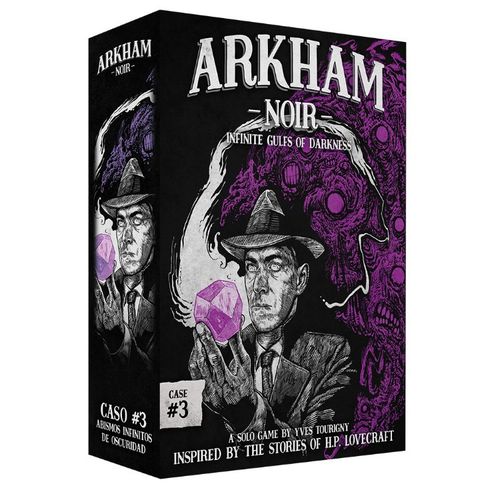
Arkham Noir: Case #3 – Infinite Gulfs of Darkness
Arkham Noir: Case #3 – Infinite Gulfs of Darkness Rulebook
Table of Contents
Table of Contents
- Objective
- Components
- Clue Cards
- Setup
- Game Play
- 1. Action Phase
- 2. Maintenance Phase
- Game End
- Game Settings
- Card Effects Reference
- Case Card Icons
- Menace Card Effects
- Acknowledgements
Objective
This third installment of Arkham Noir includes 2 game modes. The Classic Mode where the goal is to collect 5 different types of clues with the Puzzle Attribute before time runs out or you lose your sanity. And the Hardboiled Mode that consists of completing all the Objective Cards before running out of time or sanity.
Components
- 45 Clue Cards
- 8 Case Cards (including 4 Clue Cards)
- 1 Case Card Cover Card
- 7 Case Cards
- 5 Objective Cards
- 5 Reference Cards (including Briefcase)
- 6 Menace Cards (including 1 Clue Card)
- 1 Professional Contact Card
- 2 Equipment Cards from Case #1 and Case #2: Necronomicon and Third Aklo Ritual
- 5 Player Aid Cards
Clue Cards
Each Clue card shows its clue type(s) and attributes at the top, an investigative technique icon on the left edge and right edge, and its card effects at the bottom. Card effects shown in brown are voluntary; effects shown in black are mandatory.
Clue Types
- Person of Interest
- Threat
- Artifact
- Evidence
- Location
- Monster
- Formula
Investigative Techniques
- Collection
- Surveillance
- Interview
- Research
Attributes
- Puzzle
- Key
- Lock
- Card Minimum
- Skeleton Key
- Skeleton Lock
- Darkness
- Equipment
- Ally
Setup
A. Place the 5 Reference Cards as indicated in the Setup Diagram. Choose the level of difficulty (Reference Card 4) and the Game Mode (Reference Card 3) by placing these Reference Cards face up on the corresponding side (see GAME SETTINGS). You can use the Professional Contact Card included in this game and one Equipment Card: Necronomicon or Third Aklo Ritual. If so, place them in the Briefcase Area under Reference Card 5.
B. Place the Case Cards to the right of Reference Card 1 without looking at them. The Case Cards are all those that contain the Case Card icon in the top right corner on one of their sides. Place the Cover Card on top of the deck. Find Case Cards 1A and 2, and place them in the Open Cases Area under Reference Card 2. If you are using an Equipment Card (Necronomicon or Third Aklo Ritual), place Case Card 1 on side 1A, if not, place it on side 1B.
C. Separate the Menace Cards into 2 decks, the standard Menace deck and the Aurora Borealis deck, shuffle each deck separately, place the standard Menace deck next to the Case Deck, then place the Aurora Borealis deck on top of the standard Menace deck.
D. Shuffle the Clue Cards. Place them in a face-down stack to the left of Reference Card 1. This is the Draw Stack. Some Clue Cards are in the Menace Deck and in the Case Deck; these remain in their respective decks until they are called into play.
E. Draw 5 Clue Cards and place them face up, from right to left, in the five spaces to the left of the Draw Stack. This forms the Leads Row. The first card on the left of the Leads Row will now be referred to as the First Lead Card.
F. Draw 3 Clue Cards and hold them face up. This is your hand.
G. If you are playing Hardboiled Mode (Reference Card on side 3A) take the Objective Cards and display them to the left of (but not in) the Big Picture Area, so that the requirements for each Objective is visible. If you are playing Classic Mode (Reference Card on side 3B) remove the Objective Cards from the game.
Game Play
The game is played over a series of turns until one of the three Game-Ending Conditions is met (see GAME END).
One turn consists of 2 phases:
- ACTION PHASE: You must take the First Lead Card and perform one of the five actions, which are described in detail in the following section.
- MAINTENANCE PHASE: Perform all four end-of-turn Maintenance Actions and check the three Game-Ending Conditions.
1. Action Phase
a. Take the First Lead Card in Hand
Take the First Lead Card and add it to your hand. Your hand size is limited to 3 cards. If you ever have more than 3 cards in hand, you must immediately discard until you have only 3 cards left.
Discarding Clue Cards / Time Penalty
Whenever you discard a Clue card for any reason, put it in the Time Penalty Area if it has the Time Penalty icon. Otherwise, put it in the Discard Area. Cards with the "cannot discard" icon can not be discarded: you must choose another card when required to discard (if you can). If you have no choice but to discard a card with the "cannot discard" icon, put it in the Discard Area.
b. Play the First Lead Card to an Open Case
Take the First Lead Card, play it to an open case and resolve the card effects printed at the bottom of the card, in order from left to right (see CARD EFFECTS). Each open case starts with a Case Card and forms its own line of investigation, with Clue Cards added to the right of previously-played cards.
You can play a Clue Card to an open case if the Investigative Icon on the left edge of the card matches one of those on the right edge of the last card in the line of investigation. The Clue Cards with the ANY icon can be played in any open case and can be combined with any other Investigative Icon.
Locks, Keys and Other Requirements
Some Clue Cards have a Lock, Card Minimum, or Skeleton Lock Attribute on their top left edge. There are also Clue Cards with purple Investigative Icons. In order to play these cards, the open case must meet the additional requirements described:
- To play a Clue Card with the Lock Attribute to an open case, there must be a Clue Card with the Key Attribute already in that line of investigation. Each Key card allows you to play one Lock card. The cards do not have to be played consecutively.
- To play a Clue Card with the Card Minimum Attribute to an open case, there must be at least that many Clue Cards already in that line of investigation.
- To play a Clue Card with the Skeleton Lock Attribute to an open case there must be a Clue Card with the Skeleton Key Attribute already in that line of investigation. Alternatively, you can use the Key Attribute as a common key to play a card with the Lock Attribute.
- To play Clue Cards with purple Investigative Icons, you must have the Tillinghast's Machine Card in play.
Mental Strain Rule
Long investigations are draining. Each card played to an open case after the seventh (which lines up with Reference Card 1) requires a Stability Check before you resolve that card's printed effect(s).
Stability Check
To perform a Stability Check, draw the top card of the Draw Stack. If the card has the Stability Penalty icon, place it in your Stability Penalty Area. Otherwise, discard the card (see DISCARDING CLUE CARDS).
Briefcase Area
The Tillinghast's Machine and the Elder Sign Cards (from this Case File) show the Equipment Attribute and can be added to your Briefcase Area, at any time, from your hand. Conversely, if those cards are in your Briefcase Area they can be returned to your hand at any time. Those cards do not count against your hand limit while in your Briefcase Area. There is no limit to the Equipment Cards that can be in your Briefcase Area.
The Professional Contact Card and the Equipment Cards (Necronomicon or Third Aklo Ritual) chosen during SETUP start in your Briefcase Area and can never go into your hand, or be played to an open case by any means.
Cards in your Briefcase Area can be used at any time for their Equipment or Ally Effect(s), shown under the Attribute on the card (you can use the effect listed on either side of your Professional Contact). When used for these effects, the card is removed from the game and returned to the box. See CARD EFFECTS for a description of the effects.
Tillinghast's Machine Card
Once the Tillinghast's Machine Card is in play, you can use the purple icons that appear on some cards. These purple icons can only be used while the Tillinghast's Machine Card is in play (e.g. in your hand, in your Briefcase Area or in an open case). If the Tillinghast's Machine Card is removed from the game, or enters your Closed Cases Area, you can not use the purple icons.
c. Discard the First Lead Card and Play a Card from Your Hand to an Open Case
Discard the First Lead Card (see DISCARDING CLUE CARDS) and play a Clue Card from your hand to an open case, using the same rules described previously.
d. Discard the First Lead Card and Close an Open Case
Discard the First Lead Card (see DISCARDING CLUE CARDS) and close one of your open cases. An open case can be closed if its line of investigation consists of at least five different types of Clue Cards.
You can score any Clue Card(s) with the Puzzle Attribute in that case if, when they are removed, there are still at least 5 different types of Clue Cards remaining in the case.
Place the scored Clue Card(s) in the Big Picture Area, and all other cards from the closed case in your Closed Cases Area (above Reference Card 3).
Follow the effects of the Case Card Icons for the Case Card you closed, then place it in your Closed Cases Area (unless otherwise instructed). See CASE CARD ICONS for a description of the effects.
In this example, the player decides to close the case as it now contains 5 different types of clues. They only score the Clue (with the Puzzle Attribute) that they place in the Big Picture Area. They cannot score any more clues with the Puzzle Attribute because if they did so, they would be left with fewer than 5 different types of Clue Cards in the case. They place the other Clue Cards in the Closed Cases Area and follow the effects of the Icons for the Case Card that has just been closed.
Closing an Open Case with a Card Effect
One Card Effect allows you to close an open case when played to the correct case, even if it has less than five different types of Clue Cards:
- Close Case #5, if played to Open Case #5
- Close Case #6, if played to Open Case #6
The steps for closing a case using that Card Effect are different from those above:
- Place all Puzzle Clue Cards in your Big Picture Area.
- Place all other Clue Cards in your Closed Cases Area.
- Follow the effects of the Case Card Icons for the Case Card you closed, then place it in your Closed Cases Area (unless otherwise instructed).
e. Discard the First Lead Card and Pass
Discard the First Lead Card (see DISCARDING CLUE CARDS) and proceed to the MAINTENANCE PHASE immediately.
2. Maintenance Phase
Before starting your next turn, you must perform each of these steps in the following order:
a. Check Victory Condition
Classic Mode: If you have five or more Puzzle Clue Cards of different types in your Big Picture Area, the game ends (see GAME END). Otherwise, continue playing.
Hardboiled Mode: If all the Puzzle Clue Cards required for an Objective Card are in your Big Picture Area, add that Objective Card to your Big Picture Area. If all Objective Cards are in your Big Picture Area, the game ends (see GAME END). Otherwise, continue playing.
Objective Cards, Puzzle Letters
The Objective Cards represent natural conclusions to the case. Each Objective Card is identified by an Objective Number in the top left of the card. The requirements to score the Objective are identified by Puzzle Icons and Letters. Each one refers to the particular Puzzle Clue Card which bears that Letter. When all the required Puzzle Clue Cards for an Objective are in your Big Picture Area, add that Objective Card (without turning it over) to your Big Picture Area at the start of the MAINTENANCE PHASE.
At the bottom of the Objective Card, you can see the path to find each specific Puzzle Clue Card. This is provided as a Cheat Sheet, in case the difficulty is too great for the player.
The Puzzle and Case Card icons in purple indicate that you need to have the Tillinghast's Machine Card in play to access those cards.
b. Check Stability Penalty Area
If the number of cards in your Stability Penalty Area is equal to or greater than 5, the game ends (see GAME END).
c. Check Time Penalty Area
If the number of cards in your Time Penalty Area is equal to or greater than 5, you must:
- Turn over a new Menace Card and play it. If you have to turn over a new Menace Card and there are no cards left, the game ends (see GAME END).
- Take all the cards in the Time Penalty Area and place them in the Discard Area.
Menace Cards
These enter play in one of three ways:
- When the Time Penalty Limit is reached;
- When the Draw Stack is exhausted;
- When a Card Effect instructs you to put one into play.
When a Menace Card enters play, it is placed in the Active Menace Card Area (next to the Menace Deck). Menace Cards are cards which can have immediate and/or ongoing effects. The ongoing effects remain active as long as the card is in play. New Menace Cards do not replace any Menace Card already in play. Multiple Menace Cards can be active simultaneously. See MENACE CARD EFFECTS for a description of the effects.
d. Refill Leads Row
Move all the Clue Cards in the Leads Row to the left, closing any gaps. Draw cards from the Draw Stack to fill the empty spaces in the Leads Row, from left to right.
Running Out of Leads
At any point during the game, if you have to draw a card from the Draw Stack but find it empty, you must:
- Turn Over a new Menace Card and play it. If you have to turn over a new Menace Card and there are no cards left, the game ends (see GAME END).
- Shuffle the cards in the Discard Area (if any) and form a new Draw Stack with them.
- Draw the card(s) needed (if any) to continue the game.
Game End
Classic Mode: The game ends immediately if one of the following occurs:
- There are 5 or more Puzzle Clue Cards of different types in the Big Picture Area during the MAINTENANCE PHASE. You win!
- The number of Clue Cards in the Stability Penalty Area equals or exceeds your limit during the MAINTENANCE PHASE. You lose!
- You must draw a Menace Card but the Menace Deck is exhausted. This can happen during ANY PHASE. You lose!
Hardboiled Mode: The game ends immediately if one of the following occurs:
- All Objective Cards are in your Big Picture Area during the MAINTENANCE PHASE. You win!
- The number of Clue Cards in the Stability Penalty Area equals or exceeds your limit during the MAINTENANCE PHASE. You lose!
- You must draw a Menace Card but the Menace Deck is exhausted. This can happen during ANY PHASE. You lose!
You may now turn over all Objective Cards in your Big Picture Area and read their text, whether you have lost or won. A complete victory requires you to score all Objective Cards. Any other result is a defeat.
Game Settings
These are settings that you can change to adjust the difficulty level of the game. Each of the settings can be changed independently of the others. The rules assume the default setting for each of these options. Adjust the rules to reflect the new settings when playing.
Option 1: Game Mode Adjust by using the reverse of Reference Card 3 during SETUP (Step A).
- SIDE 3A, Hardboiled Mode. Score all Objective Cards (#1, #2, #3, #4, #5). (Default)
- SIDE 3B, Classic Mode. Score 5 different Puzzle Clue Card types. (Easy)
Option 2: Stability and Time Limits Adjust by using the reverse of Reference Card 4 during SETUP (Step A).
- SIDE 4A, LIMITS of 5. (Default)
- SIDE 4B, LIMITS of 6. (Easy)
Option 3: Menace Cards Adjust during SETUP (Step C).
- Use all Menace Cards. (Default)
- Randomly remove one Menace Card. (Difficult)
- Remove Aurora Borealis. (Most difficult)
Option 4: Outside Help Adjust during SETUP (Step A).
- Use one Professional Contact and one Equipment Card. (Default)
- Use one Professional Contact or one Equipment Card. (Difficult)
- Use no Professional Contact and no Equipment Card. (Most difficult)
Card Effects Reference
Black effects are mandatory and brown effects are voluntary.
| Effect icon | Description | Type |
|---|---|---|
| hand taking a card from the Leads Row | Take 1 card from the Leads Row. | Voluntary |
| hand taking a card from the Discard Area | Take 1 card from the Discard Area. | Voluntary |
| hand taking a card from the Closed Cases Area | Take 1 card from the Closed Cases Area. | Voluntary |
| hand taking a card from the Stability Penalty Area | Take 1 card from the Stability Penalty Area. | Voluntary |
| hand taking a card from the Time Penalty Area | Take 1 card from the Time Penalty Area. | Voluntary |
| eye over cards, searching the Draw Stack | Search the Draw Stack for 1 card, then reshuffle. | Voluntary |
| discards shuffling into the Draw Stack | Shuffle the Discard Deck into the Draw Stack. | Voluntary |
Case Card Icons
Case Cards come in three anatomies: Victim, Missing Person, and Missing Object, each showing a Case Card number, an Icon Area, and a set of Investigative Icons matching the last-played Clue Card requirements.
Black icons are mandatory and brown icons are voluntary.
| Icon | Description |
|---|---|
| folder with a down arrow | When you close this case, apply the icons underneath in order from top to bottom. |
| curved arrow | Flip this card. |
| hand adding a card | Add this card to your hand. |
| floppy disk marked with a number | Access the Case Card with the indicated number and put it into play in the Open Cases Area (always on the side that shows the Case Card icon in the top right corner). |
| circle with a slash, over a crossed-out card | This card can not be discarded. It counts against your hand limit. In the event that the number of cards in hand exceeds your limit, discard cards without this icon (if you can). If you have no choice but to discard a card with this icon, put it in the Discard Area. |
| detective figure with an exclamation mark (brown) | Take 1 card from the Stability Penalty Area. |
Haunter of the Dark
This Case Card has purple icons in its Icon Area but also mandatory effects printed at the bottom of the card. As soon as you access this Case Card, you must check first if the Tillinghast's Machine Card is in play or not:
- If the Tillinghast's Machine Card is not in play, place the Haunter Of The Dark Card in the Active Menace Card Area (next to the Menace Deck): the mandatory effects printed at the bottom of the Haunter Of The Dark Card take place (see MENACE CARD EFFECTS).
- If the Tillinghast's Machine Card is put into play later, apply the effects of the purple icons immediately.
- If the Tillinghast's Machine Card is already in play, apply the effects of the purple icons immediately, which means that the effects printed at the bottom of the Haunter Of The Dark Card do not take place.
Menace Card Effects
All effects are mandatory and are divided between immediate and ongoing effects.
Immediate Effects
| Icon | Description |
|---|---|
| floppy disk marked 3 | Access Case Card #3 and put it into play in the Open Cases Area. |
| crossed-out Menace creature marked I | Remove all Aurora Borealis Menace Cards from the game (those in the deck and those in play). |
| hourglass leading to a crossed-out card leading to a discard pile | Take all cards in the Time Penalty Area, Discard Area and Draw Stack, and shuffle them to form a new Draw Stack. |
Ongoing Effects
| Icon | Description |
|---|---|
| Menace creature : hourglass with a plus | Clue Cards with the Darkness Attribute gain the Time Penalty Icon. |
| Menace creature : cards with an X | Clue Cards with the Darkness Attribute gain this Card Effect (see CARD EFFECTS). |
| Menace creature : detective figure | Clue Cards with the Darkness Attribute gain this Card Effect (see CARD EFFECTS). |
| hand with +1 | Hand Limit is increased by 1. |
| hourglass with -1 | Time Penalty Limit is decreased by 1. |
Nyarlathotep
As soon as this Menace Card enters play, apply the effects of the icons listed in the Icon Area (see CASE CARD ICONS).
Acknowledgements
Many thanks to Rich Dodgin, Sean Ross, Al Leduc, Anne-Elise Keen, and others, for their help and support.