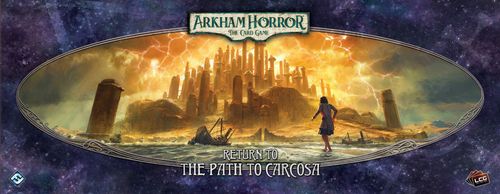
Arkham Horror: The Card Game – Return to the Path to Carcosa
Arkham Horror: The Card Game – Return to the Path to Carcosa Rulebook
Table of Contents
Table of Contents
How to Use This Expansion
In order to use this expansion, begin a campaign of The Path to Carcosa (or a standalone scenario from that campaign) as normal, using the setup instructions in The Path to Carcosa Campaign Guide. However, when setting up a scenario using this expansion, find the new scenario card titled "Return to (scenario name)" and follow its additional setup instructions.
Each of these new scenario cards is included in one of the following encounter sets, which modify and enhance the original scenario:
- Return to Curtain Call
- Return to Echoes of the Past
- Return to A Phantom of Truth
- Return to Black Stars Rise
- Return to The Last King
- Return to The Unspeakable Oath
- Return to The Pallid Mask
- Return to Dim Carcosa
These encounter sets contain new challenges and new versions of old cards. When you are instructed to gather one of these encounter sets, follow the instructions on the new scenario card. Some of these cards will replace old cards, while some will simply get set aside or shuffled into the encounter deck.
For example: When setting up Curtain Call using this expansion, find the card titled "Return to Curtain Call" and follow its additional setup instructions.
Return to Curtain Call
Front:
Perform the setup as indicated in The Path to Carcosa Campaign Guide, with the following exceptions:
- When gathering encounter sets, also gather the new encounter sets for Return to Curtain Call shown here.
- Construct the act deck using all six copies of Act 2a—"The Stranger."
(Continued on reverse side.)
Back:
Attach this card to Royal Emissary. It gains the following text:
"This card cannot be detached from Royal Emissary (even if Royal Emissary leaves play).
Forced – After Royal Emissary is added to the victory display: Place 1 resource on this card, as a warning.
Each warning on this card: Royal Emissary gets +1 health."
Replacement Encounter Sets
This expansion also includes five brand-new encounter sets, which are designed to replace five encounter sets used in The Path to Carcosa campaign:
- Ancient Evils is replaced by Delusory Evils.
- Striking Fear is replaced by Neurotic Fear.
- Agents of Hastur is replaced by Hastur's Envoys.
- Decay and Filth is replaced by Decaying Reality.
- Delusions is replaced by Maddening Delusions.
Delusory Evils replaces the Ancient Evils encounter set from the core set.
Neurotic Fear replaces the Striking Fear encounter set from the core set.
Hastur's Envoys replaces the Agents of Hastur encounter set from the core set.
Decaying Reality replaces the Decay and Filth encounter set from The Path to Carcosa.
Maddening Delusions replaces the Delusions encounter set from The Path to Carcosa.
When you are instructed to gather one of these encounter sets, it replaces the original encounter set. Remove that encounter set from the game and use the new one, as depicted.
For example: The setup instructions on the Return to Curtain Call card indicate that the players should replace the Delusions encounter set with Maddening Delusions and replace the Striking Fear encounter set with Neurotic Fear.
As an optional variant, for added chaos and replayability, you may choose to shuffle the old encounter set and the new one together, then randomly select a number of those cards to create a new encounter set. The total number of cards in the new encounter set should be the same as the number of cards in the original set (3 cards for Ancient Evils + Delusory Evils; 7 cards for Striking Fear + Neurotic Fear; 6 cards for Decay and Filth + Decaying Reality; 6 cards for Delusions + Maddening Delusions; and 4 cards for Agents of Hastur + Hastur's Envoys).
Achievement List
The following is a list of achievements you may strive toward as you play the Return to The Path to Carcosa campaign. These achievements can only be completed while playing using the Return to The Path to Carcosa encounter sets. As you complete each of these achievements, check the box next to them. Try to complete all of them for the ultimate challenge!
- ☐ Fair Warning: Defeat the Royal Emissary three times during a single playthrough of Curtain Call.
- ☐ First Steps: Interview the following VIPs in The Last King:
- ☐ Constance Dumaine
- ☐ Jordan Perry
- ☐ Ishimaru Haruko
- ☐ Sebastien Moreau
- ☐ Ashleigh Clarke
- ☐ Crashing the Party: Defeat the Lunatic version of Dianne Devine in The Last King.
- ☐ For Prying Eyes: Add the Hidden Library to the victory display in Echoes of the Past.
- ☐ The Cuckoo's Nest: Resign with Daniel Chesterfield under an investigator's control in The Unspeakable Oath.
- ☐ Take A Look At This!: Parley with the Host of Insanity in The Unspeakable Oath.
- ☐ The Path of Death: Use your Clasp of Black Onyx to find a shortcut in The Pallid Mask.
- ☐ Guessing Game: Advance to the final agenda of one agenda deck before advacing the first agenda of the other agenda deck in Black Stars Rise.
- ☐ Hastur Made Me Do It: Defeat Hastur in Dim Carcosa while a Possession treachery is in your hand.
Optional Variant: Ultimatums
The following is an optional variant you can use to add an additional layer of difficulty and excitement to your experience. Before setting up the campaign or a standalone scenario, the investigators may optionally select as many of the following Ultimatums as they wish. Each Ultimatum is a restriction, limitation, or additional rule that makes the game harder. You are not forced to choose any particular Ultimatum, and the choice of which Ultimatum(s) to use must be unanimous among all investigators in the group. Once chosen, all Ultimatums are permanent throughout the duration of the scenario/campaign.
The following is a list of some Ultimatums we've designed, but feel free to use these as inspiration to design your own.
- Ultimatum of the Unspeakable Name: Campaign Mode only. If you heeded Daniel's warning in your Campaign Log, each time you speak the name of HASTUR aloud during the setup or play of a scenario, in addition to taking 1 horror, suffer 1 mental trauma.
- Ultimatum of Finality: Campaign Mode only. If an investigator is defeated by physical damage, they are killed. If an investigator is defeated by mental damage, they are driven insane.
- Ultimatum of Survival: Campaign Mode only. If an investigator is killed or driven insane, that player is eliminated from the campaign and cannot continue playing as a new investigator.
- Ultimatum of Failure: Add an additional chaos token to the chaos bag for the entirety of the scenario/campaign. (Transcription note: the printed insert shows a specific chaos token symbol in this line. The symbol does not survive the PDF text layer and is not reproduced here; check it against the printed insert.)
- Ultimatum of Broken Promises: Remove the chaos token from the chaos bag for the entirety of the scenario/campaign. (The printed insert shows a specific chaos token symbol here; the symbol does not survive the PDF text layer and is not reproduced.)
- Ultimatum of Induction: Investigator decks can only contain level 0 cards. Investigators cannot earn or spend experience.
- Ultimatum of Disaster: Add 1 additional random basic weakness to each investigator's starting deck.
- Ultimatum of Dread: Do not skip the mythos phase during the first round of each game.
- Ultimatum of Agony: When assigning damage or horror, investigators must assign as much damage and horror as possible to a single card before any excess damage or horror may be assigned to a different card.
New Weaknesses
Each of the 3 new weaknesses in this expansion bear the hidden keyword, which was first introduced in The Path to Carcosa expansion. These weaknesses function like other hidden encounter cards, except that when discarded, they are placed in your investigator's discard pile instead of the encounter discard pile.
Expansion Icon
The cards in the Return to The Path to Carcosa expansion can be identified by the expansion icon before each card's collector number.
Note: Some cards in this expansion are alternate versions of existing cards from the core set. In order to prevent players from being able to tell which card is which, the front side of some of these cards bears the same copyright information, encounter set number, expansion icon, and card collector number as its original version. The back side reflects the card's true set information.