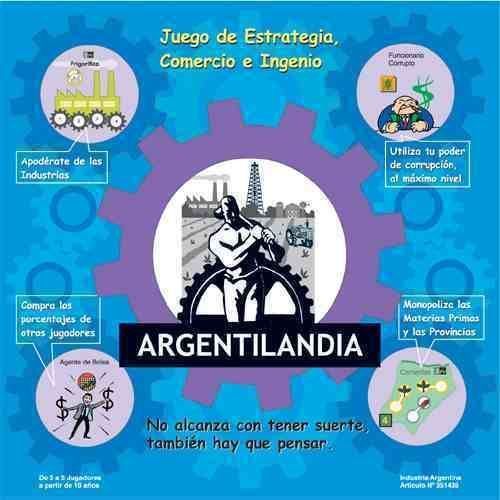
Argentilandia
Argentilandia Rulebook
Table of Contents
Table of Contents
Components
1 game board (a map of Argentina divided into Provinces and Regions), 175 tokens divided into 5 colors, 2 six-sided dice, 144 Production cards, 12 Corrupt Officials, 12 Stockbrokers, 1 Union Organizer, 8 Factories, 5 Exchange and Cost cards, and 1 rulebook.
Objective
The idea is for the players to fight for the Victory Points granted by the Provinces and the Industries. The player who reaches 16 Victory Points at the end of their turn wins the game. To do this it is essential to gain control of several provinces and industries by monopolizing them.
The board shows Victory Points on each Province and Industry: for example, Jujuy is worth 4 PV, a monopoly on it is shown with a token of each color, and the Metal Refinery is worth 6 PV.
Setup
- Place the board on the table. The map is divided into 24 provinces, grouped into 12 regions.
- One player acts as the Banker and manages all payments and exchanges in the game. The Banker places the Production cards, the Corrupt Official and the Stockbroker on the table, near their own position.
- Each player chooses a color of tokens and takes an Exchange and Cost card in the same color.
- The Industries are kept in the box or set aside until they begin to be used.
- The Province of Tucumán is blocked by placing the Union Organizer on the raw material Wood.
- The Banker gives each player 1 Corrupt Official.
- Each player rolls the dice. The player with the highest result begins the Preliminary Round.
Raw Materials
Raw materials are an essential part of survival in the game, so they are mentioned repeatedly in these rules. To simplify, from here on "MP" means a raw material and "MPS" means raw materials.
There are 9 types of MPS in total: Oil, Fish, Sheep, Metals, Soy, Cows, Grapes, Tobacco and Wood. Each MP is represented by a Production card.
To buy 1 free MP (one with no owner) you need 3 Production cards of different resources.
- 1 MP: 3 different resources.
Preliminary Round
Every player must choose 7 starting MPS, at no cost, from any provinces they wish, with the condition of taking no more than 1 MP per province. The first player places 1 token on the MP they chose, and the rest repeat the action, continuing their turn clockwise, until the last player places their token. Each player receives, for each MP they choose, the corresponding Production card.
Now the last player becomes the first and begins the round of placing tokens again, but counterclockwise. The change of last player to first and the direction of rotation is repeated until the last player places their seventh token. This is done so that all players have the same chance of accessing the best resources.
Now, with their 7 Production cards in hand, each player may buy 1 MP, only if they wish, by giving 3 Production cards of different resources to the Banker and placing 1 token of their color on the chosen MP. Only 1 MP can be bought, and without taking more than 1 per province, keeping the order and the rules established above. In this phase of the game players may NOT trade, buy MPS (except the one allowed), buy ports or play the Corrupt Official.
Example of Production cards: 3 different resources = 1 MP. For most examples the Red player's token will be used.
Round Summary
The rounds of play set out the steps each player must follow on their turn to carry out game actions. The order is:
- Before rolling the dice, you may play 1 Corrupt Official to unblock a province, move the Union Organizer and draw, according to the rules.
- The player whose turn it is rolls the dice. The sum of the dice determines which provinces are in play, grouped by a single color into a region.
- The Banker makes payments, handing out the corresponding Production cards to the players with MPS in the provinces in play. 1 Production card for each MP the player owns.
- If 2 dice show the same face, proceed according to the rules. (See Doubles.)
- Trade: you may trade with other players, with the Banker or through ports.
- Purchases: you may buy anything permitted by the Exchange and Cost card.
- Stockbroker: it may be played at any moment of the turn.
- Union Organizer: you may move the Union Organizer to block a province or industry. Also if two dice show the same face.
- End the turn; play passes to the player on the left.
Important: Points 2, 3 and 4 are compulsory. After them, the player may trade, buy, play a Corrupt Official or a Stockbroker, in no fixed order, but respecting the rules of each item.
When the game begins, the order of turns is clockwise. The turn order does not rotate and remains the same until the end of the game. The player who placed the last token in the preliminary phase is responsible for starting the game.
Exchange and Cost Card
The Exchange and Cost card (Canje y Costos de Tarjetas) lists what may be bought:
- 1 MP, or 1 Port: 3 different resources.
- 1 Factory: 1 Oil + 3 identical resources.
- 1 percentage of an Industry: 1 Oil + 1 Soy + 1 Metals.
- 1 Corrupt Official: 1 Grapes + 1 Cows + 1 Sheep.
- 1 Stockbroker: 1 Wood + 1 Tobacco + 1 Fish.
Playing the Game
1. Corrupt Official. Before rolling the dice, you may play 1 Corrupt Official, if you acquired it in an earlier round or phase.
The Corrupt Official is used to remove the Union Organizer from a blocked province or industry, or to buy the MP of another player.
To buy one, you must give the Banker 3 Production cards: 1 Grapes, 1 Cows and 1 Sheep. A Corrupt Official may also be obtained from an earlier buy/sell action, where the winner turned out to be the seller.
On their turn a player may buy as many Corrupt Officials as they wish. A Corrupt Official bought on the same turn may be played immediately; you do not have to wait for the next turn.
Removing the Union Organizer from a blocked province or industry
On their turn a player may play 1 Corrupt Official to move the Union Organizer from one province or industry and block another. It may also be done before rolling the dice. In either case, only 1 Corrupt Official may be played per turn to unblock. To carry out the action, the player must move the Union Organizer to another province or industry and draw 1 Production card from each player, where applicable. The Corrupt Official used to move a Union Organizer returns to the Banker after use.
Buying another player's MP
On their turn a player may play 1 Corrupt Official to buy another player's MP, as many times as they wish, regardless of whether they have already used one to unblock.
2. Provinces and dice. All provinces are numbered from (2) to (12). When the player whose turn it is rolls the dice, the sum determines which provinces are in play. They are grouped by regions of the same color.
3. Production. Players who have MPS in those provinces collect 1 Production card for each MP they hold in them.
Example: a 6 is rolled, so Mendoza and Neuquén are in play. The Red player has 1 MP of Grapes in Mendoza and 1 of Sheep in Neuquén, so they receive from the Banker 1 Grapes card and 1 Sheep card. The rest of the MPS remain free.
The board marks the number of the region in play: 6 = Mendoza and Neuquén.
When the Banker has finished paying production, the player whose turn it is may buy free MPS, only from the provinces in play, or MPS from other players in any fully occupied province where they have at least 1 MP of their own. (See Purchases.)
4. Doubles. When the player whose turn it is rolls the dice and they show 2 equal faces (1-1, 2-2, 3-3, 4-4, 5-5 or 6-6), the following steps apply, in this order:
- a. All players count their Production cards. A player holding more than 7 must hand half of them to the Banker. If the number is odd, subtract 1 and hand over half. Example: if a player has 9 cards, they hand 4 to the Banker.
- b. Players with MPS in those provinces now collect the production corresponding to the region in play. Those regions will surely have the number 2, 4, 6, 8, 10 or 12, since the dice show equal faces.
- c. The player whose turn it is must move the Union Organizer, compulsorily, to another province or industry. If it is occupied by other players, the player must draw 1 Production card from each of them, where applicable.
After these 3 steps, the player may trade, buy, play a Corrupt Official, a Stockbroker, or pass the turn.
5. Trade. Production cards may be traded between players without using ports, but only the player whose turn it is may do so. Players who do not have the turn may not trade with each other or suggest transactions of any kind.
Example: the Red player has the turn and wants to swap 2 Oil cards for 2 Fish cards with any player who shows interest. The other players may make offers and trade, but the Yellow player may not trade with the Blue player.
Trading rules between players are free: each player decides how much they are willing to give or receive, and supply and demand are left to each player's judgment. When a player has no chance to trade through a port or with the other players, they may trade with the Banker, giving 4 identical cards for 1 of any resource of their choice.
Trading at ports
Ports are used to exchange Production cards with the Banker, instead of trading with the other players.
To buy a free port (one with no owner), the player must give the Banker 3 Production cards of different resources and place 1 token of their color on the chosen port. A port may only be bought in provinces that are in play, and the buyer must have at least 1 MP in that province. Once a player obtains a port, they may start using it in the same turn.
There are 2 kinds of port, 2 x 1 and 3 x 1. The numbers 2 and 3 show how many Production cards the player must give to receive in exchange 1 card from the Banker, of any MP they wish. On a 2 x 1 port the player must give 2 identical cards; on a 3 x 1 port they must give 3 identical cards.
Only the player whose turn it is may use a port, and they must have at least 1 MP in the province where the port is located. Use of a port does not depend on which provinces are in play. Example: if an 11 is rolled, the player whose turn it is may still use the ports.
On their turn a player may use a port as many times as they wish, always clearly stating to the other players which port they are using to exchange. If a player loses the last MP of the province where their port is located, the port passes to the player who has the most MPS in that province; if there is a tie, it is decided by rolling 1 die, until one player rolls a higher number than the other. The token of the player eliminated must be replaced by that of the new owner.
When a province with a port is blocked by the Union Organizer, the port is also blocked for exchanging cards.
6. Purchases. On their turn the player may buy anything permitted by the Exchange and Cost card.
Buying a free MP (no owner)
To buy a free MP (one with no owner), the player must give the Banker 3 Production cards of different resources and place a token of their color on the chosen MP. The player does not receive 1 Production card; they must wait for the province to come into play again. They may buy as many MPS as they wish, from any province in play. A player may not buy another player's MP while free MPS exist in that province.
Buying another player's MP
An MP may be bought from another player when all the MPS of a province are occupied by 2 or more players. It is not necessary for that province to be in play. Only the player whose turn it is may buy, they must have at least 1 MP in the province, and they must play 1 Corrupt Official.
Example: the Red player has the turn and rolls a 6, so Mendoza and Neuquén are in play. But the Red player has 2 MPS in San Luis and wants the third, which belongs to Green, so Red may attempt to buy the MP from Green. On their turn, Green could also attempt to buy the MP from Red in San Luis.
To buy another player's MP, a Corrupt Official must be put into play. The player taking the role of the Buyer announces aloud which player (the Seller) they wish to buy the MP from, and places their Corrupt Official on the table. The Seller and the Buyer, in that order, roll the dice; the one who rolls the higher result wins, and in case of a tie the Seller is the winner. If the Buyer wins, they remove the token of the loser, place 1 token of their color on the MP, and hand the Corrupt Official to the Banker. If the Seller wins, they keep the Corrupt Official.
Monopoly. If a single player buys all the MPS of a province, they achieve a Monopoly and the Victory Points that the province grants. From that moment no other player may buy its MPS, and the monopolist collects double each time one of them is in play again. The monopoly may be blocked by 1 Union Organizer.
Example: Monopoly of the Red player, 4 Victory Points for the Red player, from the province of San Luis.
Important: No player may refuse to sell an MP if another player requires it, unless the player taking the role of Seller holds a monopoly in that province. On their turn a player may try to buy an MP from another player as many times as they wish.
Buying Industries (Factories)
To buy an industry you must give the Banker 1 Oil card plus 3 identical cards of any other resource. In exchange, the player receives the industry they want and places 1 token of their color on the first free percentage.
With 1 Oil and 3 Metals you may buy any Factory, and also with 1 Oil and 3 other identical resources.
Example: 1 Factory for 1 Oil + 3 identical resources.
Industries and doubling
Industries are used to double the production of cards of a given MP that corresponds to the factory. The number of percentages a player has in an industry does not matter: the effect on the MP is simply doubling. The owner of an industry is the player who buys it first or who holds the largest percentage. Only the owner gets the benefit of doubling, but this can change if other players buy the remaining percentages.
To double production, the player must have MPS in the provinces in play that correspond to the Factory. Example: the Red player owns the Wool Factory and holds the Sheep MP in La Pampa; each time an 8 is rolled, they collect 2 Sheep cards instead of 1.
Buying free industry percentages
Once an industry has been bought, any player may buy its remaining free percentages. To do so, the player gives the Banker 1 Oil card, 1 Soy card and 1 Metals card, and places a token of their color. A player may buy free percentages even if they do not hold the corresponding MP; in that case they do not benefit from doubling production, but keep their chance of obtaining it in the future. On their turn, a player may buy as many percentages as they wish.
Buying other players' percentages
Any player holding a Stockbroker may buy a percentage of an industry from another player, provided that the industry is not a monopoly. A player may buy another player's percentage even if there are free (unowned) percentages in that industry, or if the buyer has no percentages in it and does not hold the corresponding MP.
To buy another player's percentage, a Stockbroker must be put into play. The player taking the role of the Buyer announces aloud which player (the Seller) they wish to buy the percentage from, and places their Stockbroker on the table. The Seller and the Buyer, in that order, roll the dice; the one who rolls the higher result wins, and in case of a tie the Seller is the winner. If the Buyer wins, they remove the token of the loser, place a token of their color on the percentage, and hand the Stockbroker to the Banker. If the Seller wins, they keep the Stockbroker. If the purchase eliminated the owner of the industry, or changed the majority of the percentages, the ownership must change hands. On their turn a player may try to buy another player's percentage as many times as they wish, provided they have the necessary Stockbrokers.
Important: No player may refuse to sell a percentage of an industry if another player requires it, unless the player taking the role of Seller holds a monopoly in that industry.
Monopoly (industries). If a single player buys all the percentages of an industry, they achieve a Monopoly, and from that moment no other player may buy its percentages. If the owner holds at least 1 MP of the corresponding industry, they also obtain the Victory Points of the industry. The owner may obtain a monopoly without counting the MP correspondent, in which case they do not get the Victory Points. If a player holds a monopoly and loses the only MP corresponding to it, they automatically also lose those Victory Points; this happens when another player removes that last MP, in any province. The monopoly may be blocked by a Union Organizer.
Example: Monopoly of the Red player. 4 Victory Points for the Red player, from the Wool Factory.
Important: majority of percentages. When a player obtains a greater number of percentages than another, the industry passes into the hands of the owner of the larger percentage, keeping its composition. Example: the Red player buys the Wool Factory and so holds one percentage (the only one). On the next turn the Yellow player buys 2 percentages of it, so the Red player hands the Wool Factory over to the Yellow player together with its 3 percentages, which remain intact (2 Yellow, 1 Red and 1 free). Only the owner of the industry (the holder of the largest percentage) obtains the benefit of doubling.
When 2 or more players share the same number of percentages, the industry always belongs to the player who bought it first or to the last owner, that is, the player who holds it up to that moment. In that case, all players with percentages collect double, if they also hold the MP. Only by obtaining a larger percentage can ownership change.
Example: the Yellow player owns the Wool Factory and is the only player who doubles production.
7. Stockbroker. The Stockbroker serves to buy the industry percentages of other players. To buy one, the player must give the Banker 3 Production cards: 1 Wood, 1 Tobacco and 1 Fish. On their turn the player may buy as many Stockbrokers as they wish. A Stockbroker may also be obtained from an earlier buy/sell action, where the winner turned out to be the seller. A Stockbroker bought on the same turn may be played immediately; you do not have to wait for the next turn.
8. Union Organizer. The Union Organizer blocks every action that could take place in a province or industry. When a player places the Union Organizer in a province or industry, the following situations are blocked, as applicable: the production of cards, the purchase of a free MP or another player's MP, trading through a port, the purchase of free percentages or another player's percentages, the effect of monopolies, and victory points.
In the preliminary phase the Union Organizer is placed for the first time in Tucumán on the Wood, blocking the province and the MP. This is done to prevent a player from starting the game with a monopoly and 1 victory point.
When the player whose turn it is rolls the dice and they show 2 equal faces, the player must compulsorily move the Union Organizer to another province or industry. That province or industry remains blocked until 2 equal dice are rolled again, or a player uses a Corrupt Official to unblock it. The player who moves the Union Organizer must compulsorily draw 1 Production card from each player in that province or industry. Each player places their Production cards face down and the player drawing chooses which one to keep. If the players have no Production cards, the Union Organizer may still be moved without drawing any card. The Union Organizer may be moved to an unoccupied province (with no players), but the benefit of drawing 1 card is then lost.
9. After complying with points 2, 3 and 4, which are compulsory, the player may end their turn, and play continues with the player to their left.
Special Rules and Considerations
Oil. Oil is the only MP not directly associated with an industry, but it is vital for buying factories and their percentages. The Oil card is traded like the rest. It should be made clear that to buy 1 industry you may NOT hand over 4 Oil cards; it must be 3 identical cards of any other resource plus 1 Oil.
Production cards. If, when paying production, the Banker does not have the full number of cards corresponding to a particular MP, that MP is not paid to any player. Example: a 6 is rolled and the Grapes in Mendoza belong to 3 different players, but the Banker has only 1 card to pay, so it pays none of them. The same would occur if all 3 Grapes belonged to a single player.
Pacts. Non-aggression pacts and trade pacts between players are permitted; their duration and conditions are set by the participants. Explicit pacts to attack another player are not permitted, but it is permitted to suggest that someone is winning the game.
General rules and tips. All decisions made by a player must be announced clearly and aloud before they are carried out, so that everyone can understand them. Players' Production cards must not be left in view of others. Gifts between players are not allowed, nor any other action not contemplated in these rules.
International Trade
There is a group of provinces that border other countries and have no port on the Argentine Sea. They are: Neuquén, Mendoza, San Juan, La Rioja, Catamarca, Salta, Jujuy, Formosa, Chaco, Corrientes, Misiones and Entre Ríos. Players who monopolize these provinces may trade as if they had a 2 x 1 port, with the same rules and conditions that apply.
Special Provinces
Players who monopolize the provinces of Santiago del Estero, Córdoba, San Luis or Santa Fe receive from the Banker, once per turn, either a Corrupt Official or a Stockbroker. This applies from the first turn after the monopoly was achieved. At the start of the player's turn, after rolling the dice, the Banker hands over the card the player chooses, which may be used in the same turn. If the player chose a Stockbroker, on their next turn they will receive a Corrupt Official, or vice versa, but they must always alternate between the two. They may not receive the same card on consecutive turns. If the Banker does not have 1 Corrupt Official or 1 Stockbroker to hand over, it is lost and does not accumulate for the next turn.
Doubling
A player who achieves a monopoly on a province doubles the production of cards, and a player who owns a factory also doubles it. This means that if the same player combines both situations, they collect 4 cards for each MP they hold in the province in play that corresponds to the factory.
Example: the player monopolizes San Luis and also owns the Meatpacking Plant (Frigorífico), so when a 2 is rolled they collect 4 Cows, 2 Grapes and 2 Metals.
Red player collects 2 Cows for the monopoly of San Luis, and doubles production because they own the Meatpacking Plant. They also collect 2 Grapes and 2 Metals.
Victory
The player who reaches 16 Victory Points at the end of their turn will be the winner. The player must hold at least 1 factory and 1 province, whose victory points are included in the 16; that is, it is not possible to win by summing 16 points that come solely from factories or monopolized provinces. A province or industry blocked by the Union Organizer contributes no points.
Example: Winner, the Red player: 16 Victory Points, 12 points from the Factories (Metal Refinery 6 and Furniture Factory 6) and 4 points from San Luis.
Special Considerations
The dimensions, scales, borders and the territorial division do not reflect reality; they were designed, replaced, modified or invented solely to improve the sense and spirit of the game.
Variant: 3 Players
When playing with 3 players, some rules are modified:
- The Victory Points needed to win are 18.
- To win, a player needs at least 2 Factories and 1 Province.
- The available Corrupt Officials are 8; 4 are removed from the game.
- The Corrupt Official is not dealt during the setup phase.
- The available Stockbrokers are 8; 4 are removed from the game.
All other rules remain the same.