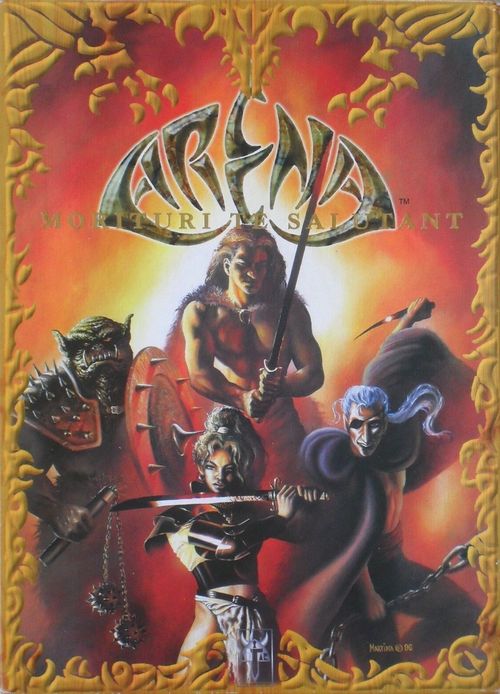
Arena: Morituri te salutant
Arena: Morituri te salutant Rulebook
Table of Contents
Table of Contents
Description of the Game
Arena has many different variants of how to play - a different number of players, different options as to which gladiators can be pitted against each other, what happens to the defeated and what the winner gains. The simplest is a fight of two opponents, each of whom controls one character.
Each player chooses which character he will play. To begin with, the most suitable are the barbarian, the killer (Vrah) or the swordswoman. He chooses the corresponding figure and the deck of cards that belongs to his character. (He must not have a card of another character, nor any card twice.) The cards do not need to be shuffled - the player has them all at his disposal at the start and may use them as he sees fit.
The figures are placed on the game board, and each player notes on a piece of paper how many Condition points his character has, and the fight can begin. Both players alternate turns. By suitable manoeuvring around the game board and by using combat action cards they try to defeat the opponent - take away all his Condition points, so that he collapses exhausted to the ground and is unable to continue fighting.
In a real arena, however, the fight is not as clear as the player sees it on the table. Therefore he cannot always use the most advantageous card at any moment. And moreover - no fight turns out so that both opponents rush at each other and strike without pause until one falls to the ground. An experienced swordsman stands for a moment on guard, carefully watches the opponent and guesses his intentions, thinking how best to strike. Then he performs a lunge, several quick attacks - and if the opponent defends himself, he steps back into defence and prepares the next action.
For this reason the player must plan his actions. When planning, he places the combat action cards he wants to use on the table one after another face down, so the opponent does not see what he is preparing. In later turns he can then use the first of the planned actions, after it the next, then the next, etc. - in the order in which he planned the actions.
In each of his turns, however, a player may perform only one activity - either plan, or use a planned combat action. He cannot do both at once. The player can choose various tactics - e.g. always plan one combat action in one turn and carry it out in the following one, which is slow, but requires no preparation and allows him to react to a situation that has arisen; or conversely plan a series of actions over several turns and then carry them out in quick succession over several further turns. The second way makes it possible to create more lasting attacks, but requires time for preparation and above all a seasoned estimate of the situation several turns ahead. Everything depends on the situation and on the opponent's tactics.
If a character uses an attack action, he can attack the opponent with it. And here another game element enters the game - the die, which is however used in an unconventional way. The attacking player chooses the strength of his attack by setting a number on a six-sided die so that the opponent does not see it. What prevents him from always using the strongest attack? The opponent usually has one or several guards against the attack - he tries to guess which number the opponent set. If he succeeds, the character has defended against the attack; if not, he loses some Condition points - the more, the greater the number the attacker set on the die. This turns the game into a real psychological duel of both players, similar to a real duel of two gladiators trying to guess how the next blow will be delivered.
Rules
I. Before the Game
In the game each player chooses one character - with it he receives the corresponding figure and cards. He should at least roughly familiarise himself with the cards. In addition the players need a Condition counter, the game board, a playing die and small tokens.
Each character has 33 cards and a figure. The exception is the goblins - they have two figures, but only one shared deck of 33 cards. The cards are of four kinds. In the explanation we will use the Killer's cards as examples.
1. Combat Action Cards
Combat action cards are numbered cards with pictures. For example, the Killer has 22 combat action cards marked at top left with the numbers 1 to 22. To the right of the number is the action's name and below these data is an illustration.
At left under the illustration there are one or more small axe icons, each containing three numbers. They correspond to the three types of attack that exist in Arena - slash (sek), thrust (bod) and contact (kontakt). The gladiators defend themselves by trying to guess the strength of the opponent's attack. The numbers in the axe state how many guesses against the individual types of attack the player has at his disposal. A guess against a slash is on the blade of the axe, a guess against a thrust is at the tip of the axe, and a guess against contact is in the ball opposite the blade. Each combat action card, among other things, denotes a certain combat position in which the character is, and the guesses determine how well he is able in this position to defend against slashing wounds, thrusting wounds and direct contact.
Under each axe is given the weapon or combination of weapons for which the given guesses apply. If there is only one axe on the card, it means that the character can perform this action only while using exactly the corresponding weapon. If an action has several axes, the axe that corresponds to the weapons in the character's hands applies. If a character has another combination of weapons, not stated on the card, he cannot use the action.
To the right under the picture one or more attacks may be given - these are small frames with white numbers. The shape of the left part of the frame determines the type of attack - it may be the blade of an axe for a slash (e.g. the Killer's action 7), an arrowhead for a thrust (e.g. action 6) or a ball for contact (e.g. action 13). If the left part is angular, the manner of the attack is described in the text of the action (e.g. the second attack of combat action 16). The number in this left part of the frame states at what distance the attack can be made; the pattern in the right part is the calculation of the attack's strength. The colour of the frame determines what the opponent sets against the attack - if it is blue, then his Defence (most actions); if red, then his Strength (the first attack of action 16); if half red-blue, then the sum of Strength and Defence (the second attack of action 16 or action 20); if it is grey, the opponent sets nothing against the attack.
Example of a combat action card (Fig. 1)
The card's parts, as labelled in the figure:
- number
- name
- guesses (Odhady): guess against thrust, guess against contact, guess against slash
- equipment necessary for the action
- description of the action and the rules for it
- Attack: strength of the attack (sum of the number and the bracket); what the attack is directed against (colour of the background); distance (number); type of attack (shape of the left part of the frame)
The example card is "Strong slash with a sword" (silný sek mečem). Its text reads: "If there is still some strength left in him, the swordswoman can grip the sword with both hands and put into the blow all the strength she can find. This action costs one Condition point. She can use it only if she has at least 5 Condition." Its attack frame reads 2 | 3+(1-5)x2.
Most attacks are so-called untargeted attacks - it is not determined where the blow lands. Targeted attacks may be aimed at the head, the arm, the body or the legs. Such a card has next to the attack a small drawn figure on which the target of the attack is marked in red (e.g. the Killer's combat action 16 is aimed at the head, action 17 at the body, action 15 at the arm).
The text of the card follows. In normal type the course of the action is given, in italics the rules relating to the card. Important rules are printed in bold. Whenever the rules on a card contradict the general rules, the text on the card takes precedence - this applies to all kinds of cards.
At the start the players have all their combat action cards with them. These are the so-called "cards in hand", even though in reality they are more likely laid out on the table in some way so that the player can find his way among them easily and quickly. During the game the combat action cards are laid out on the table and then return back to the hand.
2. The Standard Action Card
This is the card on which the name of the character is written in bold letters. The goblins have two standard actions, one for each of them. It is in fact also a combat action - it is the stance in which the character is when he is doing nothing else. That means a stance to which he can return at any time, even if he has not planned it in advance.
Like the combat action cards, the standard action card contains, besides the name and picture, also guesses. E.g. the Killer's standard action has six axes - the first five for various combinations of weapons, the sixth for all other cases.
Here, however, the similarity with the other combat actions ends. On the standard action card is a description of the whole character (normal type), the general rules that relate to it (italics), and above all the basic characteristics of the character - its Strength, Defence and Condition (bold). Strength expresses the character's ability to attack (it is not only physical strength, but also combat experience), Defence the ability to avoid the opponent's attack, and Condition the degree of wounding and physical strain the character can bear. Strength and Defence may be influenced by the items the character is currently using (e.g. the Killer's cloak). In addition the card states the character's Quality - only characters of the same quality should fight each other.
The standard action of each character lies face up throughout the game. Around it the item cards are laid out. The basic characteristics of the character and of the items he has are thus always visible to all players.
3. Item Cards
Each character has several item cards (e.g. the Killer has two daggers, a chain and a cloak), which the character has at his disposal at the start of the duel and with which he can handle. On an item card there is its name, picture, description (normal type), rules for its use (italics) and for the item's value (bold). For each item it is stated how it is used - mostly it is held in one or both hands, some can also be used otherwise (the barbarian's helmet).
The items are laid out on the table around the standard action. To the left and right of the character lie, text facing up, the items the character holds in his hand, and it does not matter which item is in which hand. If the character uses an item with both hands, he has it in either hand and the other place is free. Items which the character uses but does not have in his hand (a helmet) are laid text up above the standard action. Items which the character does not use but has on him are laid under the standard action card face down.
If a character holds an item with both hands, it is the same as if he held it in one hand and had the other free. He can therefore use both actions that require an item held in both hands, and actions that require a free hand. E.g. a Killer who has only a chain in his hand can use action 16, which requires a chain in both hands, as well as action 17, which requires a free hand.
At the start of the game the character has all his items at his disposal. Decide which of them he will use right from the start and which he will have only stored on him - accordingly he places them in the appropriate place around the standard action card.
During the game a character may use only the items of his own character or items with exactly the same name. E.g. the Killer may use the swordswoman's dagger and vice versa, but the barbarian cannot use instead of the barbarian sword the sword that the swordswoman has (it is named differently). Other items he may have on him, he may even hold them in his hand, but he cannot use them in any way (unless stated otherwise on some card).
4. Special Action Cards
Special actions are cards with which the player can intervene in the game without having them planned in advance. They have no pictures and are not laid out lengthwise but crosswise.
Besides the name they contain the description of the action (normal type), the manner of use and effects (italics) and above all information on at what moment they can be used and at what price (bold).
At the start the player has all his special actions at his disposal - they lie openly before him on the table. Many actions can be used only once per game - after use they are set aside for the rest of the game.
5. The Condition Counter
A pencil and paper serve well for this purpose, but other counters (e.g. dice, tokens etc.) will do too. At every moment the player must have an overview of how many Condition points he has left. The character's Condition determines how many physical strengths he still has. It is lowered by every wound of the character, and may also decrease through the use of some more demanding combat or special actions.
At the start the player notes on the counter the number of points given as Condition on the standard action. Gradually he will subtract points (exceptionally also add). As soon as the Condition falls to zero or below, the character is no longer capable of fighting and the game ends for him.
6. The Game Board
The game board is made of hexagonal spaces surrounded by walls. In addition a compass rose is shown on it, which is important for some rules. The directions are marked with the numbers 1 to 6.
7. The Figure
The character's figure is at every moment on some hex on the game board. It does not matter in which direction it is turned. If it is placed lying on the hex, it means the character is lying down. It is removed at the moment the character is definitively eliminated from the fight.
At the start the players place their figures in opposite corners of the arena (unless agreed otherwise). The figures may not leave the arena.
8. Tokens
The game contains tokens that correspond to the weapons of the individual characters. They are used only if some item lies on the ground - the character may put it down there, it may fall out of his hands, it may be knocked out of them, or he may himself throw it somewhere. Also all items of a defeated character remain lying on the space where he fell.
II. Course of the Game
We will first focus on a game of two characters against each other.
1. Start of the Game
The players place their figures on the game board, put the standard action cards of their characters on the table and lay the item cards around them. Then they draw lots (preferably rock-paper-scissors, so that chance is excluded here too) to decide who begins. The game then starts with his turn.
2. Course of the Game
The players alternate regularly in their turns. The time that passes between two turns of one player is called a combat round. The game ends at the moment when the Condition of one of the players falls to zero or below.
3. Planned Actions and the Current Action
During the game the character thinks ahead and plans his actions. On the table there always lies, visibly, the last combat action he used (the so-called current action), and a row of planned actions (these are face down). The current action determines the stance in which the character is and on what he concentrates. If no card lies in the place of the current action, the character stands in the standard stance - if needed, the standard action is used.
At the start of the game the character has no action planned and no current action. As the character thinks and plans during the fight, the row of his planned actions slowly grows. When the character fights, the row slowly shortens as he carries out the planned actions one after another. The opponents do not see the actions the player has planned, even though he himself may look at them at any time.
4. The Cards of One Player During the Game
Fig. 2 on this page shows how the cards of one player are laid out on the table and in the hand during the game. The standard action lies text up. Above it and beside it lie the items the character uses, below it the items he has on him. The row of planned actions lies face down, the current action text up. Special actions that the character can still use lie text up.
In the hand he holds all the other combat action cards, so that the opponent does not see them and cannot deduce from this which are planned.
Fig. 2 - On the Table / In the Hand
On the table (labels from the figure): planned actions (face-down row); current action (a combat action); item elsewhere than in the hand (e.g. helmet); standard action; item in hand; unused item that the character has on him (face down under the standard action); special actions the character has at his disposal; used special actions (face down). In the hand: combat action cards.
III. One Turn
1. What the Player Can Do During a Turn
During a turn the player may do only one big activity. It may be:
- planning
- use of a combat action
- re-equipping
That means that in one turn the player cannot use several combat actions, cannot plan and at the same time use an action, nor re-equip and at the same time plan, etc.
2. Planning
Planning reflects the fact that the character is in completely different conditions than the player - he has plenty of time to think about what his character will do; for the character, however, everything unfolds very quickly, and so he is unable at every moment to perform exactly the most advantageous activity.
So during the game there lies on the table, face down, a row of planned cards. The player has three planning options:
- add to the end of the row another combat action card from his hand
- remove one card from the beginning of the row and take it back into his hand
- take all the cards back and lay out in their place only the one that he had in his hand before (i.e. that was not planned)
In one round the character can do only one of these planning activities. It is not allowed, for example, to add a card at the beginning or in the middle of the row, remove it from the end or from inside the row, or change the order of the cards.
3. Use of a Combat Action
This is the activity in which the current action changes. It can be performed in three ways:
- if there is no current action, the player may turn over the first of the row of planned actions and thereby replace the standard action with it,
- if there is a current action, the player may take it back into his hand and replace it with the first of the row of planned actions,
- the player may take the current action (if there is one) back into his hand and replace it with nothing - the action is replaced by the standard action.
From this moment the character is in the position given by his current action; if none is laid out, the standard action fulfils its function. If an attack is marked on the currently laid-out card, the character may use it in this turn (and only in this turn). The standard action cannot be used to attack.
4. Re-equipping
This concerns the exchange of the items in use. The character cannot do anything else in this turn, but he can determine anew which of the items he has on him he will use and which he will have only stored on him. He may even say that one or more items he puts down on the ground, but he cannot pick an item up from the ground - one of his combat actions is intended for that. Throughout the game one rule applies:
If the current action requires the use of some item and the character does not use this item, this action is immediately taken back into the hand and the standard action takes its place. This can occur at various moments of the game: the character may lose an item by re-equipping, but also an item can be knocked from his hand, taken or even thrown away by the opponent. The same procedure applies to an action requiring a free hand, which the character does not have, e.g. after re-equipping or another activity.
Withdrawing an action for the reasons above is not considered use of a combat action, so the character may do some further activity in this turn.
Example: Adam has a current action laid out, and the first of the planned actions requires an item that is not in his hand. He may:
- re-equip in this round and use the action in the next,
- cancel the first planned action (see Planning),
- use the first planned action; in that case the action is immediately withdrawn into the hand and the standard action replaces it. The situation thus differs from the previous case, where the current action did not change.
5. The Five Phases of a Turn
The turn of each player is divided into five phases in which the character can (and sometimes must) perform various activities. These phases have a fixed, unchangeable order and are called:
- first action phase
- defence phase
- second action phase
- movement phase
- declaration of attack
6. Action Phase
In the first action phase the player can do only a single thing:
- use of a combat action
In the second action phase the character can perform one of three activities:
- use of a combat action
- planning
- re-equipping
Attention! There are two action phases, but in each turn the player may use only one of them. If in the first action phase he used a combat action, he cannot do anything in the second action phase. The point is that if the player wants to use a combat action, he can decide whether to do so before the defence phase or after the defence phase. In each turn only one of the activities can be done, and only in one action phase!
7. Defence Phase
In the defence phase the character with his current action gradually defends against all the attacks that were directed at him. Precisely for this reason a combat action can be used already in the first action phase, so that the player can change his current action even before the attack is evaluated. The player actually has two options - either his character defends in the stance he is currently in, and in the second action phase he may switch to another stance, or he changes it immediately after the attack is announced and defends in the new stance. If the character has no current action at the moment when he is defending, then his standard action is used.
An attack is not evaluated immediately after it is declared or during the attacker's action. It would cause problems in a game of more players, where several attacks may be directed at a character in one round. All attacks are therefore evaluated only in the defence phase of the attacked player, in the order in which they were declared.
8. Movement Phase
In the movement phase the player may move his figure on the game board by some number of unoccupied spaces. Their number is determined by the kind of activity the character performed in his action phases. The character can move at most:
- 3 spaces, if he did nothing in the action phases,
- 2 spaces, if he planned in the second action phase,
- 1 space, if he used a combat action,
- no spaces, if he re-equipped in this turn.
9. Declaration of Attack
If in this turn the character used a combat action on whose card an attack is given, and all conditions are fulfilled, then at the very end of his turn the character can determine whom the attack will be directed at. The attack, however, is evaluated only in the defence phase of the chosen target of the attack - this is important to realise especially in a game of more players. The character can attack even with an action he already used in the first action phase (he can therefore defend with it in the defence phase and then still declare an attack).
Except for exceptions where it is stated directly on the card, every combat action serves for attack only in the turn in which it replaces the previous one. So if the player uses a combat action in one turn and in the following round plans, for example, the card of this combat action remains the current action and the player defends with it against attacks on his character, but the attack can no longer be made in the second and further rounds (regardless of whether he actually made an attack in the turn in which he laid out the action).
10. Summary
The overview on this page precisely and concisely summarises the turn of one player.
Example: Blanka has planned an attack action, a guard (střeh) and again an attack; Cyril two attack actions, a guard and an attack. Both are in the position of the standard action.
Blanka uses in her action phase (first or second) her attack action, in the movement phase she moves the necessary distance (she may make one step) and in the last phase declares an attack.
Cyril does not use the first action phase, and because he has no current action, he defends in the defence phase with the standard action. In the second action phase he uses his first planned attack, during the movement phase he moves to the appropriate distance and finally declares an attack.
Blanka uses her first action phase and uses the guard. In the defence phase she defends with it. Attention! In this round she can no longer do anything else, only move by one space. Players often make mistakes and want to attack immediately with another action, but that is not allowed.
It is again Cyril's turn, who in one of the action phases uses his second planned attack action. This time, however, Blanka does not use the first action phase and still defends with the guard. In the second action phase she can therefore use her last planned attack action and declare an attack on Cyril.
Cyril uses the guard in the first action phase, then steps back one space, and it is again Blanka's turn.
She has no planned action left, so she plans another attack and in the movement phase advances by two spaces.
Cyril uses his last planned action and attacks.
Blanka now has three options - either defend with the current action (attack), or use the first planned one (which is also an attack), or withdraw the current action and defend with the standard action. Because both attack actions are very weak in defence, she decides for the third option and defends with the standard action. She will be able to attack only in the next round, because replacing an action with the standard one is considered use of a combat action.
Summary of One Turn
First action phase
Only one option:
- use of a combat action, which is one of three possibilities:
- the first planned one replaces the standard one
- the first planned one replaces the current one, which returns to the hand
- the standard one replaces the current one, which returns to the hand
Defence phase
The character defends one after another against all attacks directed at him.
Second action phase
If the first action phase was not used, then one of three options:
- use of a combat action, which is one of three possibilities:
- the first planned one replaces the standard one
- the first planned one replaces the current one, which returns to the hand
- the standard one replaces the current one, which returns to the hand
- planning, which is one of three possibilities:
- adding an action from the hand to the end of the row
- removing an action from the beginning of the row and returning it to the hand
- exchanging the whole row for a single card from the hand
- re-equipping, which is an exchange of the items in use
Movement phase
- If no action phase was used, movement is by at most three spaces.
- If the second action phase was used for planning, movement is by at most two spaces.
- If a combat action was used in one of the action phases, movement is by at most one space.
- If the second action phase was used for re-equipping, no movement.
Possible choice of the target of the attack
If a combat action that allows attacking was used in this round, the character may determine the target of the attack.
IV. Result of an Attack
An attack is evaluated in the defence phase of the character at whom the attack is directed.
1. Description of an Ordinary Attack
Parameters of an attack:
- type of attack (shape of the left part of the frame)
- distance (the number written in the left part of the frame)
- strength of the attack (the expression written in the right part of the frame)
- against what (colour of the frame - red against Strength, blue against Defence, grey against nothing)
- target of the attack (a small figure may be in front of the frame)
Sometimes several attacks are given on the card. The text of the card then specifies the order or conditions under which each of them is to be used.
2. Types of Attack
We distinguish three basic types of attack:
- slash (sek), i.e. all attacks made with a weapon in an arc
- thrust (bod), i.e. all attacks made with a weapon in a straight line
- contact (kontakt), i.e. all attacks made directly with the body, head, limbs
For every ordinary attack its type is given. The type is important because of defence - a character expecting that the opponent will slash him with a sword will be worse covered against a thrusting wound and vice versa.
3. Distance
From the standpoint of using an attack combat action, this is the most important part of the description of the attack. It determines how far the attacker must be from the opponent for the attack to be possible at all. Some attacks can be made at several distances, e.g. 1-2 (one to two) or 2+ (two or more). For some actions the attack even has different properties at different distances (e.g. the Killer's action 18).
Distance 1 means a space immediately adjacent to the attacker, distance 2 a space between which and the attacker lies one other space, etc.
A character uses a combat action in the first or second action phase. In the movement phase she can then move by one space - and by this movement she should get into the appropriate distance so that she can declare an attack at the end of her turn. If she does so, her attack can be evaluated in the opponent's defence phase, and he can no longer avoid it by ordinary means, because the phase of his movement follows only after his defence.
Special rules apply to attacks of the throw (vrh) type (see below).
For attacks at a distance greater than 1 it is necessary that the space between the attacker and the defender is free, i.e. not occupied by an opponent or a wall. For example, for an attack at distance 2 two situations may occur:
- If the attacker and the target stand on the same line of spaces, one space lies between them, and it must be free. In the situation in the picture (Fig. 3), character P can therefore attack character A, but not character D (character Y prevents it by defending her).
- If the attacker and the target do not stand on the same line of spaces, two spaces lie between them and at least one of them must be free. In the situation in Fig. 3, character P can attack at distance 2 character B, but not character C - characters X and Y defend her.
Fig. 3: a section of the hex board with the characters marked A, B, C, D, X, Y and P.
4. Description of the Strength of an Attack
The strength of an attack is written as the sum of a number and some range, for example 3+(1-5). This means that the attacker is to set (not roll) on his die some number from one to five - the sum of this number and three is then the resulting strength of the attack.
Often the whole bracket is also multiplied by some number, for example 2+(1-3)x2. So if the player sets a one on the die, the resulting strength is 2+1x2=4, if he sets a two, then 2+2x2=6, and if he sets a three, 2+3x2=8.
The character's Strength is directly counted into the strength of the attack (it is not added again). If the character is to receive some bonus from an item, either to Strength or directly to the attack, it is added to the first number. E.g. if a barbarian performs the action Slash with a sword at distance 2 and has a helmet at the same time (bonus -1 to all attacks), his attack has strength 2+(1-5)x2 instead of 3+(1-5)x2; if he moreover uses the special action Exertion of Strength (+2 to the strength of the attack), the attack has strength 4+(1-5)x2.
5. Against What the Attack Acts
Most attacks are directed against Defence (blue colour). After the attacker has set some number on the die, the resulting strength of the attack is calculated and compared with the Defence of the attacked character, given on the standard action card. If it is higher than the Defence, the victim loses as many Condition points as the difference.
An attack need not always be directed against Defence - it may be directed against Strength (red), against the sum of Strength and Defence (half red-blue) or even against zero (grey). In that case the strength of the attack is compared with the corresponding value.
Some attacks may have a meaning other than wounding - for these it is usually written what other harm the victim suffers.
6. Target of the Attack
Most attacks are untargeted, i.e. they are not directed at any specific part of the body. For some, however, a target is determined by means of a grey small figure before the frame - arm, head, body or legs. This is significant for a few combat actions that provide a different option of defence against a targeted attack.
7. Guess Against an Attack
So far it might seem that the whole attack is nonsense. What prevents the attacker from setting the highest attack strength on the die? It is the opponent's guess.
The guess expresses the character's ability to defend against attacks of various types in the stance in which he currently is. In the axes on all combat action cards the guesses against slash, thrust and contact are given for each combination of weapons, i.e. against all basic types of attack. In defence the guess is determined from the current action; if none is laid out in the defence phase, the standard action is used.
The attacker secretly sets a number on the die and covers it with his hand. The victim of the attack guesses what is set on the die - as many times as is his guess against this attack. Finally the attacker uncovers the die. If the victim with one of his attempts hit the number set on the die, the character succeeded in guessing the opponent's intentions and in avoiding the attack - the guess was successful, the attack unsuccessful, without any consequences. If the victim does not guess what was set on the die with any attempt, he is unsuccessful and the attacker wounds him or causes him other harm according to the rules in the preceding paragraphs.
This thus gives the defender and the attacker the possibility to influence the result of the attack not by chance but by guessing the opponent's psychology. The attacker tries to set the highest number possible, but one that the defender will not guess. The defender could always guess the highest numbers, but the other player would certainly soon notice this and always use the highest of the remaining numbers and so always wound the opponent's character. This gives giant possibilities of combinations to both attacker and defender. Only if the defender has a guess of 0 can the attacker without risk set the highest permitted number on the die - the defender made a mistake in his fighting tactics and completely exposed himself to the enemy's attack.
The player may give up his guess at any time. In that case the guess is automatically unsuccessful.
8. Successful Attack, Guess or Defence
Some action cards can, for example, allow a counterattack in the case of a successful guess or defence. A guess is successful, then, if the defender hits the number on the die with his guesses; in that case the defence is of course successful too. In addition a situation may arise where the guess was not successful, but the attacker set such a small number that the strength of the attack is lower than the number the defender sets against it, and thus the attack would have been completely harmless - in that case the defence is successful even though the guess was not successful. The attack is successful, therefore, if the defence is unsuccessful, and vice versa.
Example: David and Emil fight against each other, both have the Killer character. David has just used the combat action Kick (action 18) and attacked with it at distance 2. Emil in the very first action phase replaces his current action with the action Throw with a cloak (action 12).
David therefore attacks with contact at distance 2 with strength 4+(1-5) against Defence; Emil has Defence 5 and a guess against contact of 2 (see the text of the card). In the case of a successful guess David's Killer is tangled in the cloak.
David sets a number from 1 to 5 on the die and Emil guesses. He decides to guess the numbers 3 and 4. The attacker uncovers the die - the number 1 is set on it. That means that the guess was not successful, but the defence was, because the resulting strength of David's attack is only 5, which is the same as Emil's Defence. Emil is unharmed and David has not become tangled in the cloak.
If David had set, say, a three on the die, Emil would not have been wounded and David himself would have been tangled in the cloak. If he had set the number 5, he would not have been tangled and Emil would have been wounded for 4 Condition points (the resulting strength of the attack would be 9, the Defence is 5, the difference 4).
10. Special Attacks
Some attacks may have a different aim than wounding the opponent. For these attacks it is usually written that they do not cause wounds, and their effect is described. Further there are attacks that have no type (slash, thrust or contact). These have an angular left part of the frame, and the text directly states what guess the opponent will have against them.
V. Further Rules
Rules for the use of special actions and mainly further rules concerning some cards, but so extensive that they did not fit on the small card. Such cards mostly contain a reference to these rules.
1. Use of Special Cards
Each character has several special cards that allow him to gain certain exceptions to the rules. On each such card it is stated when the card can be used. Special cards are used in the most various phases of a turn, both one's own and the opponent's. Unless expressly stated on the card, it does not limit the player's options in any way during his turn. If a player decides to use some special ability, he must announce it in advance (e.g. if the result of an attack depends on it, the use must be announced before the attack is evaluated). Opponents have the right to react to special cards by using their own special abilities.
If a card is usable only once, it is set aside after use; if it is usable once against each opponent, it is set aside if there is no character left in the game against whom it has not been used. For actions where it depends on how many times the action is used, it is necessary to remember the number of uses or record it, e.g. by marking on paper or by turning the card. Some actions also require a certain minimum Condition; if the character does not have this Condition and cannot gain it any more, the card may likewise be set aside.
2. Compulsory Movement
For some combat actions a specific movement is prescribed directly on the action card for the attack. If such a combat action is used in the action phases, the character must in the movement phase perform exactly the specified movement, otherwise the attack does not take place. Movement prescribed in this way may even contradict the ordinary rules (for example, when using some actions it is possible to make more than one step).
3. Collision and Retreat
Some actions may result in a compulsory retreat of one of the opponents. It is always exactly determined by how many spaces the character must retreat and in which direction. If the space where the character should step is a wall, the character loses two Condition points for each space by which he cannot retreat because of it. If another character stands in the path, a collision occurs - each of the characters loses as many Condition points as the number of spaces by which the retreating character would still have had to move.
These collisions and retreats are resolved immediately as soon as they occur. If a character was forced to retreat, then in his nearest movement phase (in the same or the following turn) he cannot make any further movement.
One cannot enter an opponent by ordinary movement; ordinary movement must be made to an empty space of the game board (not occupied by a character or a wall).
4. Throwing an Item
Some combat actions may allow a character to throw an item. E.g. the Killer or the swordswoman can throw a dagger, goblins some items, the barbarian any.
A throw can be performed only in one of the six straight directions, i.e. the throwing character and the target must lie on a straight line of spaces. The strength and type of the attack are sometimes given on the action card, elsewhere the card refers to the item card, where the strength and type can be found. On the action card there is also given an ideal distance (e.g. the Killer's action 11 - throw of a dagger - has an attack at distance 2 and more and the ideal distance is 3 spaces). The victim has against the throw a Defence higher by as much as the distance differs from the ideal (i.e. against the mentioned throw of a dagger from distance 2 or 4 he will have +1 to Defence, against a throw from distance 3 nothing, against a throw from distance 6 he would have +3 to Defence, etc.).
If the guess against an attack by throw is successful, the weapon flies further and may hit another character. It flies in this way up to the distance given on the action card or corresponding to the weight of the item (stated on the item card) - for light items it is four times the Strength of the throwing character, for medium items three times the Strength, for heavy two times and for very heavy items once. If the item hits a wall, it remains lying on the space in front of it.
Throwing a weapon usually breaks the condition for using the action (the combination of weapons does not correspond to any of the axes on the card of the throw); in that case the current action must be immediately withdrawn - see the rules for re-equipping.
By means of an action an item can also be thrown to any space to which it would be possible to attack (the space must lie in one line, must be within range, and the connection of both spaces must be free).
5. Knocking Out a Weapon
By means of some actions it is possible to knock a weapon or another item out of the opponent's hand. In that case it is necessary to determine the direction in which the item flies away. How many spaces it flies is determined directly by the action card.
The direction is found by the knocking-out character setting a number from one to six on the die and the victim having two guesses. If the victim guesses, the weapon is not knocked out. If he does not guess, the weapon flies in the direction corresponding to the number on the die (see the compass rose on the game board). If it hit a wall, it remains lying on the ground in front of it. The characters do not obstruct it (it flies over them or past them).
After knocking out a weapon the condition for using the action is often broken (the combination of weapons does not correspond to any of the axes on the card of the throw); in that case the current action must be immediately withdrawn - see the rules for re-equipping.
6. Movement Restriction While Grappling
Some cards refer to the movement restriction while grappling. During a grapple only the stronger of the two characters can move, and only by as many spaces as her Strength exceeds the opponent's Strength. She drags the opponent behind her. So if the Killer is strangling the barbarian with a chain (the Killer's action 16), the barbarian can in all his movements move at most 1 space (he has Strength 4, whereas the Killer only 3). He drags the Killer behind him (the Killer steps onto the space the barbarian left).
If the barbarian is strangled by the swordswoman, the barbarian can move at most by two spaces. Strangling, however, is the use of a combat action, so the barbarian moves only by one space (if he uses the special action Quick Jumps, he can move by up to two).
7. A Lying Character
A lying character may not use a special action that allows any movement, unless it is stated directly on the card that it also applies to a lying character.
A lying character immediately withdraws his current action.
A lying character decides in each round whether he will defend or not.
If the character defends, he has in the given round a guess against slash, thrust and contact of 1 and can either plan an action or roll over by one space (while remaining lying).
If the character does not defend, he has in the given round a guess against slash, thrust and contact of 0 and can either re-equip (and at the same time pick up items from the ground) or stand up (he remains on the same space, but no longer lies).
If a lying character is the target of an attack that forces him to retreat, the retreat is not carried out (unless it is stated directly on the card that it is directed against a lying character).
If a character forced to retreat were to collide with a lying character, this character also falls and remains lying on the space in front of the character over whom she tripped.
VI. More Players and Characters
Arena can be played by more than two players and more than two gladiators can fill the arena. The following chapter describes the rules for some situations that may occur in such a game. Goblins are also mentioned, because they mostly fight two against one other character.
Before you try Arena in a larger group, play at least one basic version for two players. Only after you have understood all the rules written so far should you move on to more extensive duels.
1. Basic Form of a Game of More Characters
One player may have more characters, but it is more natural if each character is controlled by a different player. The characters may fight independently, each for himself, or may form groups. Usually two sides stand against each other, but it is possible to release into the arena three or more equally strong sides, each fighting against everyone. It must be stressed that an individual fight is more demanding on diplomacy than a team game.
2. Qualities of the Opponents
On each standard action card the Quality of the character is given. For a fight to be balanced, characters with the same sum of Qualities must stand on each side. So there may stand, for example, the Killer (2) against the barbarian (2), a goblin (1) against a goblin (1), two goblins (2) against the swordswoman (2), the barbarian and a goblin (3) against the Killer and a goblin (3), or e.g. the barbarian and two goblins (4) against the swordswoman and the Killer (4). One goblin (1) should not stand against the Killer (2), because then the forces would not be balanced.
3. Characters with Quality 1
Characters with Quality 1 (goblins) have two figures but only one deck of cards, which must be divided between the two characters before the game. During the game the characters can no longer exchange cards among themselves, but can only hand over items in the ordinary way - see below. The initial division of the cards differs according to whether the goblins fight on the same side or whether they fight against each other.
If the goblins fight on the same side, their player(s) divide the cards as they see fit. Each goblin must have exactly one standard action, but he may have any number of combat actions, special actions and items.
If they fight on opposite sides, the procedure is different. First the cards that are in the deck twice are divided (for goblins these are standard actions, javelins, shields and several combat actions); each character receives one of each pair. Then all the remaining cards are laid on the table. By lot (rock-paper-scissors) or by agreement it is decided which player begins. He takes one card. The opponent then takes two cards. The first player then takes another two cards. They alternate in this way by two cards until some remain.
4. Order of Play
With more players it is necessary to establish in which order the players will alternate in their turns. This order should correspond to how the players sit at the game board. In a game of more sides it is suitable for the players of opposing sides to alternate in turns.
If one player controls two characters (e.g. two goblins), he must keep the order in which they come up in turn.
5. Spaces Occupied by an Ongoing Attack
For attacks at a greater distance the space between the opponents must be empty. As long as the attack is not evaluated, no other character can enter such spaces. The attacking character actually moves both on his own space and on the space lying between him and the target of the attack.
If there are two free spaces in a situation where at least one is to be free, the character may pass through one of them.
If a player is forced to enter or pass through such occupied spaces (e.g. someone pushes him back), he must do so and thereby cancels the attack into which he intervened.
Example: In Fig. 4, character A attacks character B, character B character C. Character X is on turn and can move by three spaces. He cannot enter space 1, because it is occupied by B's attack on C. He can enter space 2 and space 3. He cannot, however, go to space 4 or 5 - he would pass through both spaces occupied by A's attack on B. If some character or wall stood on space 4, character X could not enter space 3 either.
One space can also be occupied by more attacks. One can imagine that in the same picture characters C and X attack character B. Character A can enter space 3, because X's attack on B can be led through space 1 at the same time as C's attack on B.
Fig. 4: a section of the hex board with characters A, B, C and X and spaces numbered 1 to 5.
A different situation arises with the throwing of a weapon. A character may not enter the first space of the weapon's path (i.e. at distance 1 from the attacker), because this space is partially occupied by the attacker throwing the weapon. He may enter any further space on the weapon's path. If, however, he ends his movement on the line between the attacker and the first character at whom the weapon is aimed, he immediately defends himself against this attack with his current action (he does not wait until the phase of his own defence).
6. Handing Over an Item
In a game of more characters, handing over an item may matter. A player may say in the second action phase that he is giving someone something he has in his hand, or that he is taking something from someone, if he has a free hand. He can even do both things at once (give something with one hand, take with the other). These actions are part of re-equipping, so neither of the two characters may move during them - they must already stand before the turn on spaces adjacent to each other.
The handover takes place only in the second action phase of the other character, who also must perform re-equipping. Only those actions take place which the first character offers and the second agrees with - for example, if one character wants to exchange his weapon with the other character for another, the other character may decide to take the weapon but not give his own. Or one character offers the other his item (and thereby loses his turn), and the other attacks instead. Or he offers him two things and the other takes only one.
7. Communication Between Players
It depends on the agreement of the players whether the characters may negotiate during the fight, or whether they play in silence. If, however, it is decided that negotiation is possible, the condition must be kept that all conversations take place aloud and are heard by all players. An exception is whispering - if a character does nothing else (not even movement), he may whisper something to a character standing right next to him. However, all characters standing on a space immediately adjacent to his space or to the space of the whispering character hear it too. Whispering can be well imitated in the game by sending written messages.
These rules do not in any way forbid agreement among the players before the game.
Word from the Author
You who are meeting Arena for the first time and have nobody among you who has ever played it, may now be holding the rules in your hands helplessly and not know how to start. Arena is not a simple game, and so I want to give you some advice to get into it more quickly. To begin with I assume that there are two of you - if there are more of you, you can at first have one character played by two players, at least you will be able to advise each other.
First you must choose a character. If I may recommend, take for a start Barbar (the barbarian), who is probably the simplest to play, and Vrah (the Killer). One of the players may also take the Swordswoman if he trusts himself with her, for she has several very strong but also quite risky actions. If you have two game sets, then for beginners it is best of all to set two identical characters against each other - e.g. the Swordswoman against the Swordswoman. Before the game you should at least skim through the cards of your character (and if you play with two identical characters, you will thus know the opponent's cards too). Above all do not forget to study your special actions properly! Especially for the Killer this is important, because a considerable part of his strength is hidden in them.
Place the figures in the arena, put the standard actions on the table and around them the items (choose those the character is using right now). If the barbarian has a helmet, keep constantly in mind that the increase in defence is paid for by a decrease in the strength of his attacks. Write your initial Condition on a piece of paper and the game can begin. At first it is best to place in front of yourself the scheme of the course of a player's turn from these rules and keep to it exactly. During the game this scheme will become second nature to you, so that later you will no longer need such a hint.
The first turn usually looks like this:
First action phase - nothing. Defence phase - nothing. Second action phase - planning. I take a card from the hand and put it at the end of the row (no row exists yet, so I am in effect creating it). Movement phase - I may go up to two spaces, because I planned (but it is my business whether I really go; I may also stay standing and wait for the opponent to come to me - I will not, however, be able to retreat afterwards, behind my back I have a wall). Declaration of attacks - nothing.
The opponent then mostly plays similarly. When you meet, you both already have some row of actions planned. As the current action you either have none, or you are in some defensive position (guard). The player can achieve this by planning the guard immediately in the first turn as the first action and then in one of his following turns playing e.g. as follows:
First action phase - nothing. Defence phase - nothing. Second action phase - I use a combat action, the first planned action (guard) replaces the standard one (it would have been possible to do so already in the first action phase, but because I do nothing in the defence phase, it does not matter). Movement - at most one space, because I used a combat action. Attacks - nothing.
So you have got so close to each other that you can already attack each other. The player who attacks first then mostly plays as follows:
First action phase - I use a combat action (I turn over the first planned one; if I already had some current action beforehand, I take it back into my hand). Defence - nothing. Second action phase - nothing (it would be possible to use an action here instead of the first phase, but if there is nothing in the defence phase, it does not matter). Movement - at most one space (if the card of the action just used does not directly determine something else); with this movement I move the character to such a distance from the opponent that she can attack. Declaration of attack - I attack the opponent.
Attention - the player must check whether he has the necessary items for the action. If not, he must re-equip in some preceding turn. For if he uses an action for which he does not have the necessary equipment, the action is immediately withdrawn and the character stands again in the standard stance - the player has only lost a round, because he used a combat action and cannot do anything else. If the character has the items, but the opponent is not at the prescribed distance, then he does not withdraw the action, but cannot declare an attack - and will not be able to do so in the following rounds either, because with an action one can, with exceptions, attack only in the round in which it was used.
Let us assume that everything succeeded and the attack is declared. The opponent now has several options. First of all he looks at the opponent's card to see what type of attack it is (whether it is a slash, thrust or contact - whether the attack frame has at the left a blade, a tip or a ball). Then he checks how he is able to defend against this attack in his current stance - on the card of the current action (or on the standard action, if he has no current action) he finds the axe corresponding to his combination of weapons and according to the type of attack finds in its blade, tip or ball the corresponding guess. And finally he finds out what guess he would have if he used his first planned action - do not forget that it too must have the appropriate weapons.
A frequent possibility is that the best defence against this attack is precisely the current action (or the standard one), because the first planned one is an attack. Then the player mostly proceeds as follows:
First action phase - nothing. Defence phase - I defend (using the guess from the current, or standard, action). Second action phase - I use the first planned one (the hitherto current one returns to the hand). Movement phase - at most one space (to the necessary distance). Declaration of attack - I attack the opponent.
It now mattered in which action phase the player acted - because it is in this way that he still defends with the defensive action. In the second action phase he can, instead of an attack, also plan or re-equip, for example. The fact that he defended in the defence phase in no way limits his options in the given round.
A different situation arises, however, if the first planned action is defensive and the attacked player has no current action (or only a little defensive one). Then he mostly acts as follows:
First action phase - I use the first planned one. Defence - I defend with it against the attack. Second action phase - nothing, I have already used the first phase. Movement - at most one space. Attacks - nothing.
One last case remains: the current action and the first planned action are both offensive and not very good in defence (or perhaps there is no action planned at all). Then there is nothing left but to choose one of three options - either I defend with the current action (we have already explained that), or I defend with the planned action, or I defend with the standard action. The last two cases look like this:
First action phase - I use an action, the first planned one replaces the current one and that returns to the hand. Defence phase - I defend against the attack with this new action. Second action phase - nothing. Movement - at most one space, I get to the distance from which I can attack. Declaration of attack - I attack the opponent (that is, the fact that I defended with this action does not in any way limit its attack).
First action phase - I use an action, I withdraw the current one and nothing takes its place. Defence phase - I defend with the standard action, because I have no current one. Second action phase - nothing (note: here the player wants to use a further attack, or to plan if they have no plan - that is not possible, because they have already used the first action phase). Movement - at most one space. Declaration of attack - nothing.
These are the basic schemes according to which a fight is mostly played. Of course situations are often more complicated, some combat and above all special actions can vary the situations in various ways, but if you have understood these examples, you can launch into battle with gusto.
Finally, perhaps, let me stress a few rules that are popularly forgotten in the game. Mostly they are already highlighted in the rules, but here is a summary for certainty:
When you plan or want to use an action, check that you have the necessary weapons. If at any moment of the game the character has none of the combinations of weapons given on the card of the current action, the current action is immediately withdrawn. This happens above all after throwing a weapon, after its being knocked out or taken away by the opponent, after re-equipping, but also after picking up an item (I have a dagger in my hand and with the other I pick up from the ground with the action Picking up an item - the action is withdrawn immediately after picking up the dagger, because I no longer have the free hand that this action requires).
If you did something in the first action phase, you can no longer use the second action phase. So if you used a combat action for defence in the first action phase, or you withdrew the current one and replaced it with nothing, you can no longer do anything else in this round than move by one space. Situations often tempt one to do something else, it may even seem that in this way only one player can always attack. It is not so - the opponent attacks, I use defence. Then the opponent attacks again, I defend with the defensive action used last time, and in the second action phase I attack.
On the cards there are often rules printed in bold that limit or modify their use in the sequence of other actions. For example, the Killer's Jump kick (Kop s výskokem) can be replaced only by the standard action, the barbarian's Overhead slash with wind-up (Sek shora s nápřahem) only by the action Wind-up above the head (Nápřah nad hlavou), the barbarian's Sword slashes (Seky mečem) strengthen each other when they replace one another, etc. Or they may influence the following actions - the Killer's Lunge at the face (Výpad na obličej) weakens the defence of the next action, the barbarian's Concentration strengthens the next action, the goblins' Furious attack with sabres (Zuřivý útok šavlemi) may be replaced only by the standard action, etc. Do not forget these rules!
If you want to attack with some action, check that it is really offensive! Some actions on which an attack is given are used in defence (and it is written on them), and the attack is then mostly carried out only if the defence is successful.
Some actions (especially special ones) can be carried out only if the character has a certain minimum Condition. Watch out for this. You may use the given action, but if you do not have the necessary Condition at the moment of declaring the attack, the attack does not take place. Above all take care that your character does not fall exhausted to the ground without having used his special actions - to a defeated character they are no longer any use. So do not be afraid to use special actions already at the beginning of the fight. If you keep waiting for the most suitable opportunity, you may no longer have the Condition for it. This applies above all to the Killer.
Some actions, especially special ones, cost some Condition. Do not forget to subtract it.
If the barbarian uses a helmet, do not forget to subtract one from all his attacks.
When the events described on the card of some combat or special action are evaluated together with the opponent, both read the card well.
In Conclusion
Even if you read the rules carefully and follow the advice given, it may still often happen to you that you overlook some rule or apply it wrongly. That does not matter, it is only a game and you will soon find the same mistake. We tried to make Arena rich and varied - and you actually have all these possibilities at your disposal right from the start. It will probably take you a while to discover the whole range of combinations that your character offers you. If you do not let yourself be put off if you penetrate the system of the game, exciting moments will be your reward, and if you have enough imagination, also the colourful scenes taking place in the gladiator arena.
We tried to balance the characters you found in the box against one another so that they would be equal opponents. That can, however, be done only with difficulty to perfection - every character has its weaknesses and its advantages, and so it can often happen that one character is a little stronger than the second, the second a little better than the third and the third again a little better than the first, however strange that may seem. At first the Killer may seem to someone weaker than the Barbarian - but that is given, for example, by the fact that playing the Killer requires a more experienced player. Do not try to excuse yourselves that you lost because you have a weaker character - and if you really want to measure your strength regularly with someone, get two identical characters, and then it will truly depend only on your abilities.
If more than two players play Arena, two equally strong teams (with the same sum of Quality) can stand against each other and you can play out a truly big battle, during which the imaginary stands will roar with excitement. Or you can release into the arena several equally strong characters, each for himself, and let each do what it can - the gate will open only when only one of them stands on his feet. Such a game moreover becomes a matter of diplomacy (who allies with whom against whom), but only one can survive.
Besides this it is possible to organise a tournament - you can use the most various tournament systems from today's sports or be inspired by medieval tournaments and organise a tournament of two equally strong sides. For example each side always sends one fighter without knowing who will stand against him, or one side sends a fighter and the opponent puts someone up against him. The defeated drops out and the winner must either remain on the battlefield, where he fights another opponent, or return among his own, and for the next round the players choose a new pair. Such a tournament has the advantage that it can easily be played by only two players - each leads one side. Similar is the system of the "narrow bridge", where the players line up their teams in advance and must enter the fight in that order - each fights until he falls, and the next takes his place. If there are characters with Quality 1 (goblins) on one side and not on the other, they should enter the fight together so that they are not weakened.
In all tournaments it is important to decide how much the individual fights are connected. You can choose one of the options:
a) The winner enters the next fight with full Condition and can also use all special and combat actions intended for a single use. It is in effect a new fight.
b) The winner enters the next fight with the Condition he had left from the previous fight, and may not use special cards usable once per game that he already used in previous fights. It is basically still the same fight.
In devising rules around fights you can give free rein to your imagination. You can, for example, create a whole game system in which each player leads some gladiator troupe, hires gladiators, trains and drills them, sends them into the arena to earn him more money, and then spends it on their treatment, buying more gladiators, better trainers, etc. Whoever likes such things will surely already see the possibilities opening before him.
And finally a few more things we are preparing for you. In time further characters should be added to the existing ones. And they need not be only characters with Quality 2 or pairs of characters with Quality 1. You will be able to meet characters with Quality 4 too, so you will be able to set against such a monster, for example, the Killer and the Barbarian, two Swordswomen, the Barbarian and his two goblin friends, or a family of four Goblins. Or two such monsters against each other. Some of the new characters will begin to use magic in battle, so you will also wait for a supplement to the rules on spellcasting.
We are interested in what you think of Arena. Write to us, e-mail us, call us. You too can influence in which direction Arena will develop.
I hope you will like Arena and spend many moments with it filled with tension and the gruesome atmosphere of the world of gladiators. I will be glad if the game brings you as much fun as its creation brought me.