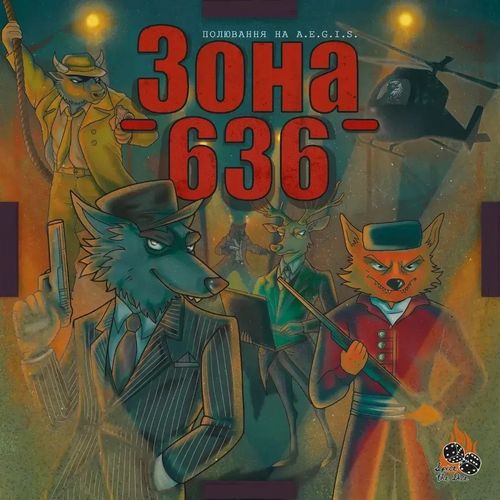
Area 636: Pursuit of A.E.G.I.S.
Area 636: Pursuit of A.E.G.I.S. Rulebook
Table of Contents
Table of Contents
Goal of the Game
Your task is to find and carry out the secret A.E.G.I.S. data fragments hidden inside Zone 636.
- In a 4-player game: 10 data fragments.
- In a 3-player game: 12 data fragments.
- In a 2-player game: 14 data fragments.
The first player to collect the required number of data fragments wins the game. The path to victory is hard: traps, armed guards and a high risk of mission failure await.
Note: the goal for the solo operation is on page 13.
Components
The box contains the following components:
- 71 cards (3 decks):
- 34 bonus cards (instant and permanent);
- 22 threat cards (base defence forces and traps);
- 15 data cards.
- Board: 49 modular tiles with different location types.
- Agent figures: 4 unique figures.
- Health tokens: 27 tokens for players and defence forces.
- Data fragment tokens: 30 tokens (13 tokens with a value of 2 and 17 tokens with a value of 1).
- Agent sheets: 4 sheets with the agents' parameters.
- Alarm sheet.
- Recharge trackers: 4 trackers, used on the agent sheets to track ability use.
- Defence force trackers: 15 trackers to mark active defence forces and their positions on the board.
- 1 alarm tracker.
- Dice: 2 dice used for combat mechanics.
- Rulebook: a book with a full description of the game mechanics and victory conditions.
Setup
Setup depends on the number of players. The example below is for a 4-player game.
- Prepare the board:
- Find the 4 starting locations and set them aside.
- Turn the other tiles face down and shuffle them.
- Build the board as a 7x7 grid following the layout in the illustration on page 6.
- Choose agents:
- Each player chooses an agent and receives the matching figure, the agent sheet with that agent's description, and a recharge tracker.
- Each agent has a unique skill that can be used during their turn:
- Taras Kovalenko can reroll a die.
- David Gilmore may, at the start of his turn, secretly look at one of the adjacent face-down locations.
- Lorenzo Volpe may move 2 tiles per turn.
- Marek Zubrovsky may stun an opponent, making them skip their next turn.
- At the start of the game the skill is fully charged: the tracker is set to the maximum value on the agent sheet. After use, the tracker drops to 1 and starts a new recharge cycle. At the start of each following turn the tracker moves up one mark until it reaches its full value. Some bonuses can speed up the skill's recharge.
- Shuffle the decks:
- Shuffle the bonus deck and deal 3 cards to each player. Place the remaining cards near the board.
- Shuffle the data and threat decks and place them next to the board.
- Prepare the tokens: place all health tokens, data fragment tokens and defence force trackers on the table in a convenient place.
- Prepare the alarm sheet and the alarm tracker.
Setup for 2, 3 and 4 Players
Between 2 and 4 players can take part (the solo operation is described separately). The position of the starting locations changes with the number of participants:
- 4-player game: the starting locations are placed in the four corners of the board. Each player begins on the starting location nearest to them.
- 3-player game: two starting locations stay in the corners, and the third is placed in the middle of the corresponding side of the board (between the two corner locations).
- The unused starting location is hidden among the face-down tiles. If it is revealed during play, it counts as an empty tile.
- 2-player game: the two starting locations are placed in the centre of opposite sides of the board.
- The two unused starting locations are also placed among the face-down tiles and count as empty tiles if revealed.
The layouts for 4, 3 and 2 players and for the solo operation are shown as illustrations on pages 6 and 7 of the rulebook.
Game Modes
The explanation of play is based on the base mode, given below. It is the foundation of the whole system, with a clear goal, basic risks and typical combat and exploration dynamics.
There are 2 game modes, plus the description of the solo operation:
- Base mode. All the rules described below apply to this level. This is the main version of the game.
- Family mode. Minimal risks. In battles between agents, health tokens are not lost; instead, data fragments are transferred. Ideal for a first introduction to the game.
- Solo operation. A mode for one player. The agent starts in the very centre of Zone 636, completely isolated. The base mode rules apply. The goal is to survive and carry 12 data fragments out alone, returning to the starting location.
Turn Structure
A turn is divided into 2 phases:
- Movement and interaction with the location the player moved into, or a battle with another player.
- Drawing or exchanging bonus cards.
Phase 1: Movement and Interaction with Locations
A player may move to any open or new adjacent tile: vertically, horizontally or diagonally. If the tile is not yet open, the player opens it and interacts with the type of location found there. During the turn the player may use their unique ability according to its effect and description on the agent sheet.
At any moment of the first phase, the player may use any number of instant bonus cards and place (or replace) a permanent bonus card on the table. Only one permanent bonus card may be on the table at a time.
Phase 2: Drawing or Exchanging Bonus Cards
After moving and interacting with a location, the player moves to the second phase:
- If the player has fewer than 3 bonus cards in hand, they draw only 1 card from the deck, regardless of how many cards they are short of 3.
- If the player has 3 cards in hand, they may discard 1 bonus card to the discard pile and draw 1 new card from the deck instead.
- If the player used all 3 bonus cards during the turn, they still draw only 1 card from the deck.
- If the bonus deck runs out, shuffle all cards from the discard pile to form a new bonus deck.
Location Types and Their Effects
Threat
When a player opens a tile with a threat card, it may be:
- Trap. The player immediately interacts with the trap according to its effect.
- Defence forces. The defence forces representative card is placed on the table next to the board. The player takes the tracker of the corresponding base guard and places it on the matching tile. The representative's health tokens are placed next to the card according to its characteristics. Some enemies have passive abilities that make combat harder; these abilities are shown on their cards. After this there are 2 ways events can go:
- a. Combat begins (see the conditions in the next section).
- b. The player avoids combat with a bonus card or a unique ability.
After defeating a defence forces representative or interacting with a trap, the tile does not become safe. The next entry onto this tile generates a new threat and raises the alarm level.
Exception: a forced retreat onto this tile (see the Alarm section).
Data Fragments
When a player opens a tile with data fragments, the player draws a data card. Possible results:
- Gain 1 or 2 data fragments.
- Misleading data that harms the player.
- Empty data carriers that bring neither benefit nor harm.
Empty Tile
Nothing happens. The player may continue moving on their next turn.
Secret Passage
If more than one secret passage is open, the player may instantly move to any other open secret passage of their choice.
Medical Post
When this tile is opened, 3 health tokens, each worth 1 health point, are placed on it. During their turn a player who has lost health may take 1 token. On their next turn they may take another token instead of moving. The remaining tokens may later be picked up by other players.
General Adams' Notebook
A notebook with detailed blueprints and notes on A.E.G.I.S. that instantly gives +3 data fragments.
Evacuation Started
When this tile is opened, the player immediately returns to their starting location.
Laser Beams
These tiles are impassable obstacles. A player may not enter such a location, and may not open new tiles in that turn.
Alarm Sheet
The alarm level is tracked with a tracker on the alarm sheet.
- Starting value: 0 (in the top left corner of the sheet).
- Maximum value: 10.
The alarm rises (+1) when:
- A player opens a tile with a threat (of any type).
- A player receives a wound from a defence forces representative. (Wounds from traps or from other players do not raise the alarm.)
The alarm falls (–1) when:
- A player inflicts a lethal wound on a defence forces representative without using bonus cards in that round.
Important: if bonus cards were used in earlier rounds in which the base defender did not receive a lethal wound, this does not affect the ability to reduce the alarm later.
Special conditions:
- If a player retreats onto a tile with a threat (for example after receiving a wound, or thanks to a bonus), then the threat is not activated and the alarm does not rise.
Defeat:
- If the alarm tracker reaches 10, the game ends in defeat for all agents. You have been discovered. Reinforcements have arrived in the zone. Zone 636 is isolated.
Combat with Defence Forces
Starting Combat
If a player has no bonus card that allows them to avoid combat, they enter combat immediately.
The player may use any of their permanent or instant bonuses before combat begins, in any quantity. The exceptions are the cards "Continuous Fire" and "Polarized Shield", which may be used after the combat, since they only strengthen the result or depend on it. All other cards must be used before combat begins.
Card names in this rulebook are the transcriber's English renderings of the Ukrainian card titles.
The player rolls the die for their agent, and another player rolls the die for the defence forces representative. Strength is calculated as follows:
- Player's strength = base agent strength + permanent bonus + instant bonuses + die.
- Defence representative's strength = base strength (1–3) + die.
The numeric base strength and recharge values printed on the agent sheets are too small to read in the source PDF and are not transcribed here; use the physical agent sheets.
Combat Result
If the player's strength exceeds the opponent's, the player inflicts 1 wound on them (or more, if the corresponding bonus cards were played). If this is the last wound, the opponent is defeated, and the player receives the number of data fragments shown on the defence forces representative's card. The defeated representative's card is sent to the threat discard pile.
If the player won the round but the opponent still has health tokens, the tracker stays on the board and the player may repeat the attack in the same turn (until the opponent loses all health tokens or the player receives 1 wound), or may choose not to.
All bonus cards used in the first round are sent to the discard pile. The player may play new ones if they have them in hand. New bonus cards are not drawn until the end of the player's turn.
In case of a draw, both sides roll the die again in the same turn, and the bonuses played at the start of the turn remain active.
If the player loses the round, they lose 1 health point. The player may use a bonus to avoid losing the health point. After a defeat the player must retreat to the nearest open location. On their next turn the player may return to the battle or take another route. On their turn, any other players may try to fight the defence forces representative.
If a player loses all of their health tokens, they leave the game. Their data fragments are sent to the discard pile.
Defence Force Movement
Waiting after combat:
- After a battle with a defence forces representative in which the player received a wound, the player retreats, and the base guard's token stays on the corresponding tile.
- Immediately after the battle the guard is inactive for 2 full rounds (that is, two full cycles of all players' turns).
- To mark this, the representative's token is placed face down (inactive).
- After the first full round the token is turned face up, signalling that the representative will begin to move in the following round.
Movement:
- An active defence forces representative moves 1 tile per turn.
- Its route is the shortest open path to the nearest agent.
- A defence forces representative may not use secret passages.
- If an agent appears who is closer, the representative changes its target to that agent.
Combat:
- Combat begins when a defence forces representative reaches an agent and that agent's turn comes. Until then the representative is merely on the agent's tile and does not initiate combat.
Delay after repeated combat:
- After combat ends, if the defence forces representative wounded the agent, the guard becomes inactive for 2 full rounds, and the corresponding agent retreats according to the basic rules.
- The token is turned face down again and waits for activation following the same scheme as at its first appearance.
Combat Between Players
Combat begins instantly when one player enters a tile where another player is. Both players roll the die:
- Attacker's strength = base strength + permanent bonus + instant bonuses + die result.
- Defender's strength = base strength + permanent bonus + permitted instant bonuses + die result.
The rulebook's example shows an agent with base strength 2, a die result of 2, a +1 permanent bonus and a +1 instant bonus, giving a total strength of 6.
Result:
- If the attacker's strength exceeds the defender's, the attacker inflicts 1 wound. If this is the last wound, the defender is defeated.
- The winner may use a "Continuous Fire" card to inflict an additional wound. The card is used after the combat.
- No more than one "Continuous Fire" card may be used per round.
- The defeated player loses 1 health point (or 2, if a "Continuous Fire" card was used).
- If the defeated player has a "Polarized Shield" card, they may discard it to avoid losing 1 health point.
- Even if the attacker won, they may not begin a new combat with the same defender in the current turn.
- After a defeat, the defeated player retreats to any nearest open location. On their next turn they can be attacked again!
- If one of the opponents loses all of their health points, the winner receives all of the defeated player's data fragments.
- The defender does not draw bonus cards, because it is not their turn, even if they used all the bonus cards in their hand.
Remember: a skilled combination of bonuses is the key to success in battle. Always watch the bonuses in your hand, play them, and swap out the ones you do not need.
Victory Conditions
The player who reaches the required number of data fragments wins:
- 4 players: 10 fragments.
- 3 players: 12 fragments.
- 2 players: 14 fragments.
If all tiles of the board are opened during play and no player reaches the required number of data fragments, the agents are forced to fight for resources or to open threat tiles anew. The player who wins a combat and forces the opponent to lose all of their health tokens receives all of the defeated player's data fragments. Battles continue until one of the players collects the number of data fragments needed for victory.
Family Mode and Solo Operation
Family Mode
For those who want to explore the game without the risk of full elimination.
- Combat with defence forces remains unchanged.
- In combat between players (PvP), health points are not lost. Instead, the losing player loses 1 data fragment. They retreat according to the standard rules.
- The "Continuous Fire" card allows taking 2 data fragments (instead of 2 health points).
- "Polarized Shield" blocks the loss of a data fragment instead of health.
This is the ideal variant for a first acquaintance with the game, for family games, or for players who dislike "permanent death".
The goal of the game stays the same: the number of data fragments needed for victory depends on the number of players, just as in the base mode.
Combat between players does not lead to the full elimination of either player.
Base Mode
The base mode is the one described in the rules above.
- Standard dynamics: battles between players lead to the loss of health tokens.
- Full elimination from the game is possible.
Solo Operation
You are alone. No allies. No conspiracy. Only silence on the airwaves and an unknown noise in your earpiece.
And 49 sectors that want to kill you.
Solo mode is for those who want to test themselves: can you survive without support, making every decision on your own?
Goal:
Collect 12 data fragments and leave Zone 636 alive through your starting location.
Basic rules:
All standard rules remain, with these exceptions:
- The game loses the PvP element (player against player).
- The game focuses on PvE mechanics (player against game).
- After collecting 12 data fragments, they must be "carried out", that is, the player must return to their starting location.
The agent's starting tile is at the centre of the board: in the 4th row and 4th column (coordinates 4×4). There are 3 tiles on each side of it. There is no safe direction. You are in the very heart of hell, and this is only the beginning.
Ending: Choice of Fate
In the depths of Zone 636 lies not just technology, but a power capable of changing the world. Each move across the board brings you closer to the truth, or to defeat.
Deadly lasers, secret passages, guards who know no mercy, and data carefully protected from outsiders await you. But the greatest threat is the other agents, who want to take everything for themselves. You are not a hero. You are a tool of your state. But it is up to you whether your country gets a chance at a new era or loses it for good.
Forward, agents! Glory to your people and your country!
Frequently Asked Questions
Q: What should I do if my character starts surrounded by laser beams on all sides? A: Ignore one of the beams and pass through it as if it were an empty tile (only on the first turn).
Q: How do the bonuses "Polarized Shield" and "Medical Injector" work with the alarm tracker? A: The shield blocks the wound, so the alarm does not rise. The injector simply adds 1 life.
Q: What happens to a permanent bonus when it is replaced? A: The bonus returns to the player's hand. It can be placed again, or discarded, on the next turn.
Q: Can you attack "inactive" defence forces (token turned face down)? A: Yes. The guard does not move, but it guards the tile. The alarm rises only after its successful attack, not at the start of the combat.
Translator's note: the pronoun "its" in this answer is ambiguous in the Ukrainian text (it may refer to the guard or to the attacker); it is kept as printed.
Q: If a guard is equally close to two agents, where does it go? A: Both agents roll the die. The guard goes toward the one with the lower result.
Q: A player must lose 1 fragment but has only a "2" token, or nothing. What happens then? A: If there is nothing, the effect is ignored. If there is only a "2", it is exchanged for a "1" token.
All additional questions and answers are available through the QR code on the following page.