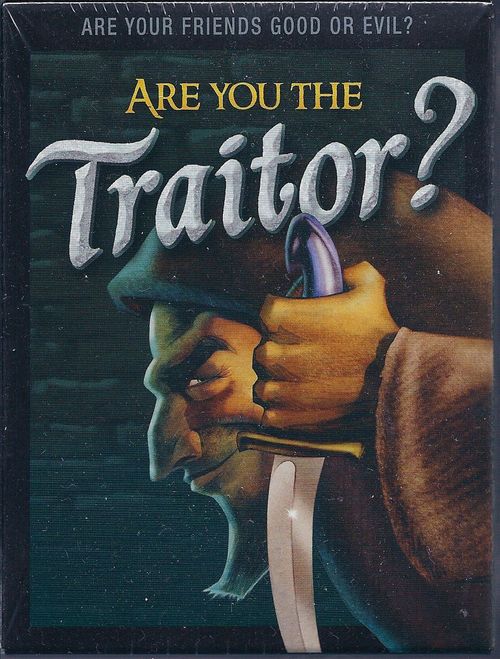
Are You the Traitor?
Are You the Traitor? Rulebook
Table of Contents
Table of Contents
Story Overview
It's the moment of truth in your quest to destroy the Evil Magic Key. The Adventurers have encountered two Wizards: an Evil Wizard who wants the Key, and a Good Wizard who can destroy it. Unfortunately, you can't tell them apart because the Evil Wizard has enchanted himself so that he looks exactly like the Good Wizard! So, who do you give the Key to? Choose quickly, before the Evil Wizard realizes who has it and grabs you! And be careful who you listen to — at least one of your trusted guards is secretly a Traitor!
Gameplay Overview
Each round, everyone is assigned a secret character and is on either the Good or Evil team. Depending on who you are, you may be trying to figure out who the Keyholder is, or who the Traitor is, or if a given Wizard is Good or Evil.
Each short round consists of unstructured conversation among all the players. As soon as you think you have figured out who is the person you're trying to find, you point at that person and say "Stop!" As soon as someone calls "Stop!" the round is over, everyone reveals their characters, and you see if the call was correct. If so, everyone on that team gets a Treasure card, if not, the other team gets Treasure. A game consists of multiple rounds, with players getting new characters each round.
Setup
The game contains:
- 4 Wizard Alignment cards
- 10 Character cards
- 42 Treasure cards
Separate out all the Treasure cards and stack them into a deck, face down. Next, look at the chart below to see which Character and Wizard Alignment cards you need, which will depend on how many players you have.
Character Cards and Wizard Alignment by number of players:
| Players | KeyHolder | Traitor | Guard | Wizard | Good Alignment | Evil Alignment |
|---|---|---|---|---|---|---|
| 4 | 1 | 1 | 1 | 1 | 1 | 1 |
| 5 | 1 | 1 | 1 | 2 | 1 | 1 |
| 6 | 1 | 1 | 2 | 2 | 1 | 1 |
| 7 | 1 | 1 | 3 |
Starting a Round
Assign Characters: Shuffle up the Character cards and deal one to each player. Anyone dealt a Wizard card immediately reveals it. Everyone not dealt a Wizard card is an Adventurer, and keeps their Character card hidden, except as noted.
Reveal KeyHolder: Skip this step if playing with 4 or 5 players. The KeyHolder reveals herself to her fellow Adventurers, but not the Wizards. To do this, have someone say the following: "Wizards, close your eyes. KeyHolder, reveal your card." (The KeyHolder reveals her card, silently making sure every other Adventurer has seen it, then hides it again.) The reciter continues, "Wizards, open your eyes."
Reveal Traitors: Skip this step if playing with fewer than 8 players. When there are multiple Traitors among the Adventurers, the Traitors get to know who each other are. Have someone recite the following steps: "Everyone, close your eyes. Traitors, open your eyes." (Traitors open their eyes, and silently acknowledge each other.) After a pause, the reciter continues "Traitors, close your eyes. Everyone open your eyes."
Assign Wizard Alignments: Mix up the Wizard Alignment cards and have Wizards choose one at random, which they look at and keep hidden.
Playing a Round
A round consists of unstructured conversation between all the players, as each person tries to figure out who their target person is. See the chart below to see who is looking for whom.
POINT & SAY "STOP!" — Your team wins if you are pointing at the right person.
The chart is laid out as two teams. The Good Team: KeyHolder, Good Wizard, Guard. The Evil Team: Evil Wizard, Traitor. Arrows on the chart show which role each player is pointing at. Traitors Can't Call Stop!
When someone thinks they have figured out who their target person is, they should raise one hand, point at that person with their other hand, and say "Stop!" in a loud clear voice. At that point the round is over, and everyone must reveal their cards.
Note that the Traitor is the only one who cannot call "Stop!" to end the round, and that no-one's goal is to target the Evil Wizard.
Winning a Round
When someone calls "Stop!" and is correct, everyone on that person's team draws a Treasure card. If the call was incorrect, then everyone on the other team gets a Treasure card.
Good players get a Treasure card if:
- The KeyHolder chooses a Good Wizard;
- A Guard or Good Wizard grabs a Traitor;
- An Evil Wizard grabs someone other than the KeyHolder.
Evil players get a Treasure card if:
- The KeyHolder chooses an Evil Wizard;
- An Evil Wizard grabs the KeyHolder;
- A Guard or Good Wizard grabs someone besides a Traitor.
Magic Rings
Once players begin to accumulate Treasure cards, a moment will need to be given between each round to allow anyone with a Magic Ring to use it. This Treasure has a special power: when invoked, you get to steal one card from another player's Treasure pile. The card you get will be chosen randomly, unless the player you are stealing from has a Gilded Statue, in which case you have to take that card. Each Magic Ring can be used only once per game. After use, set the card aside until the next game.
Winning the Game
After each round, Treasure cards are awarded, worth 0 to 5 points. Rounds continue until someone has 10 points or more worth of Treasure cards. Whoever has the most points wins!
Who's Who?
While the intertwining plotlines may seem complex at first, this game is really very simple. Everyone has a secret they are trying to keep, and everyone but the Traitor has a simple goal, which is to point at the person whose secret identity is indicated at the top of their Character card. Here's a look at each character and what they are up to:
KeyHolder: The KeyHolder is trying to figure out which of the two identical-looking Wizards is really the Good Wizard, so she can give the Evil Magic Key to someone who can destroy it. At the same time, the KeyHolder wants to avoid letting the Evil Wizard know she's the one with the Key, lest the Evil Wizard grab her and take the Key by force.
Evil Wizard: The Evil Wizard is seeking to determine which of the non-wizards is holding the Key, and make a grab at it. The Evil Wizard is also seeking to convince the KeyHolder to simply hand over the Key, by pursuading her that he's actually the Good Wizard. The Evil Wizard knows that one (or perhaps two) of the other players is a Traitor and that the Traitor knows the identity of the KeyHolder (unless playing with a small group). The Evil Wizard therefore is also trying to determine who the Traitor is, since A) you don't want to grab him by mistake, and B) he might be trying to tell you who has the Key.
Good Wizard: The Good Wizard is trying to convince the KeyHolder that he really is the Good Wizard and therefore should be given the Key. However, the Good Wizard will not grab at the KeyHolder, even if he figures out who has the Key. He will accept the Key if given it, but only an Evil Wizard will assault someone in order to obtain the Key. More to the point, the Good Wizard is focused on trying to grab the evil Traitor.
Guard: The Guards are looking for the Traitor, whom they know is hiding in their midst. They also seek to conceal the identity of the KeyHolder, and may even draw the fire of the Evil Wizard away from whoever actually has the Key, by claiming to actually be the KeyHolder. Guards may seek to determine which Wizard is which, so that they can help the KeyHolder make the right choice, and to make themselves appear to actually be the KeyHolder, and thus trick the Evil Wizard into making an incorrect choice. But mostly, the Guards are trying to locate and point at the Traitor.
Traitor: The Traitor is mainly trying to avoid getting caught. Besides this, the Traitor wants to figure out which Wizard is Evil, and perhaps signal to him that he's on the Evil team too, but this is very tricky and can interfere with job #1, i.e. Not Getting Caught. That said, it's very useful to your boss the Evil Wizard if you can let him know who you are, so that he doesn't grab you by mistake. Even better, if you can do it, is to tip off the Evil Wizard as to who the KeyHolder is, so that he can just grab the Key. The way you signal him is up to you, but be careful that no one else sees you doing it. Remember, most of the other players are looking for you, so be very careful. Also, don't try it if you aren't sure about which Wizard is which, because if you guess wrong and signal the Good Wizard, he'll grab you instantly. Sometimes it's better just to focus on not getting caught.
Treasures
Here's a list of the Treasures and how many there are of each:
| Treasure | Points | Number |
|---|---|---|
| Crown Jewels | 5 | 2 |
| Platinum Pyramids | 4 | 5 |
| Bags of Gold | 3 | 12 |
| Silver Goblets | 2 | 11 |
| Chest of Copper | 1 | 5 |
| Magic Ring | 1 | 5 |
| Gilded Statue | 0 | 2 |
Frequently Asked Questions
Q: Can I lie about who I am? A: Absolutely! This is a Deception Party Game, which means it's a game about pretending to be dishonest characters. It's about trying to figure out who is being truthful and who is misrepresenting themselves, so it's expected that some players will be lying. Claiming to be someone you aren't is NOT cheating – it's a vital part of the game.
Q: What happens if two people get ten points at the same time? A: In the event of a tie, all players continue with another round, until such time as a single winner is determined.
Q: What happens if two people call Stop at the same time? A: The group must come to a consensus about who was actually trying to call it first. Usually it's not really simultaneous.
Q: Can I stop someone from winning by using a Magic Ring? A: No. Once someone declares victory, it's too late to use a Magic Ring on them.
Q: Can I say I have a Gilded Statue, so that others won't want to use a Magic Ring on me, even if I don't really have one? A: Of course! This is a game about deception, so you are welcome to make any claims you might want. (But if they call your bluff and steal from you anyway, you must fess up and let them steal a random Treasure card as usual.)
Q: What happens if the Traitor forgets he's not allowed to call Stop and does it anyway? Or if a Guard tries to point at the Evil Wizard? Or if the KeyHolder calls out the Traitor? Or if the Good Wizard grabs the KeyHolder? A: Any of those mistakes count as a win for the other team.
Q: What should we do if someone accidentally exposes their card or otherwise compromises important secret data after the cards have been dealt? A: Start the round over.
Q: Do you get an extra Treasure card for being the player who correctly points at their target person? A: Sorry, no. Everyone on the winning team gets one Treasure card. (But maybe Fate will reward you with the Crown Jewels, or perhaps some Platinum Pyramids...)
Q: What exactly does the Evil Magic Key do? A: The Key unlocks an Evil Magic Book of Evil Magic Spells!
Q: What should I do if I still have unanswered questions? A: Visit the Looney Labs website to see if there are any more up-to-date FAQ files, or email [email protected].