Ardennes Petite: A Battle of the Bulge, Ardennes 1944, Minigame
Ardennes Petite: A Battle of the Bulge, Ardennes 1944, Minigame Rulebook
Table of Contents
Table of Contents
Combat Results Table
The combat results table is printed as follows (die roll columns A and B, then the combat odds columns):
Die Roll    Combat Odds
A    B      1:2   1:1   3:2   2:1   3:1   4:1

6    1      DR    DR    DR    DR    DR    DR
5    2      DW    DW    DW    DR    DR    DR
4    3      D     DW    DW    DW    DR    DR

3    4      -     D     D     DW    DW    DR
2    5      AE    -     D     D     DW    DW
1    6      AE    AE    -     D     D     DW
Final attacking odds less than 1:2 are not allowed. Odds can be no greater than 4:1. Attacking is voluntary and may be regardless of other adjacent enemy-occupied hexes. A unit with 0 attack factor may join in an attack with attack-factored units (even on other hexes), being able to tactically advance after combat and also possibly denying enemy retreat hexes, but may not attack by itself.
Combat Results Definitions
- DR = Defenders ROUTED and Disrupted and must be withdrawn 1 hex by Defender.
- DW = Defenders WITHDRAWN 1 hex by Defender but are not Disrupted.
- D = All Defending Units DISRUPTED. Defender may instead voluntarily choose to retreat 1 hex and NOT be Disrupted, but the Attacker may then advance accordingly.
- - = No effect against either side.
- AE = Attackers (equal to defense factors) ELIMINATED.
Disruption
A Disrupted unit may not move (except to retreat during/from a battle) or attack. When Disrupted, a unit is faced toward the enemy. Combat results against defending Disrupted units, even behind rivers, are read 1 column higher.
Retreats and Advances after Combat
A defending unit cannot retreat into a hex adjacent to a hex it was attacked from, unless there is a friendly unit in the hex and that is not under an as yet unresolved attack itself or unless the (empty) hex is across a river from the attackers and (only in this case) the defender does not have to cross a river to get to it - otherwise, units may cross a river when retreating, except for armored units across hex-side B3\C3. And if a unit cannot retreat, it is elminated by a DR (but only Disrupted by a DW) result.
No Retreat! In any individual battle, the Defender may give his units No Retreat! orders, in which case a DW becomes just a D, and a DR eliminates the defending units! If a hex is cleared of defenders, victorious attacking units at least equal to the defenders' factor strength (if possible) must advance into it.
Special Rules
Printed spellings are kept as they appear in the source (for example "elminated", "figherbomber", "infantrie", "Amoured").
German Pressed Attack. In any attack at final odds greater than 1:2, the German player may invoke this, before the U.S. player may declare No Retreat! He moves the combat odds up one column his die roll's best 3 numbers, but accepts the risk of instead having to use a combat odds column one column lower, if he rolls one of the worst 3 numbers.
Nuts! Either player may issue a surrender ultimatum to out of supply enemy units, prior to a (then mandatory) attack. Against defending hexes containing any airborne, SS, and British units, his combat odds increase by one column if he rolls his 2 best numbers - against any other enemy units, if he rolls his best 3 numbers - and his combat odds increase +1 column. If he rolls any other number, the defenders are not intimidated, his combat odds are reduced 1 column - and if the Allied player replies "Nuts!," the German player may never issue a surrender ultimatum again.
Airborne Toughness. Against a U.S. airborne unit (even if it is Disrupted) a DW becomes a D and a D becomes a -, with no Disruption.
4th Armored Division. If 4th AD is involved in an offensive or defensive battle involving any German panzers - but not just panzergrenadiers - the combat odds are shifted 1 column to the Allies' favor.
14th U.S. Cavalry Group or Fuehrer Begleit, if alone when attacked. The attack is an automatic 4:1 or (always) 3:1 cross-river. However, the result is worsened up a level, if it is already Disrupted: for example, a DR would eliminate it, while an AE would be a -. If part of an attack, 14th CavGp can only deny German retreats into its own hex - not into adjacent hexes.
Waffen-SS Ruthlessness (and consequential GI Rage). During any one game-turn, if the German player decides to invoke/use Waffen-SS Ruthlessness, there is a +2 shift bonus in the odds of any German attack which includes 1 or more SS units. In every turn thereafter, Allied units receive a +1 shift bonus, when defending against any attack containing an SS unit. After the 4th turn, the SS attack bonus is only a +1 shift.
Weather. The first 2 turns are Bad Weather. The third turn, the Allied Player's roll of 5-6 means good weather and its consequences - U.S. AIRPOWER. In every turn thereafter a die roll of 4-6 means Good weather. After the first 2 turns, if there have been 2 consecutive turns of the same kind of weather, the next turn must be the other kind.
Patton's Prayer. In any one turn after the first 3 turns, the Allied player may invoke General Patton's weather prayer to God, adding 1 to the Weather Determination die roll. (And historically, God granted his appeal.)
USAAF Airstrikes and Strafing. During a Good weather game-turn, each U.S. fighterbomber unit may fly 1 airstrike and 1 close air support mission. (Strafing speeding German units in Good weather does not count against these missions.) At the very start of a Good weather German turn, each of the U.S. fighterbomber units can airstrike 1 hex containing German units, attacking each unit therein individually.
German Antiaircraft. For each panzerkorps and each complete pair of infantrie korps or divisions, the German player can roll an antiaircraft die - 6s shooting down P-47s and 5s or 6s shooting down P-51s - P-51s being more vulnerable to groundfire - knocking them out of the battle for the rest of this and the next turn. The 2 best die rolls Disrupt a German unit, but it may not retreat. If, during Good weather, the German player moves any of his armor-type units faster than their Reserve movement rate, that unit suffers Strafing - the best 2 rolls Disrupting it - with no risk to air units.
U.S. Army Air Force Close Air Support. In Good weather, during an operational or reserved Allied attack, each of the figherbomber units can be used to increase the odds of one Allied attack +1 column with no risk to the air units. Both may be used in the same attack.
Defensive Terrain Bonuses
Cumulative - see also stacking/attacking capacities.
Hills. Infantry units - panzergrenadiers are considered armor-type units, not infantry - have their defense combat factors doubled, even if Disrupted.
Rivers. If more than half of the attack factors are attacking cross-river, the combat odds are reduced 1 column, and can never be more than 3:1, in any case. Armor and panzers attack cross-river at half their total units' value, with any fractions retained. (Thus, a 1-factor German inf. korps and 2nd PzDiv attacking cross-river would be 1.5.)
Namur and Liege. If there is any UnDisrupted infantry among the defenders in one of these cities, those defenders receive 1 additional combat factor.
The hex-side twixt Parker's Crossroads and Marche is impassable to armor-type units.
Fortification. Instead of moving/attacking, an UnDisrupted infantry corps/korps - even if out of supply - may be flipped over to its fortified status and becomes 1 combat factor more powerful on defense, and can be further bonused as such - even doubled - by terrain. It loses its fortified status, if it moves (or is moved/retreated) or attacks. An already Disrupted fortified corps/korps suffering a D combat result loses its fortification.
Stacking, Hex-side Attacking Capacity and Road Congestion
There may be any number of units in a hex, but only 4 of them of the owning player's choice may actively defend. Others suffer the same combat result.
Hex-side attacking capacity.
- In each phase - Operational and Reserve - a limit of 3 units may attack across each normal terrain hex-side. Of these:
- a. Not more than 2 may be armor/panzer, and not more than 1 of those may be a panzerkorps.
- b. Not more than 2 may be infantry corps/korps or panzerkorps unit level.
- Not more than 1 armor/panzer unit of whatever size may attack into or out of hill terrain.
Road congestion (not applying to partial, entry/exit hexes). In normal terrain, there may be 2 armor-type units - not more than one of them being a panzerkorps - in a hex without penalty. However, if the owning player moves another armor-type unit into such a "full" hex, it is immediately Disrupted, and cannot move further or attack during that player-turn. The unit is recovered from Disruption as usual, and there may then be armored units in excess of normal capacity, to move - and/or attack - off of the hex in the owning player's following player-turn.
The armor-type unit road capacity of hill terrain is only 1 unit of whatever level.
Movement and Attacks
Operational Movement and/vs. Attacks. During initial Operational Movement, infantry can only move 1 hex to attack, while armor-type units can move 2 to do so. All units can move one additional hex if not attacking, so during Operational Movement armor-type units (including Allied infantry which had trucks and fuel) can thusly move 3. A unit may not move directly from one hex adjacent to an UnDisrupted enemy corps/korps to another hex adjacent to that same enemy corps/korps unit, unless moving into a hex already occupied by a friendly unit or unless either hex is separated from the enemy unit by a river or unless tactically advancing into a vacated hex after combat. See also Supply.
Reserve Movement and Attacks. Units not moved or not attacking in the initial operational phase may do so in the Reserve phase. During Reserve Movement, units move 1 hex less in all cases - thus, armor-type units could only move 1 hex to attack or 2 hexes if not attacking, while infantry could only attack already-adjacent enemy units or move 1 hex without attacking.
German Fuel Limitations and the 1st Army Fuel Dump at Spa. Fuel was in very short supply in the German Army, so after the 3rd game-turn, all Operational German armor-type movement is limited to that of Reserve movement, unless the Germans take (and keep) the U.S. 1st Army fuel dump in Spa in the first 2 game-turns. If the Germans do so, their full operational armor-type movement is extended through the 6th game-turn. The fuel dump has an intrinsic defense factor of 1, permanently lost if the dump is taken.
Mapboard Edge and Exit Route Combat and Control. If a German unit voluntarily exits a northern exit route (for victory points), northern Allied reinforcements may not be brought into the game on the exit hex. Any defending unit forced by combat to retreat off the board is considered eliminated and does not count for victory points - see Winning. An Allied unit can voluntarily retreat off a mapboard edge to come back on along it 2 turns later. If a U.S. unit attacking from a partial off-board hex fails to advance after combat onto the board, it can retry on the next turn.
The Germans must "garrison" the N and S mapboard edge hexes they have taken, to control/hold them. Furthermore, if there is an UnDisrupted German korps on (for example) D5, a map-entering U.S. unit could not cross the (in this case southern-most) mapboard edge hex-side of an unoccupied C5 or E5 to enter the board - even in the case of a tactical advance after combat - regardless of the rivers/terrain. The korps would have to be attacked and retreated or Disrupted first.
Supply
If a unit cannot trace a line to its side of the board, it is out of supply and may not attack. (As supply sources, the Germans have the East side and the Allies the three others, unless/until controlled by the German player.)
A supply line can be traced through any friendly-occupied hex. It can be traced through an empty hex, unless that is adjacent to an UnDisrupted enemy corps/korps which is not separated from the hex by a river.
Units are eliminated if they Disrupted at the moment of supply determination, unless they are stacked with other units which are not Disrupted. UnDisrupted units out of supply are then Disrupted with the chance of being eliminated during the owning player's supply status determination phase next turn, if they cannot be resupplied. UnDisrupted Out of supply armor-type units may not move. UnDisrupted out of supply infantry (and airborne) units may only move 1 hex.
In Good weather, all Allied units are considered to be (air-)supplied, even if they can't trace a supply line on the ground.
Setup and First Turn
German SS panzer units starting the game on the board do so from one of the attack/entry hexes adjacent to Losheim. Other starting German panzer units start on one of those hexes adjacent to Clervaux. One 2-factor and one 1-factor infantrie korps must start in each of those locations. (Those hexes may not be attacked by Allied units then or later: that was the Siegfried Line.)
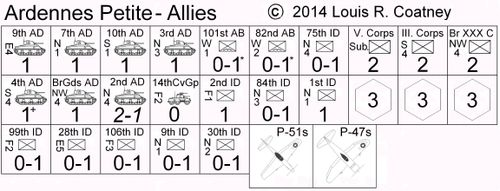
The 6 starting U.S. units have their positions on them, facing to the left/west.
A game goes no longer than eight 2-day turns - 16Dec44-2Jan45 - unless both players want it to continue longer.
Surprise! German attacks in the operational/first - not reserve - phase of the first German player-turn in the game are increased by a 1-column shift up in the combat odds.
Reinforcements
Reinforcements arrive at the start of a player's turn.
German reinforcements enter from their original attack hexes and have the gameturn (number) of their arrival on their eastern/righthand side. II. SS PzKps must enter in the north.
For Allied units, it is on their left side, and their edge of arrival is marked N, W, and S along with their entry gameturns. Note the S,W hex, where either W or S U.S. reinforcements may enter.
British XXX. Corps and Guards Amoured Division enter on Namur (or not at all).
The partial hexes from which reinforcing units enter are not counted against their movement.
V. Corps. At the start of his turn in any hexes numbered 1-3, the Allied player may combine - substitute - any 2 of his UnDisrupted Allied divisions already stacked together into V. Corps, which will be ready for immediate action.
Winning
St. Vith and Bastogne are each worth 2 victory points and Marche 1 for either side controlling them at the moment of victory determination (which the German can call at any time he has 6 or more victory points, presumably at his high water mark, in any of his Victory Determination Phases at the end of the Allied player-turn).
Each German panzerkorps exited in the north is worth 2 and every other panzer (but not panzergrenadier) unit is worth with limits of 1 each point for Liege and the hex north of Spa, 2 for Huy, and 3 for Namur. These panzer units are permanently removed from the game and count for victory permanently, even if a supply line to them is later cut.
When a German panzer exits off a northern victory point route, that route may no longer be used to bring on N Allied reinforcements.
- 5 German victory points is a draw - higher is a German victory to whatever degree - more than 8 points a crushing German strategic victory worth 2 games.
- 4 or less German victory points is an Allied victory, and 2 or less is a crushing Allied victory worth 2 games.
Game-turn Sequence
A. German Player-Turn
- After 2nd turn, Weather Determination - Allied player rolls the die - and U.S. airstrikes.
- German reinforcements and fortification.
- Operational Phases:
- a. Operational movement, including movement to attack.
- b. German attack resolutions and advances after combat.
- c. Reserve(d) units' movements/attacks.
- Recovery of German SS units from Disruption.
- German units' supply status determination.
- Recovery of other German units from Disruption.
- Allied Victory Determination after 5th turn. If German player has less than 3 victory points, the U.S. player may choose to end the game victoriously.
B. U.S. Player-Turn
- U.S./Allied reinforcements and fortification.
- Operational Phases:
- a. Operational movement, including movement to attack.
- b. U.S. attack resolutions and advances after combat.
- c. Reserve(d) units' movements/attacks.
- Recovery of U.S. airborne units from Disruption.
- Allied units' supply status determination.
- Recovery of other Allied units from Disruption.
- German Victory Determination and/or end of game (if German player has 5 or more victory points and chooses to do so).
Note: A unit may be operationally moved only once per operational phase by the owning player. A unit may additionally be tactically moved more than once - advanced after a successful attack it has participated in or retreated in defense during the opponent's combat resolution phase.
A game may be ended at whatever victory level at whatever point by mutual consent.