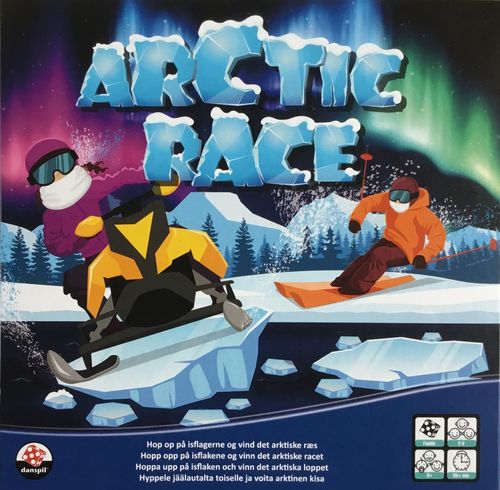
Arctic Race
Arctic Race Rulebook
Table of Contents
Table of Contents
Purpose of the Game
In Arctic Race each player controls 5 different racers (1, 2, 3, 4, 5), who compete in different races while affecting each other.
The game ends when a player has 3 of their 5 racers across the finish line, or when there are no more ice floe tiles to place on the river. The winner is the player with the most points for completed races.
Before the Game Starts
Each player chooses a colour and takes the matching 5 race cards, 1 player card and 5 racers. Choose a starting player (the youngest player), who places the start token on their player card.
Shuffle all the ice floe tiles and place them face down to the left of the game board.
Use all 30 ice floe tiles in a 6-player game. Remove 2 ice floe tiles in a 5-player game, 4 ice floe tiles in a 4-player game, 6 ice floe tiles in a 3-player game, or 8 ice floe tiles in a 2-player game. Then take the top 5 ice floe tiles and place them on the river (in the recess) face up. The numbers, dice icons, collection icons and arrows must have the same orientation as the board and its icons.
Components shown in the rulebook's setup illustration: game board (spilleplade), point board (pointplade), start token (startbrik), racers 1–5 (ræsere), die (terning), player card (spillerkort), race cards (ræskort), and an overview of the ice floe tiles (overblik over isflager).
How the Game Is Played
All players choose one of their 5 race cards and place it face down in front of them. When all players have done this, the player with the start token reveals their chosen race card.
Each card contains 2 or 3 actions, from which the player may choose:
- Card with the snowmobile (5): move racer 5 forward 5 spaces, or the start token changes owner.
- Card with the snowboarder (2): move racer 2 forward 2 spaces, or the player collects all of their played cards.
- Card with the dog sled (4): move racer 4 forward 4 spaces, or all ice floe tiles on the river are moved one step to the right.
- Card with the skier (3): move racer 3 forward 3 spaces, or the die is rolled to move a random racer.
- The last card: racer 1, racer 2 or racer 3 moves forward one space.
(The actions on the cards are described in more detail in a later section.)
When the starting player has revealed their chosen card and carried out one action from it, the turn passes to the next player clockwise. That player reveals their chosen race card, carries out one of the actions on it, and so on.
When a card has been used, it stays on the table face up. Players may not collect the revealed cards back, so they must choose a different card in the next round. Each newly revealed card is placed on top, so that only the most recently played card is visible.
A new round starts after all players have revealed their card and carried out an action. The player with the start token starts the new round.
Illustrated sequence: Choose card (a card is chosen and ready to be revealed) → Reveal card (the card is revealed and one of its 2 actions is chosen) → Cover earlier cards (after one of the card's actions is carried out, the card is placed on top of the previously revealed/played cards).
As shown, one card has the hand icon, which can be chosen and used to collect all of the player's played cards (the used cards lying on the table), even if that is the only card played. If a player plays their fifth card (there are no more cards in hand), the player must choose an action from the card, and when the round ends, the player collects all of their cards.
If a card with a racer who is already at the finish is played, the card's other action must be carried out. When the card that allows moving racer 1, 2 or 3 is chosen, it must always result in one of the three racers being moved one space forward.
Game Icons
- +1, +2, +3: If a racer lands on +1, +2 or +3, the racer then moves the indicated number of extra spaces forward.
- Start icon (green circle), or START on the snowmobile card (5): the player must choose a new player to receive the start token. This can be any player, as long as the start token is moved. The round is finished before the effect of the moved start token takes effect. Note that the start token can be moved several times during a single round.
- Arrow icon (red circle), or the arrow on the dog sled card (4): a new ice floe tile is inserted, which pushes the ice floe tiles one step to the right. The ice floe tile that is pushed off the board is removed from the game, and racers on that ice floe tile are pushed off with it and returned to their players, and must therefore start their race again from the beginning.
- Die icon (purple circle), or the die on the skier card (3): the die must be rolled. The number rolled corresponds to the player's racer with that number, which must be moved: roll 5 and the snowmobile (5) moves 5 spaces forward; roll 4 and the dog sled (4) moves 4 spaces forward, and so on. If a number is rolled where the corresponding racer is already at the finish, nothing happens. If a black circle is rolled, the player freely chooses one of their racers and moves it one single space. It is possible to get several moves and roll the die again, as several die icons can be activated in the same turn.
- Hand icon (blue circle): if a racer lands on the hand icon, or the hand is chosen on the snowboarder card (2), the player immediately collects all of their played cards.
More on Racer Movement
To reach the finish, a racer must move off the board's last space at the top right and onto the point board.
If a racer lands on top of one of the other racers, it must continue to the next free space. Racers must always move toward the finish when they move.
In the example illustration, the red snowmobile (5) moves 5 spaces. The yellow skier (3) moves 3 spaces and lands on top of another racer (the red skier 3), so it continues to the space with +2, moves 2 more spaces, lands again on top of another racer (the blue snowboarder 2), and then moves one more space to the next free space. The blue dog sled (4) has to move 5 spaces, as its 4th space is occupied. The space is then activated, and the ice floe tiles are shifted.
Illustration caption: Example of racer movement.
How to Win
All racers with the same number compete in the same race. The game ends after a round in which at least one player has 3 of their 5 racers at the finish.
The races for the snowmobile (5), the dog sled (4) and the skier (3) all have the same point distribution: 5 points for first place, 3 points for second, 2 points for third, and 1 point if the racer finishes outside the top 3.
The race in which the snowboarder (2) takes part has the point distribution 6, 4, 3, 2.
The race in which the cross-country skier (1) takes part has the point distribution 7, 5, 4, 3.
Racers that do not reach the finish give no points.
The winner is the player with the most points when the game stops. If there is a tie, look at the individual races. First look at the placement of the cross-country skiers (1): the best placed among the tied players with the most points wins. If there is still a tie, look at the placements of the snowboarders (2), where the best placed wins, and so on.
Alternative End of the Game
The game can also end when there are no more unused ice floe tiles to place on the board. In this case, the round is finished with 4 or fewer ice floe tiles left on the board, after which the game ends. A racer that as a result ends up in the river is returned to its player.
Score-table illustration (as printed): cross-country skier (1), yellow, 7 points for first place; no snowboarders at the finish; skier (3): green 5, yellow 3, red 2 points; dog sled (4): red 5, purple 3, orange 2, green 1 point; snowmobile (5): blue 5, green 3, purple 2 points.
Example point count in a 6-player game (as printed): Yellow 7 + 3 = 10 points; Purple 3 + 2 = 5 points; Green 5 + 1 + 3 = 9 points; Blue = 5 points; Red 2 + 5 = 7 points; Orange = 2 points.