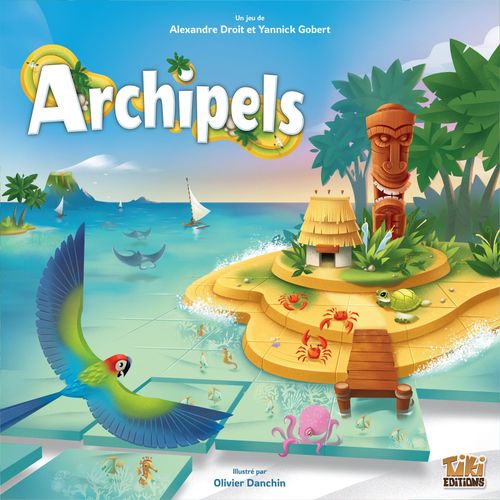
Archipels
Archipels Rulebook
Table of Contents
Table of Contents
Components & Setup (3 or 4 Players)
For 2-player games, see the special rules at the end of this rulebook.
A Game Board. Before your first game, assemble the 3D board as shown in the assembly guide. You won't need to disassemble it; it fits in the box as is.
B 142 Island Tiles. Shuffle and stack them face down. Draw 20 tiles and place them face up on the sea spaces of the board.
For 3 players: Place one paddle on a board edge. It stays there all game. Do not place tiles under this paddle. Only 17 tiles will be on the board.
C Score Board. Place it next to the main board.
D Day Counter Token. Place it on the first day space of the score board.
E 7 Starting Score Tiles. Shuffle and draw 4 at random. Place them on the matching animal spaces of the score board. Return the unused 3 tiles to the box.
4 Paddles & 4 Docks. Each player gets one paddle and one dock.
1 Canoe Token (First Player). Assign the first player and give them the canoe token.
Leave the score pad in the box. It will only be used at the end of the game.
Playing a Day
The first player begins. Then play proceeds clockwise.
Player Turn
On your turn, perform the following steps in order:
1 - Choose Tiles:
A Select 1 to 3 visible tiles from the same row or column of the board. These tiles must be free, that is, not covered by any paddle.
B Then, place your paddle on that row or column. Tiles under a paddle become inaccessible for the rest of the day.
2 - Place Tiles:
Add these tiles to your island and/or store up to 2 on your dock. You may also place stored tiles from your dock onto your island. So, it's possible to play up to 5 tiles in a single turn.
If you can't place a drawn tile and your dock is full, discard either a dock tile or a newly drawn tile.
Island Building Rules
Tiles represent three types of terrain, stacked in layers:
- Level 1: Sea (mandatory base)
- Level 2: Sand. Must overlap at least 2 Sea tiles.
- Level 3: Construction. Must overlap at least 2 Sand tiles.
Rules for placement:
- Tiles have a specific orientation: the arrow at the bottom must always point upward.
- Construction tiles (Level 3) have only one element, so orientation is less important, but isn't it prettier right side up?
- A Sea tile (Level 1) or Sand tile (Level 2) contains 4 squares.
- Your island always begins with a Sea tile (Level 1).
- After placing the first Sea tile, any new Sea tile (Level 1) must be placed adjacent to another Sea tile (even if covered) by at least one square. Sea tiles cannot touch only by a corner.
- A Sand tile (Level 2) must overlap at least two Sea tiles. It can cover 3 or even 4 Sea tiles. A Sand tile can never be placed over empty space: its entire surface must rest on Sea tiles.
- A Construction tile (Level 3) must overlap at least two Sand tiles. It can cover 3 or even 4 Sand tiles. A Construction tile can never be placed over empty space: its entire surface must rest on Sand tiles.
- A Construction tile can never be placed directly on the Sea.
- Once a tile is placed on your island, it cannot be moved.
- Before moving on to the Increase Element Value phase, make sure each player has completed their construction.
Examples from the rulebook (illustrated): two Sea tiles that only touch at a corner are not allowed; a Sea tile placed upside down is not allowed; a Sand tile partially placed over empty space is not allowed; a Construction tile partially placed over Sea is not allowed; a Sand tile that does not overlap at least 2 Sea tiles is not allowed; a Construction tile that does not overlap at least 2 Sand tiles is not allowed.
Increase Element Value
When all players have taken their turns (placed their paddle and built their island), the last two players will increase the value of certain animals or constructions by moving tiles from the board to the scoring area. This increase affects all players.
Follow these two steps in order:
1st Flower: The last player of the round chooses 1 Island tile still available (free) on the board. They flip it to the flower side and place it in the scoring area. Only one element on the tile can have its value increased. If two elements are shown, the player chooses which one to boost. They then add a Flower to that animal or construction's row, increasing its value for everyone.
2nd Flower: Then, the second-to-last player (to the right of the last player) does the same, adding another tile to the scoring area.
Example: Alex is the last to have taken their turn. They choose a tile showing an Octopus and a Manta Ray. They decide to increase the value of Octopuses. They flip the tile to the flower side and place it in the Octopus row of the score board. Yannick does the same, choosing to increase the value of Tikis.
End of Day
A. Advance the Day Counter.
B. Retrieve your Paddle. (Except the fixed one in 3-player games.)
C. Refill empty board spaces with new tiles.
D. Pass the Canoe Token clockwise.
Game End
When the Day Counter reaches the icon matching the number of players at the table, play one final day.
- With 3 players, the game ends at the end of Day 9.
- With 4 players, the game ends at the end of Day 8.
Final Scoring
Final values for each animal and construction:
Take a score sheet and check the score board.
- For each Sea animal: count the number of flowers in its zone. Write that number in the corresponding box on the score sheet.
- For each land animal (Sand): count the number of flowers in its zone. Multiply this total by 2, and write the result in the corresponding box.
- For each construction (Hut or Tiki): count the number of flowers in its zone. Multiply this total by 7, and write the result in the corresponding box.
If there are no flowers in a zone, that element has no value and will not earn any points for the players.
Scoring:
Write each player's initial at the top of the score sheet.
- For each animal and construction listed, players count the number of matching elements visible on their island (not covered). Then, multiply that number by the final value of the element and write the result in the appropriate box.
- Each player then counts the number of visible bottles on their island and multiplies that number by -3. This is a penalty.
- For each player, add up all their points from animals and constructions, then subtract any bottle penalties.
The player with the highest total wins. In case of a tie, the player with the fewest bottles wins. If still tied, the victory is shared.
Scoring example: Debora has the following visible elements on her island:
- 4 seahorses worth 3 points each: 12 points total.
- 2 manta rays worth 0 points: 0 points.
- 3 octopuses worth 5 points each: 15 points total.
- 2 fish worth 4 points each: 8 points total.
- 3 turtles worth 8 points each: 24 points total.
- 4 parrots worth 4 points each: 16 points total.
- 1 crab worth 4 points: 4 points.
- 1 hut worth 0 points: 0 points.
- 2 tikis worth 14 points each: 28 points total.
- 2 bottles worth -3 points each: -6 points total.
Her final score is: 12 + 0 + 15 + 8 + 24 + 16 + 4 + 0 + 28 - 6 = 101 points.
Special Rules for 2 Players
Setup: Give each player 2 paddles. The rest of the setup is the same as for a 4-player game.
Playing a Day: Each player takes two turns per day, in the following order: 1st player (with the Canoe token), then 2nd player, then 1st player, then 2nd player.
Player Turn:
- Choose Tiles. Select 1 or 2 free visible tiles from a single row or column, then place a paddle on that line to block it.
- Place Tiles. This step follows the same rules as in a 4-player game.
Increase Element Value: Once both players have placed their two paddles, proceed as follows:
- 1st & 2nd Flowers: The second player (the one without the Canoe token) selects 2 free Island tiles from the board. For each tile, they flip it to the flower side and place it in the scoring zone (same as in a 4-player game).
- 3rd Flower: Then, the first player (with the Canoe token) selects 1 more free tile and places it in the scoring zone in the same way.
By the end of this phase, 3 tiles will have been added to the score board.
The rest of the game proceeds just like a 4-player game. The game ends after Day 6.
Three Helpful Tips
- Pay close attention to the other players' islands before placing a tile in the score zone.
- Be careful not to leave high-value elements for your opponents to benefit from.
- Your paddle blocks tiles and prevents others from taking them, both for building and scoring. Choose your row or column wisely!