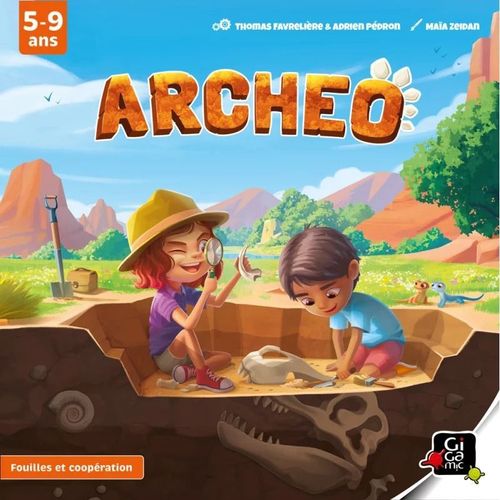
Archéo
Archéo Rulebook
Table of Contents
Table of Contents
Setup
- Place the game box in the middle of the table. Using the cut-out, lift the dirt tiles in the dig site. Divide the fossil boards as fairly as possible among the paleontologists (players). Take the suction-cup shovel and the shovel cards.
- Give each paleontologist a wheelbarrow token.
- Randomly place the egg and stone tokens into the 4 compartments at the bottom of the box. If this is your first game, the box is already pre-set up.
- Place the discovery, dirt and sand tiles face down in the box. When placing them, follow the colours in the box (black layer = discovery tiles, brown layer = dirt, beige layer = sand). This creates 4 layers in total: 1 discovery layer, 2 dirt layers and 1 sand layer. If this is your first game, everything is already prepared.
- Around the box, place the number of shovel cards that matches the number of players, turned to the shovel side (undamaged).
| Players | 2 | 3 | 4 | 5 |
|---|---|---|---|---|
| Shovel cards | 11 | 10 | 9 | 8 |
- Return the remaining cards to the lid of the box. You will not need them during the game.
- Shake the box several times at random so that you are not sure where the individual items are hidden.
Example of a prepared game for 5 players.
How to Play
The starting player is the one who most recently dug a pit. Players then take turns in clockwise order. On your turn, use the suction-cup shovel to turn over one available tile in the dig site.
Note: a tile is available if no part of it is covered by a tile in a higher layer.
How to use the suction-cup shovel: slide your fingers under the handle and cover the small hole at the top with your thumb. Press the suction cup of the shovel onto the tile you want to turn over and press your thumb until the shovel lifts the tile. Release your thumb to let go of the tile.
Three tiles carry a bone. This is a hint that a fossil is on the opposite side of the tile.
Wheelbarrow token: lets you get rid of a stone tile. You may use it only once (see the description of the stone tile on the right). You may not lend it to another player.
Turning over a stone tile: you have 2 options.
- Turn over as many shovel cards as there are stones pictured on the tile. The stones break your shovels. Then discard the stone tile.
- Example: a tile with 2 stones means you must turn 2 shovel cards to the broken side.
- Place the stone tile on your wheelbarrow token / wheelbarrow tile and then discard both the stone tile and the wheelbarrow. The stones do not break your shovels.
Turning over a wheelbarrow tile: add it to your supply. It works the same way as a wheelbarrow token. You may not lend it to another player.
Turning over a fossil-matching tile: if the tile you turn over matches one of the fossil boards, place it in the correct spot on that board.
Turning over a magnifier tile: immediately turn over another available tile (dirt or discovery) and show it to the other players. Then return the turned tile to the same place, face down. Discard the magnifier tile.
Turning over a hammer tile: immediately discard it and repair your shovels:
- Turn over as many shovel cards to the undamaged shovel side as there are hammers on the tile. You may never have more shovel cards on the table than there were at the start of the game.
- Example: a tile with 2 hammers lets you turn 2 shovel cards.
Once a discovery tile in the fourth layer is available, you may decide during your turn to lift it and look at what is hidden underneath.
At the start of the game, four items are hidden at random under these tiles:
- If you find an egg with 2 stars, you immediately gain these 2 extra stars.
- If you find a stone token, the stones damage two of your shovels. Turn 2 shovel cards to the broken side. You may use your wheelbarrow token/tile to get rid of the stones.
- If you find one of the cracked eggs, nothing happens.
Then the next player takes their turn.
End of Game
The game ends as soon as one of these conditions occurs:
You have collected all 10 stars (8 on the fossil boards and 2 on the egg). Great work! You are amazing paleontologists!
You turned over the last shovel card around the box to the broken side. All your shovels are broken! You can no longer dig.
You can now count your score according to how many stars you managed to collect on the fossil boards and on the egg (if you found it).
- 0-3 stars: You are on the right track, but you must find more treasures!
- 4-6 stars: You are on the good path to become real paleontologists!
- 7-9 stars: Very impressive! You are clear experts in excavation and have found almost everything!
You can now return the hidden items and tiles to the corresponding layers in the dig site and set up the game for the next session.
Solo Mode
If you are playing alone, start with 2 wheelbarrow tokens.
Place 8 shovel cards around the box.
Play according to the normal rules.
Components
- 1 four-layer dig site
- 1 suction-cup shovel
- 11 double-sided shovel cards (shovel side / broken side)
- 5 wheelbarrow tokens
- 5 fossil boards
- 50 earth tiles
- 25 sand tiles
- 25 dirt tiles
- 4 discovery tiles
- 1 stone token
- 2 cracked eggs
- 1 egg with 2 stars
- The egg and stone tokens are placed at random into the 4 compartments in the bottom of the box (see Setup).
Note: the Czech sheet uses "hlína" (dirt) for the brown layer and "země" (earth) for the 50 tiles listed as "50 destiček země". Both are rendered as printed.
Fossils
The sheet presents five fossils that players may uncover during the game (flavour text summarised from the sheet's information page):
- Triceratops: had three large horns on its head, two above the eyes and one on the nose. A large bony frill behind its head protected it from predators. Although huge and strong, it was a herbivore and ate only plants.
- Sarcosuchus: a giant aquatic reptile related to today's crocodiles, but up to 12 metres long. It lived in rivers and swamps and had a long snout full of very sharp teeth, with which it hunted its prey.
- Ammonite: a sea creature with a spiral shell that moved backwards through the water and fed on molluscs and crustaceans. Ammonites died out about 66 million years ago, like the dinosaurs, but their fossils are very numerous all over the world.
- Tyrannosaurus (T-Rex): one of the largest carnivores that ever walked the Earth. It grew to about 12 metres in length. Its jaws were armed with teeth up to 18 centimetres long, and it had one of the strongest bites in history. It could also run at almost 20 km/h.
- Stegosaurus: had large bony plates along its back, which probably served to catch heat from the sun or to display to other stegosaurs. It also had large spikes on its tail, with which it defended itself against predators.