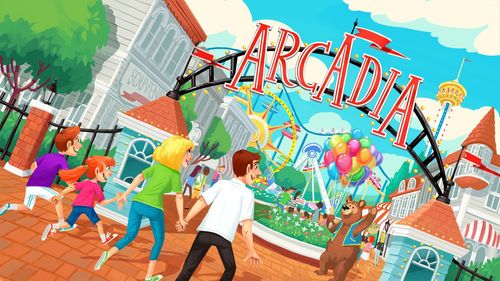
Arcadia
Arcadia Rulebook
Table of Contents
Table of Contents
Goal of the Game
Build the amusement park of your dreams! Add rides, shows, midway games and eateries to your park, and improve it to make your park the most profitable!
Components
Attraction: There are four different amusement park attraction types. Each attraction type has four improvement levels.
- Food: Start with corn dog stands and cotton candy and work your way up to the mascot character restaurant.
- Midway Games: Games include everything from the Baseball Throw to Ring Toss and Guess Your Weight.
- Rides: Build your rides up from wow to WWWOOOOWWW!!
- Shows: You went from hiring a neighborhood girl who could do a few cartwheels to a show that's a real Cirque!
Job: It takes all types of jobs to make your park run smoothly. You'll need Operators and Mechanics to keep your rides operating safely, Cooks to create delectable cuisine and Choreographers to stage shows that amaze!
Expert: Experts do the jobs of Operators, Mechanics, etc. but a lot more effectively. They are the spark of inspiration and the ones you can trust with the hard jobs.
Review: Find out what the critics like so that you can tailor your park to their tastes!
Year Track Card: Token tracks the current Year to determine progress toward game end. A typical game lasts four years.
New Year Card: The New Year Card is placed at the bottom of the Attraction deck to notify players when they have run through the Attraction deck.
These Rules
(Heading as printed on page 3; the setup section follows on page 4.)
Setup
Separate the cards into their types: Attraction, Job, Expert and Review. Shuffle each deck.
Deal three Review cards to each player. Set aside any unused Review cards, as they will not be used in this game.
Deal four Job cards to each player as a starting hand.
Turn four Job cards face-up in the center of the table. Place the rest of the Job deck next to the face-up cards to be used as a draw deck.
Turn four Expert cards face-up in the center of the table. Place the rest of the Expert deck next to the face-up cards to be used as a draw deck.
Turn four Attraction cards face-up in the center of the table. Place the rest of the Attraction deck next to the face-up cards to be used as a draw deck.
Set the token on the year "1" position of the Year Track.
Variant: More experienced players can customize game length for variation by adding or subtracting Years.
Put the New Year Card at the bottom of the Attraction deck.
Each player must discard one of his Review cards and keep the other two. The unchosen Review card will not be used for the rest of the game.
Choose a first player by a means agreeable to all. We suggest the player that most recently screamed on an amusement park ride.
Gameplay
Each player, starting with the first player and proceeding clockwise around the table, becomes the active player and performs the following:
Action Phase
The active player chooses one of the following actions:
Take Two Job Cards: Take two Job Cards into hand. The cards taken may be face-down from the top of the Job deck, from those revealed in the center of the table, or one each. A player may look at a drawn card before deciding whether to draw a second card or take a face-up card.
Take One Expert Card: Take one Expert card into hand, either from the face-up selection of Expert cards or face-down from the top of the Expert deck.
Sweep Job and Expert Cards: If the active player does not like the selection of face-up Job Cards, but is looking for something in particular, he can sweep all of the face-up Job and Expert cards into their respective discard piles and replace them with four new face-up Job Cards and four new face-up Expert cards. After doing so, the active player may draw one Job card (Note: Not an Expert card), either face-down from the top of the deck or from the newly-revealed face-up cards.
Build an Attraction: A player may build a face-up Attraction from the center of the table, and place it face-up in the area in front of him. This area starts empty, but becomes the player's Park as Attractions are added. Use the following rules to acquire Attractions:
Any player may build any Level 1 Attraction at any time. In order to build a level 2 or higher Attraction, a player must already have an Attraction with the previous Level of the same type in play.
For example: Melissa wants to build the Level 3 Carousel Ride Attraction. In order to do so, she must have at least one of the Level 2 Ride Attractions (Carousel 2, Ferris Wheel 2, Roller Coaster 2) already in front of her with no Level 3 card after it. (This assumes that she has already played a Level 1 Ride Attraction before the Level 2 Ride.)
A player must pay using Job or Expert cards containing at least as many icons as specified in the Attraction's cost. Players will not get 'change' for overspending icons. Spent cards go to their respective discard piles—Expert cards to the Expert discard pile, and Job Cards to the Job discard pile.
For example: Eric wants to build Taco Woc-o, a Level 3 Food Attraction that costs 3R, 3B, 2Y. He already has Custard Stand (level 2 Food Attraction) in his park. He pays for Taco Wac-o using cards from his hand, and the 1R from Funnel of Love. His total is 3R, 4B, and 2Y, which is more than enough, so he puts Taco Wac-o into his Park beside the Custard Stand. He does not get 'change' for overpaying B.
Note: A player may use any three of the same icons as one icon of a different kind. The icons converted in this manner may be specific to certain types of Attractions, but do not have to be.
For example: Carla has a Food Vendor (2Y for Food), a Mechanic (1Y), Sales (1G) and two Builders (1B each) in her hand. She wants to build the Roller Coaster 1 Ride Attraction, which requires 2G and 2B. She indicates that the three Yellow icons (including the Food Vendor, which is specific to Food Attractions) become a Green icon, and spends the Food Vendor, Mechanic, Sales and two Builders for 2B and 2G - enough to build the Roller Coaster 1 ride!
The ability to change 3 icons into 1 different icon means that Expert cards can often be used as wild cards by themselves, since they frequently have at least 3 icons of the same type.
Note: Some Attractions have build icons in their text area. These can be used toward the cost of all subsequently built Attractions requiring that icon. The attractions are not discarded when spent, like Job and Expert cards.
For example: Mark builds the Funnel of Love (Level 1 Food Attraction), which has a 1R icon. For any Attraction that he builds for the rest of the game, he needs to pay using one fewer R icon among his Job and Expert Cards.
Players may accumulate and use any number of build icons on Attraction Cards.
Players may trade any combination of Attraction icons on cards and Attractions at 3:1. Again, icons on Attractions are not discarded when used.
Take Attraction Into Hand: If the active player wants to build a face-up Attraction card from the center of the table, but cannot pay for it immediately, he may take the desired Attraction card into his hand for the purposes of building it later. Players receive no penalty for unbuilt Attractions at the end of the game.
A player may have no more than two Attraction cards in his hand at one time. If he already has two cards, and wishes to draw another one, that player must discard one Attraction card face down to the bottom of the Attraction stack.
A player may not take an Attraction card into his hand unless he has the immediately preceding Attraction (e.g. a Level 3 Ride immediately precedes a Level 4 Ride) either in his Park or in hand. If challenged, a player must reveal a card in hand to prove that he meets this condition in the case that the immediately preceding Attraction is not face-up in the player's Park.
For example: Sylvia has recently built Ferris Wheel 2, and already has Carousel 3 card in her hand. She may take the Roller Coaster 4 into her hand, because she meets the prerequisites.
Build Attraction from Hand: The active player, following the rules specified in Build Attraction, may build an Attraction card that he has been saving in his hand.
Maintenance Phase
A Maintenance Phase occurs after each player completes their Player Turn. Perform the following steps:
Replace Job Cards: Draw and place enough Job Cards in the center of the table such that four cards are again visible. Reshuffle the Job discard pile to create a new Job draw deck when it becomes empty.
Replace Expert Cards: Draw and place an Expert card in the table if fewer than four are visible. Reshuffle the Expert discard pile to create a new Expert draw deck when it becomes empty.
Replace Attraction Cards: If there are fewer than four face-up Attraction cards, fill any 'holes' by moving face-up Attraction cards one space away from the Attraction deck. Then draw a new Attraction card to put in the empty spot closest to the Attraction deck.
If no Attraction was built or taken into a hand this turn, remove the Attraction card furthest from the Attraction deck and put it face-down at the bottom of the Attraction deck. Then move face-up Attraction cards and replace the removed Attraction, as described above.
If the New Year card turns up, set it aside to the current player's left, and refill the face-up Attraction cards to four. Each player (including the one whose draw triggered the Year change) gets one more turn before the end of the Year.
Year One, Year Two, or Year Three: Calculate Intermediate Scoring (see below). Advance the Year marker, take all of the face-up Attraction, Job and Expert cards on the table and put them into their respective stacks, keeping the New Year card set aside. Shuffle all three stacks and reveal four of each card. Put the New Year back on the bottom of the Appliance deck.
Year Four: The game is over! Proceed to Final Scoring.
Intermediate Scoring
Add all Victory Points (the numbers in the stars) from Attractions in each player's current Park to his score. Do not score any Review bonuses until game end. Use a separate sheet of paper to track player scores.
For example: As the Year changes from Year 2 to Year 3, Dorian has the Teacups (4 points), the Ferris Wheel 2 (3 points), the Duck Pond (4 points), and the Baseball Toss (8 points) in his Park. He adds 19 points to his current score of 8 points (from the Year 1->Year 2 Change), for a total of 27 points.
Final Scoring
Players add up the total point values of their Attractions, and add their Review bonuses (if any) for their final totals.
For example: Tina has the Ring Toss (Level 1, 2 points), the Baseball Toss (Level 2, 8 points), the Acrobats 1 (Level 1, 4 points), the Get-a-Gopher (Level 1, 2 points), the Balloon Darts (Level 2, 8 points), the Guess Your Weight (Level 3, 13 points), the Juggler 1 (Level 1, 2 points), and Acrobats 2 (Level 2, 6 points) for a subtotal of 45 points. In addition, she holds the Greatwood Press card, which gives 4 points for each Level Two Attraction. She adds 12 points (4 each for the Baseball Toss, Balloon Darts and Acrobats 2) for a new subtotal of 57 points. Her other Review card is the Pinehurst Picayune, which grants points for her Midway Attractions. She adds 11 more points (1 each for Ring Toss and Get the Gopher, 2 each for Baseball Toss and Balloon Darts, 5 for Guess Your Weight) for a grand total of 68 points. Good game!
Transcriber note: the printed rules are reproduced as printed. The Year Three step says "Appliance deck" and the example spells the Taco card both "Taco Woc-o" and "Taco Wac-o"; both are kept as printed.