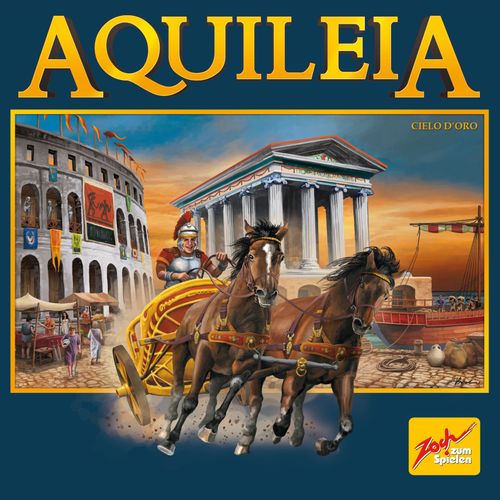
Aquileia
Aquileia Rulebook
Table of Contents
Table of Contents
Pieces of the Game
- 4 decks of cards:
- 22 servi (slave) cards (22 cards; 11 singles and 11 doubles)
- 17 equi et arma (horses and weapons) cards (17 cards; 2x double golden horse, 3x single golden horse, 2x double silver horse, 3x single silver horse, 1x 3 weapons, 3x 2 weapons and 3x 1 weapon)
- 12 Stadium laurel cards (12 cards; 2x each color and 10-7-5-3 points)
- 6 Theatrum laurel cards (6 cards; white/blue, blue/yellow, blue/purple, white/purple, yellow/purple, yellow/white)
- 1 game board, divided into 6 different areas: Portus, Forum, Mercatus, Theatrum, Stadium, Arena.
- 7 dice (4 blue, 3 red). Each die has 2 golden sides, 2 silver sides, and 2 bronze sides.
- 1 large token "starting player"
- 117 coins (39 gold, 39 silver, 39 bronze)
- 5 sets of playing pieces of different colors. Each set includes:
- 5 henchmen
- 9 houses
- 1 scorekeeper disc
- 1 tiebreaker disc
- 1 strength shield
For the first game, carefully push out the carton playing pieces from the punchboard.
How to use money and cards during the game
Money. During the game it's not allowed to change any money with the bank, except while executing the action in Pecunia. If you need a certain kind of metal to pay for an object and you haven't got it, then you are not able to buy this item. You can never pay with other kinds of metal, even if they would be worth more. During the complete game, money should be kept visible for all other players.
Cards. During the game, players will win, buy or receive different cards. They don't have to show the other players how many cards they have or which background color they have. Once played, put the cards on a discard pile next to the game board. When a deck runs out, reshuffle and reuse the corresponding discard pile.
Preparation of the Game
- Give each player a set of henchmen, houses and markers (scorekeeper disc, tiebreaker disc and strength shield). Put all the score markers at 0.
- Give each player 1 golden coin, 1 silver coin, and 2 bronze coins.
- Shuffle the equi et arma cards together and place them face down on the game board. Draw 3 cards from this pile and put them face up next to it.
- Shuffle the servi cards and place them face down on the game board.
- Place the blue dice at the Potentia location on the game board.
- Shuffle the Stadium laurel cards and place them face down on the game board. Draw 1 card from this pile and put it face up next to the pile.
- Shuffle the Theatrum laurel cards and place them face down on the game board.
- Place the red dice next to the game board.
Determine the first starting player randomly (for example: roll the red dice to see who collects the most gold).
Goal of the Game
Each player, representing a wealthy Aquileian patrician, owns a certain number of henchmen (pawns) whom he uses for the main activities: playing, culture, trading, and building. Each activity can bring expenses, earnings and sometimes victory points. The game lasts for 6 rounds. The winner is the player with the most victory points.
Playing a Round
A round consists of the placement phase, followed by an action phase. Rounds always start with the starting player and then continue clockwise. In the action phase the areas will be executed in the mentioned order.
Placement Phase
The starting player places one henchman on one of the action fields on the game board, or his tiebreaker disc on the next available field of the tiebreaker track. Then the next player places one henchman or his tiebreaker disc, and so on. Once all players (in clockwise order) have placed their first piece, the starting player places his second and so on, until all pieces have been placed (5 henchmen + 1 tiebreaker).
A player is allowed to pass, but that means he is not allowed to place another henchman this round. Only 1 pawn can be placed on each action field. Placing the tiebreaker disc is mandatory. After all players are ready, the action phase starts.
Tiebreaker
The tiebreaker area only provides a way to determine the new starting player and to break ties in the Arena and the Stadium. You can't do an action in this area. However, placing your tiebreaker disc does count as choosing a placing action in this round, but this can only be claimed with the special disc, and this disc cannot be used otherwise.
A player is allowed to place more than 1 henchman in an area (but note the Stadium and the Portus below). After the action with a henchman is taken, the owner takes it back in his supply.
Stadium
In the Stadium, a player is not allowed to place a henchman at the golden side if he already placed one at the silver side this round and vice versa.
Portus
In the Portus, a player can choose an action field to activate the workshops he owns, but then he must place a coin in addition to his henchman. There are three action fields with different costs, respectively 1 bronze, 1 silver, or 1 gold. A player placing a henchman on one of these action fields is not allowed to place another henchman on one of the other 2 action fields this round. However, a player is allowed to have a henchman on one of these action fields, and a henchman on the Portus Latro.
Forum
The player can place his henchmen on any of the action fields, the order 1-2-3-4-5 is important in the action phase only.
Action Phase
There are several areas which will be executed in order:
I. Mercatus II. Arena III. Stadium IV. Theatrum V. Forum VI. Portus
All actions are executed according to the order of the Latin numbers. No action will occur on fields, where there is no henchman placed. After having executed an action the player takes away his respective henchman from that field.
The Areas
I. Mercatus
In this area you can choose many actions, which are executed in the order below:
Dolus — Roll 2 red dice and collect the money shown on both dice.
Pecunia — You may change money and claim 4 points if you do. Allowed changes:
- 1 gold ↔ 1 silver + 2 bronze
- 1 gold ↔ 2 silver
- 1 gold ↔ 4 bronze
- 2 silver ↔ 4 bronze
- 1 silver ↔ 2 bronze
Equi et Arma — You may buy a card on any field, where you have placed a henchman. The costs for it (on any field) is 1 bronze coin, which you give to the bank. If any of your henchmen is placed on the very left field, you also get the top card from the deck (without showing it to the other players).
Servi — You may buy slave cards. You pay to the bank:
- field on top: 1 bronze coin for 1 card.
- field in the middle: 1 silver coin for 1 card or 2 silver coins for 2 cards.
- field at the bottom: 1 golden coin per card, but not more than 3.
Potentia — Claim the 4 blue dice. The player is allowed to use 1 or more of these dice at the Arena and at the Stadium in this round. After using them, he returns them to the Potentia. A die can never be used more than once during a round.
II. Arena
All players, that placed at least one henchman in the Arena will be part of a gladiatorial combat:
- Players determine their fighting strength by adding the values of the fields they put their own henchmen.
- In turn order all participants of the combat throw the 3 red dice. Any "bronze" rolled is added to their fighting strength.
- In turn order, each participating player may add servi and arma (slaves and weapons) cards to increase his fighting strength.
- The player with the blue dice may roll any 0-4 dice and increases his fighting strength by adding the amount of dice showing bronze.
The winner of the fight. The most powerful player (highest score in fighting strength) is the winner of the gladiatorial combat. In case of tie, the lower position on the tiebreaker track will decide for a better position within the combat.
The winner of the fight gets:
- 3 bronze coins from the bank AND one of the following:
- victory points, equal to his doubled strength, OR
- 1 servi card from the face down pile
- (the winner chooses either victory points or a servi card).
The second best gets:
- 2 bronze coins from the bank AND one of the following:
- victory points, equal to his doubled strength, OR
- 1 servi card from the face down pile
- (whichever the winner didn't choose).
The third best gets:
- 1 bronze coin.
Example of a contest in the Arena
Stefan (blue) is the starting player. He starts with 1 point from the Arena itself. He rolls the 3 red dice for a result of 1 bronze, 1 silver and 1 gold. Since only bronze results increase the score in the Arena, he adds 1 point to his total on the strength track. Now Giorgio (yellow) rolls the dice. No bronze, so no additional scores. Kiko (red) manages to roll 3 bronze. He has a total strength of 4 now.
Next, the players may play servi and arma cards to improve their strength. Stefan starts again. He chooses not to play cards. Giorgio plays 1 arma card with 2 symbols and 1 servi card with 1 symbol. These 3 points are added to his strength, making a total of 5. Now Kiko chooses to play 1 arma card with 2 symbols, making his total 6.
Giorgio has got the 4 additional dice and decides to use 2 of them. He rolls 1 bronze, making it a tie between him and Kiko for first place with both a strength of 6. The tie is broken by the tiebreaker track.
"Since Giorgio is 4th and Kiko 2nd, Kiko wins."
Kiko wins 3 bronze from the bank and chooses to gain 12 points (twice his final strength in the Arena this round). Giorgio receives 2 bronze and a servi card from the deck. Stefan gains 1 bronze.
During the fight players chart their current results by moving their strength shields on the strength track. Players can score more points as the strength track is long. For example, scoring a strength of 12 for 24 victory points is allowed.
III. Stadium
All players, that placed at least one henchman in the Stadium will be part of a chariot race:
- Players determine their horse power by adding the values of the fields, where they put their own henchmen. No player is allowed to place henchmen on both (gold/silver) parts of the Stadium.
- In turn order all participants of the race throw the 3 red dice. Players engaged on the golden horse area will add the amount of golden dice to their horse power. Players engaged on the silver horse area will add their amount of silver dice to their horse power.
- In turn order, each participating player may add equi (horses) cards of the chosen side (silver or gold) to increase his horse power.
- The owner of the 4 blue dice may roll all those of them, which he did not use in the Arena. He adds the amount of dice showing "his horse colour" to his horse power.
The winner of the race gets:
- 3 coins from the bank (gold or silver, depending on the chosen side) AND additionally:
- his choice of the open laurel card and the top card of the pile (he is allowed to look at both of them). He gives the other card (unseen by the others) to the second best.
The second best gets:
- 2 coins from the bank (gold or silver, depending on the chosen side) AND additionally:
- the laurel card he received from the winner of the race.
The third best gets:
- 1 coin (gold or silver, depending on the chosen side).
Example of a contest in the Stadium
Stefan (blue) is the starting player, so he begins again. He has got a henchman on action field 1 of the silver side, so he starts with 1 point. He rolls the 3 red dice and scores 2 silver, getting a score of 3 at the moment. Then Walter (green) takes his turn and rolls 1 gold for a total of 3 as well. Giorgio (yellow) rolls 1 silver and has a strength of 3 currently. Kiko (red) rolls 2 gold for a current strength of 4.
Now the cards are played: Stefan plays 1 card with 2 silver horses for a final strength of 5. Walter decides to play no cards. Giorgio plays 2 cards with 1 silver horse each for a total strength of 5, and Kiko plays no cards, staying at 4. Giorgio still has 2 remaining blue dice from the Potentia action. He is lucky and gets 1 more silver. So the final result is: Giorgio wins with strength 6, Stefan is 2nd with strength 5, Kiko 3rd with strength 4 and Walter is 4th with strength 3.
Giorgio raced with the silver horses, so he collects 3 silver coins. Stefan gets 2 silver and Kiko 1 golden coin. Giorgio also receives the open laurel card and the top card from the deck. He chooses 1 of them to keep, he gives the other one to the second best. He doesn't have to show the other players which card he keeps and gives.
During the race players chart their current results by moving their strength shields on the strength track. Players can score more points as the strength track is long.
IV. Theatrum
The player with a henchman on this site shows the top card of the deck to everybody and auctions it. He opens the bidding with 1 (not more) coin of his choice. Now clockwise each player may pass or increase the bid with 1 coin of his choice. Once passed, he cannot rejoin this auction. If he decides to increase the bid, he first has to offer exactly the same (number and sorts of) coins as the currently highest bid. Then he adds one more coin of his choice. This is to be continued until only one player is left (with the highest bid). This player wins the auction. The winner gets the card and gives his money to the player who chose the Theatrum. If this player wins his own auction, the money goes to the bank.
Example of an auction in the Theatrum
Walter chose the action Theatrum and starts the auction by showing the top card of the deck to all players. He then opens the bidding by offering 1 coin for the card, he decides to bid 1 silver. The next player is Giorgio. He matches the 1 silver and adds another silver. Kiko passes. Stefan matches the 2 silver and adds 1 bronze. Walter has no bronze, so he cannot match the current bid and is forced to pass. Giorgio passes also. Stefan wins the card and pays his winning bid to Walter (who chose the action).
Remarks:
- If the player with a henchman on the Theatrum is not able or not willing to auction the card, the next player may auction the card, and so on. If nobody wants to auction the card, the player who put his henchman on the Theatrum will receive the card for free.
- When nobody put a henchman on the Theatrum, no card is drawn.
- Players who don't win the auction get back their bid.
V. Forum
Players can build workshops, private banks (left part of the game board), and villas (right part of the game board), in order 1-2-3-4-5 as shown on the action fields:
- first to build
- second to build + claim points when building
- third to build + may build 2 buildings
- fourth to build
- fifth to build + claim points when building
A player constructing a building must pay all resources shown on the chosen location. If he cannot pay the exact amount of slaves, he will have to pay more than the actual cost. He must pay the exact amount of coins, there are no refunds and he cannot exchange coins!
Buildings have to be paid separately. If a player needs for example 3 slaves for the first building and 1 slave for a second building, he can't pay with 2 servi cards with 2 slaves each.
Example of building in the Forum
Kiko is building the blue villa of 10 points which costs 2 bronze, 2 silver, 1 gold and 3 slaves. He only has 2 servi cards with both 2 slaves on them, so he pays all the needed coins and 4 slaves. Then, he places his red house on the building to show it is his one now. He then immediately scores 10 points on the score track because he builds from the 2nd action field in the Forum (which grants this right).
Both Kiko and Walter may build two buildings. Kiko will get victory points, Walter will not.
VI. Portus
In the Portus, 2 things happen. First, the Latro gets into action. Then, players can pay 1 coin (the same as the action field they chose during the placement phase) to activate their workshops to win points or to receive coins.
- The Latro always goes first. The player with a henchman over there rolls 2 red dice and takes the money he rolls from the action fields in the Portus (which were placed there in the placement phase). If he rolls coins that are not available on the Portus action fields, he won't get them.
- Now the "real business life" awakes in the Portus - starting with the bronze action field and ending up with the golden one. Whoever has placed a henchman there, has to pay a coin corresponding to the colour of that respective action field. Players being spared by the Latro use the coin they used to place underneath their henchman. Victims of the Latro have to pay from their own supply of money. Players who are not able to pay exactly the coin in demand may not perform the action at all.
The action itself consists of activating all workshops and private banks of his own: the player gets all victory points provided by all of his workshops and he also gets all amounts of money, which his private banks pay (as printed inside of the square space on the right top of the bank areas).
Each building site clearly indicates the construction costs and the income (points or coins) when being activated.
Example of the Portus in action
Walter is the Latro and rolls the 2 dice: bronze and gold. He takes the coins from under the red and yellow henchmen.
Kiko goes first and pays a new bronze coin from his supply to the bank. He activates his private bank to gain 1 silver and 1 gold, and his workshop to score 4 points. Now Stefan takes his silver coin from the Portus, pays it to the bank and activates his private banks and workshops. Giorgio has no more gold and cannot activate his buildings.
Remark: When a turn is completed, the "starting player" token goes to the player who is first on the tiebreaker track. All players take their tiebreaker disc back in their supply.
End of the Game
After 6 rounds the game ends (the laurel cards will be exhausted, so the players will notice easily). At the end of the game, a final scoring takes place:
- Points for Stadium cards with written points (can be 3-5-7-10)
- Points for the total value of the villas (right side of the game board) multiplied by the number of laurel cards (Stadium + Theatrum) in the same color. For each Theatrum card the owner must choose for which color it counts.
Money and other resources are not worth any points.
Remark: No points are gained from villas without at least one laurel card of the corresponding color!
Example scoring points for the villas
Kiko has 1 blue card from the Stadium and 1 blue/yellow from the Theatrum, which he chooses to be blue. He also possesses the blue '10' villa and the blue '6' villa. He scores 2 x 16 = 32 points for the villas. These are added to his score on the score track on which he has already indicated the points gained during the game. He also owns the 5 points card from the Stadium and adds these 5 points to his total as well.
The player with the most points wins.