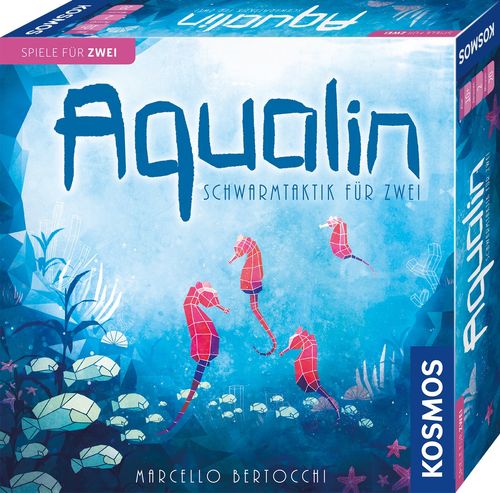
Aqualin
Aqualin Rulebook
Table of Contents
Table of Contents
Components
- 1 Reef board
- 36 Sea Creature tiles
Setup
Place the board (the Reef) between the two players in the center of the table. Shuffle all the Sea Creature tiles and form a face-down Reserve next to the board.
Take 6 tiles at random from the Reserve and place them face up next to the board. This is the Display.
Decide together on each player's goal:
- one player must form shoals of the same type;
- the other player must form shoals of the same color.
A shoal is a group of adjacent tiles that share the same type of animal or the same color.
Whoever last went swimming in the sea starts the game and becomes the active player.
Sequence of Play
A turn consists of three phases:
- Move a Sea Creature
- Place a new Sea Creature on the Reef
- Refill the Display
1. Move a Sea Creature
Note: this phase does not happen on the first turn.
Before taking a Sea Creature tile from the Display, the active player may, if they wish, move a Sea Creature already on the board. The tile can be slid any number of spaces along its row or column (but it may not jump over another tile or go past the edge of the board).
Example 1 — "Move a Sea Creature"
Nina must build shoals of the same type. She pushes the yellow crab toward the purple crab.
2. Place a New Sea Creature on the Reef
The active player chooses a Sea Creature tile from the Display and places it on an empty space of the board. The tile can be placed next to another tile, but this is not required.
Tip: to keep a better overview of the board, arrange Sea Creatures of the same type facing the same direction.
Example 2 — "Place a New Sea Creature on the Reef"
To stop Marc from moving the yellow crab into the yellow shoal, Nina places a pink crab in between.
3. Refill the Display
Before ending their turn, the active player draws 1 tile from the face-down Reserve and adds it to the Display (face up). Then it is the other player's turn, who becomes the active player.
Note: if there are no more tiles in the Reserve, you can no longer refill the Display. In that case, keep playing until the Display is empty.
Players alternate turns until all 36 Sea Creature tiles have been placed on the board. Then proceed to scoring.
Scoring
Each player's score is calculated from the shoals of marine animals on the reef. A single Sea Creature can count toward both a same-color shoal and a same-type shoal at once.
A shoal is a group of two or more adjacent tiles that are the same type or the same color. To form a shoal, tiles must touch along one of their sides (tiles touching only diagonally do not count).
To score, leave all tiles on the board. First count all the same-color shoals (blue, green, pink…). Then count the same-type shoals (crab, fish, jellyfish…). The table below shows how many points each shoal is worth:
| Tiles in shoal | 2 | 3 | 4 | 5 | 6 |
|---|---|---|---|---|---|
| Points | 1 | 3 | 6 | 10 | 15 |
Note: a single tile on its own is not a shoal and therefore scores no points!
In case of a tie, the winner is whoever did not go first.
Scoring example:
Marc plays the same-color shoals: blue (4 tiles = 6 points, 2 tiles = 1 point), green (1 point), pink (3 points), purple (3 points), red (3 points), yellow (2 × 1 point). He scores a total of 19 points.
Nina plays the same-type shoals. So she counts the crabs (1 point), the jellyfish (1 point), the seahorses (2 × 1 point), the starfish (10 points), the fish (6 points), and the turtles (1 point). That comes to a total of 21 points: she wins the game!
Rematch
Want to play again? Swap your goals: if you were forming same-type shoals, form same-color shoals instead, and vice versa!