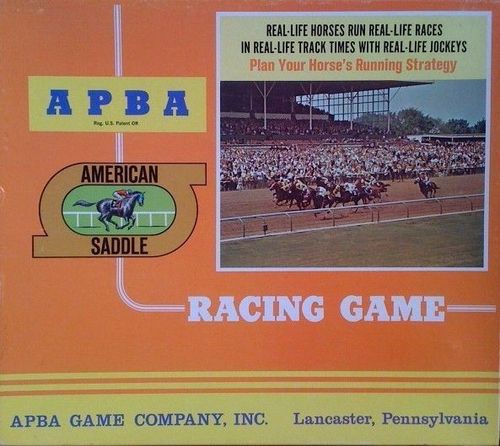
APBA American Saddle Racing
APBA American Saddle Racing Rulebook
Table of Contents
Table of Contents
How To Play
The playing procedure of APBA horse racing is unique, yet simple. One roll of the APBA dice for each furlong of the race for each horse in the race initiates all the exciting action. The APBA dice are the same as those in all other APBA games — two colors, two sizes. The large red die is read first as the first of a two-digit number. The small white die is the second number of the two digit figure. This makes a possible total of thirty-six dice roll numbers. The bottom section of Stage Door Johnny's card, shown at left, lists these thirty-six numbers in black. The red numbers after each of the thirty-six black numbers are the computed numbers, based upon APBA's exclusive formula, which make the horse perform just exactly as he did in real-life.
This red number, found under the appropriate Furlong Column in the Race Action Board above, will give the number of spaces the horse may move on each dice-roll. Any leftover decimal fractional figure is accumulated for subsequent later moves that add up to subtle separating distances and running time differences that make APBA American Saddle Racing the most realistic and unusual table game ever created. Simple to play, it is so completely realistic that the most sophisticated racing fans will be enthralled with it. This is not just another dice game with turn-by-turn, pure-chance track moves. The moves are scientifically produced by a complex formula that breaks down the final outcome of each race into time differences of fifths of a second!
A typical dice-roll is shown above on the Race Action Board. The large red die shows a three and the small white die is a five. This produces number 35, one of the thirty-six dice roll possibilities existing with the APBA dice. Look for number 35 on Stage Door Johnny's card and there you find a red number six. Next you find number six under one of the seven Dice Roll Columns at the left side of the Race Action Board and on that line move across to the Furlong Column in which Stage Door Johnny happens to be in at any given point of the race. There you will find the number of track spaces to move. Which of the seven Dice-roll Columns you use is determined by the net rating of the horse after taking into consideration track conditions and any jockey points that might accrue to the horse in this particular race.
And that's all there is to it. Variances in this simple standard playing procedure will come up from time to time and they are simply and explicitly explained. Anyone can play APBA American Saddle Racing.
Horse Card Reference (Sample Card: Stage Door Johnny)
The brochure reproduces one sample horse card as an example of the card layout. The card shown is Stage Door Johnny, Chestnut Colt, age 3, 1968 statistics, by Prince John—Peroxide Blonde, by Ballymoss, bred by Greentree Stud, Inc. (Ky), owned by Greentree Stable, trained by J. M. Gaver.
The sample card's rating values are printed as:
- Rating: 23
- Good: -2
- Slow: -4
- Turf: 21
- Muddy: -6
- Sloppy: -8
The brochure states that each horse's card gives the horse's age and parentage, color, breeder, owner and trainer; the horse's APBA dirt track and turf course ratings; the impairment ratings for the various kinds of unfavorable track conditions; and the set of thirty-six numbers computed with the APBA formula from the horse's complete racing record for the year. The sample's thirty-six numbers are the dice-roll key described in "How To Play."
Worked Example
The brochure's example, as printed: the large red die shows a three and the small white die shows a five. This produces number 35. On Stage Door Johnny's card, number 35 lists a red number six. Find number six under one of the seven Dice Roll Columns, then move across to the Furlong Column the horse is currently in. That column gives the number of track spaces to move on that roll.
Not Included in This Source
The following are referenced in the brochure but are not printed in the transcribed source and have not been transcribed: the Race Action Board's full Dice Roll Column and Furlong Column tables, the Track Conditions table, the Timing the Race table, the Odds Chart, and the Complete Playing Instructions booklet. Players should consult the original game materials for these.