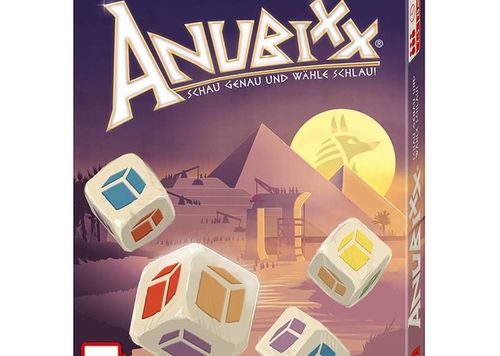
Anubixx
Anubixx Rulebook
Table of Contents
Table of Contents
Content
4 colour dice, 1 score pad, 5 pens
Preparation
Each builder takes a different playing card from the score pad and a pencil. You can tell the difference between the playing cards by looking at the letter in the bottom-right of the card.
Only as many jokers are used in the game as there are builders. Cross out the superfluous jokers. Use 3 dice if you are two players, otherwise use all 4 dice. Decide who is to start the game. This first builder takes the dice.
Building Rules
or: how do you cross out the stones on your score pad
Each round you can add a maximum of 2 stones to your building site. You do this by crossing the boxes on your playing card. You choose the stones from your supply of coloured dice and your own quarry.
- You must cross out 2 floor mosaic stones at the same time. These 2 stones must be vertical or horizontal neighbours.
- You can cross out 1 or 2 stones on the pyramid. You must start the pyramid at ground level. You can only cross out a stone higher up when both stones beneath the desired stone have already been crossed out.
- You can cross out 1 or 2 stones on the arch of triumph. You have to start the columns of the arch at the bottom. You can build the columns at different speeds. However, you can only cross out the final stone when both columns are complete.
You can share your 2 stones between the pyramid and the arch of triumph! You can choose to not build any stones at all.
Playing the Game
The starting player is the first active builder. If you're the active builder you throw the dice once and place them visibly in the middle of the table. Then you can cross out up to 2 stones on your building sites (beware of the building rules!).
For each stone you cross out, you have to immediately take the matching die from the middle of the table and place it at the top of your playing card. If there is no matching die, you must cross out either a stone of the same colour or a joker stone (joker) in your quarry.
You must cross out the coloured stones in your quarry from left to right. You can skip as many stones as you would like. You can only cross out stones that lie to the right of the last crossed-out stone.
Example: The blue stone was the last stone Florian crossed out in the quarry having skipped the red and lilac stones. He can continue crossing out stones from the orange stone.
If you would like to use 2 stones from the quarry for the same building (pyramid or arch of triumph), then you must cross them out in the quarry in the same order that you are able to build with them.
Be observant! If you can't take a die, or cross out a coloured stone or joker in your quarry, then you can't cross out a stone in your building. If you have taken dice, do not put them back in the middle of the table!
Then each of the other builders have a turn. The game is played clockwise. As described above, each builder can also cross out up to 2 stones on their building site. However, they can only use the dice that remain in the middle of the table, and not the dice that you as the active builder used.
Once a player has completed his building works, all dice are returned to the middle of the table to be used by the next player.
IMPORTANT: Only the dice that the active builder has used to cross out stones are blocked for the other builders!
Example: Clemens is the active builder. He rolls red, green and 2x blue. He first crosses out a blue stone on his pyramid and places the blue die on his playing card accordingly. Then he also crosses out a green stone and places the green die on his playing card.
The next builder is Florian. He wants to cross out a red and a yellow stone in his floor mosaic. In order to be able to do that he takes the red die from the middle of the table and crosses out the yellow stone in his quarry. When he is finished, he places the red die back in the middle of the table.
Finally, it is Simon's turn. He uses a joker stone from his quarry to build the first yellow stone of his arch of triumph, and uses the red die from the middle of the table to build a red stone in his pyramid. He crosses out the joker stone in his quarry, and also the yellow and red stones that he has built.
Have You Earned a Reward by Building Quickly?
If you cross out a unique symbol (scarab, jackal, snake, eye, ankh) in a building, or the last symbol in the same group (baboon, palm tree), then declare this to the other builders and as a reward, you can cross out the same bonus symbol on your playing card.
Example: A builder crosses out the last stone in a group bearing the snake symbol and calls out "Snake!" — as a reward, the bonus symbol for the arch of triumph is crossed out on the playing card.
All following builders can receive the same bonus, providing they can cross out the stones with the bonus symbol during this same round. If you can't receive the same bonus, then it's best to scribble out the bonus symbol on your playing card to maintain a good overview. In one round, it is possible to receive several bonuses.
The round is complete when all builders have had a turn. The next player clockwise from the first active builder, then becomes the new active builder. He rolls all of the dice and makes his play, followed by the other builders. As described above, you continue to play in succession.
End of Game and Scoring
The game finishes at the end of the round in which one of the builders completes his second building. Each builder who manages to complete 2 buildings receives the bonus for initiating the end of the game.
In order to score, each builder needs to determine the points for each of their buildings and their bonuses and enters the scores on the game sheet.
- For the pyramid, you receive the points from the highest crossed out stone.
- If both columns in the arch of triumph are the same height, you receive the points for this level. Otherwise, you receive the points for the lower of the two columns.
- For the floor mosaic, count the number of used stones and determine the score here: 4 stones = 4 points, 6 stones = 6 points, 8 stones = 8 points, 10 stones = 11 points, 12 stones = 15 points.
- For each bonus, you receive 3 points.
- Each stone that is still left in the quarry (counting on the right of the last crossed out stone) is worth 1 point. Each joker stone that is unused is worth 2 points.
- Add all of your points together. The winner is the player with the most points. In the case of a draw, the winner is the player who has crossed out more stones in the pyramid.
Scoring Example
By reaching the top stone in the pyramid, Simon receives 21 points.
He receives no points for the arch of triumph. To score points here, he would have had to cross out both red stones on the second level.
On the floor mosaic, he has crossed out 8 stones → 8 points.
Simon has acquired a total of 5 bonuses → 5 x 3 = 15 points.
In the quarry, there remains a joker stone (each one 2 points) and 4 coloured stones (each one 1 point) giving 2 + 4 points.
Simon's game total is 50 points.