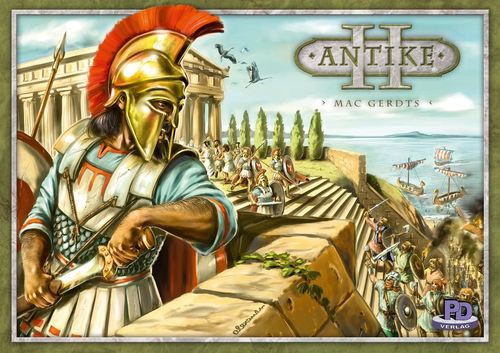
Antike II
Antike II Rulebook
Table of Contents
Table of Contents
Game Material
212 wooden pieces
- 78 galleys (13 per nation)
- 72 Legionen (12 per nation)
- 6 game markers
- 36 game markers (small) (6 per nation)
Each in the nation colours yellow, red, green, blue, black and grey.
- 20 temples
144 city tokens
- gold city
- marble city
- iron city
24 double sided tokens per nation
53 cards
- 37 ancient personages
- 14 nation and temple cards
- Bellona Card (German and English)
double sided game board — Mare Nostrum / Orient
coins
resources — 1, 2, 5
Pictured are the resources for gold. The resources for marble are white and for iron blue.
Other material
- 1 game rules
- 1 quick intro
- 1 historical information booklet
- 6 short rule cards in either German, English or French
The bank's supply is meant to be limited. If a player has no more legions, galleys or city tokens, or if the bank has no more coins or temples, the supply is empty. Only resource chips are considered unlimited.
Overview of the Game Flow
Each player leads an ancient civilization. Each nation starts with 3 cities which produce marble, iron, and gold respectively. These resources are used to develop the civilization. A nation can erect temples with marble, or develop technologies with gold, or arm legions and galleys with iron.
The nations expand their territories by moving their legions and galleys and founding new cities, which each cost 1 of each resource: marble, iron, and gold. Legions and galleys may also be used to conquer the opponent's cities.
Temples triple a city's capacity to produce, defend, and build new military units. Knowledge of new technologies may double the moving capabilities of military units, boost the defensive strength of owned cities, or strengthen the economy.
If a nation achieves certain goals, it wins the favour of ancient personages.
Goal of the Game
The first nation to own a certain number of personages, wins the game. There are five different types of personages, which are received for reaching special goals:
10 Kings (card: Dareios der Grosse). For every 5 cities a nation owns it receives a king. They are gained at the completion of city 5, 10, 15 etc.
7 Generals (card: Scipio Africanus). For every temple (also neutral temples) a nation destroys it receives a general. A temple is destroyed when its city is conquered.
6 Citizens (card: Perikles). For every 3 temples a nation owns it receives a citizen. They are gained at the completion of temple 3, 6, 9 etc.
9 Scholars (card: Zarathustra). For every new advance (new technology) a nation receives a scholar. The ninth scholar, Pliny the Elder, comes into play with a variant: He is awarded to the first nation, that owns all 8 technologies.
5 Navigators (card: Hanno der Seefahrer). Gaining a Navigator requires control of 7 sea areas.
Sea regions without a city are indicated by a galley symbol. These regions count double for the purpose of gaining Navigators. A clever distribution of only 4 galleys could be enough to gain a Navigator. Sea regions are counted at the end of the turn after all possible fights and conquests are over when calculating navigators.
Any deserved personages are awarded at the end of a turn. Once won, an ancient personage cannot be lost. This applies even when possessions that led to any awards are no longer held.
Example: A nation with 10 cities and two ancient kings loses one city (to conquest), so it no longer has the 10th city it needed to gain the second king. Nevertheless, it keeps the second king. However when the nation has 10 cities again, it doesnot get another king. The third king is awarded only when the nation possesses a total of 15 cities.
The number of ancient personages for each nation is recorded with an octagonal game marker on the victoy point track on the game board. The necessary number of personages to win the game depends on the number of nations playing, and is marked with a laurel wreath. For instance, in a six player game 7 personages are required to win, whereas with 3 players it is 10 ancient personages. If a nation is short of winning by only 1 personage, it may win the game by destroying a temple even if the bank has no more general on offer.
If a nation only owns 0, 1, or 2 personages its cities have an extra defense strength of +1.
Game Flow
The setup is described in detail on the quick intro.
The starting nation is decided randomly, and the last nation in turn order receives the BELLONA card. If a nation with the BELLONA card enters MILITIA (Arming), it receives an extra military unit for free, and hands the card over to the next nation to the right, counter-clockwise (there is no option to keep it). Nations take their turns in clockwise order.
Each turn consists of 3 steps taken in order:
1. Action Selection
A turn begins by placing the octagonal game stone on the circular rondel depicted here, and performing the indicated action. On a nation's very first turn the position on the rondel may be freely chosen. On each following turn, the game stone moves forward on the rondel in clockwise order. When moving forward, any of the next three fields ahead can be chosen free of charge. If the game stone moves further than three fields, each additional field costs 1 resource of the nation's choice, i.e., 1 marble, iron or gold chip or a coin. A nation may not stay in the same field twice in a row; executing the same action on two consecutive turns would require moving forward 8 fields, and paying 5 chips/coins. Game stones in the same position on the rondel do not affect one another. Every action is described in detail on the following pages.
Example: A nation's game stone is on FERRUM. It can advance to TEMPLUM, AURUM, or MOVERE free of charge. However, to advance to MILITIA, the nation must pay the bank one resource chip, to MARMOR two resource chips etc.
2. Founding Cities
A nation may found one or more new cities. The nation must have at least one military unit (legion or galley) in the region where the city is to be built. Foreign military units (of other nations) in the region do not prevent the city's founding. For each newly founded city, the nation must pay the bank one marble, one iron and one gold chip. Coins can substitute for marble, iron or gold chips. A respective city token (marble, iron, or gold), is placed at the site of the newly founded city on the board. On the board "Orient" there are cities which show all the 3 resources at once. On these spaces a nation decides freely which city token to use. The general city limit for every region is 1. In regions with neutral temples these temples have to be destroyed first, before a new city can be founded.
Example: In the situation depicted to the right, red can found cities in Attalia and/or Paphos. Antiochia cannot be founded because it does not contain a red unit.
Whereas in Attalia only a gold city is possible, red may decide for Paphos which resource it shall produce: gold, marble, or iron. The supply of 2 gold, 2 marble, 1 iron, and 1 coin (instead of the missing iron) is sufficient enough to pay for the foundation of both cities.
3. Winning ancient Personages
At the end of a turn, a nation collects one or more ancient personages if it meets the requirements for each and if the bank still has them available.
Actions
The actions on the rondel are described on the following pages.
There are three kinds of actions on the rondel:
- Actions to produce resources: MARMOR, FERRUM and AURUM (marble, iron and gold)
- Actions to utilize produced resources: TEMPLUM, MILITIA, and SCIENTIA (Temple, Arming, and Know-How). These utilization actions are located exactly opposite of the corresponding resource production actions on the rondel.
- MOVERE (Maneuver) for military action - which appears twice on the rondel.
Production Actions
Marmor (Marble), Ferrum (Iron), Aurum (Gold)
Each of these 3 actions produces the respective resource. On MARMOR (Marble) the nation produces:
- 1 marble (per marble city without a temple)
- 3 marble (per marble city with a temple)
FERRUM (Iron) and AURUM (Gold) are done in similar fashion with their respective cities.
The nation receives the produced amount of resource chips out of the bank's supply. In addition, it receives 1 coin, no matter which resource or how many it produces. Coins may be used as marble, iron or gold whenever necessary. If the bank has no more coins, the nation may chose whatever other type of resource it wishes instead.
Examples
Producing: Yellow possesses the 5 adjacent cities shown. With the action AURUM yellow collects 4 gold: 3 gold from Syracus and 1 gold from Carthago. In addition it receives 1 coin.
The action MARMOR would result in collecting 2 marble + 1 coin, or the action FERRUM would result in collecting 1 iron and 1 coin.
Utilization Actions
Militia (Arming)
When arming, military units (legion or galley) are placed at a nation's owned cities on the map. This costs 2 iron chips per new military unit paid to the bank. The number of new military units added to a city is limited to:
- 1 at each own city without a temple,
- 3 at each own city with a temple.
Legions and galleys can be added to cities even when they already contain military units (friendly and enemy). The limit of 1 (or 3) applies only to new units added to a city.
There is no numerical limit for units in a region. Also while arming there is no fight.
Cities with only red (land) borders can only accommodate legions and cities with only blue (sea) borders can only accommodate galleys.
Tip: In order to prevent unclear situations when new units enter the board, it is recommended to place them on their side. After the turn is finished, they are set upright.
Arming: Yellow pays 4 iron chips to arm 2 galleys and uses the BELLONA card to arm 1 legion for free. All 3 units could be placed at Roma which has a temple. At the other 4 cities without temple, only 1 unit could be placed each. Yellow decides to put 1 galley to Syracus and another galley to Neapolis. The legion is placed at Carthago. Carales can only accommodate a galley because all of its borders are blue. To accommodate new units at Ancona is completely impossible as the city has no owner. All units are placed inside the borders of their city's province.
Templum (Temple)
This action enables the nation to build temples using marble. A nation may build one or more new temples.
For each new temple, it pays the bank 5 marble chips and places the temple on the board beside the city.
The temple triples the city's ability to produce, arm and defend itself. A city may never contain more than one temple. If all 20 temples are already on the board, no further temples can be built until temples are destroyed and returned to the supply.
Temple Example: The Romans (yellow) could build a temple at Neapolis or Carales. It is not possible to build a temple at Roma because there is one there already. Paying 10 marble would allow to build 2 temples at Carales and Neapolis at the same time.
Scientia (Know-How)
This action allows a nation to use its gold to develop a new Know-How. The prices of each Know-How are depicted above the science chart on the board.
| Know-How | Price (first / later) |
|---|---|
| MERCATURA | 6 / 2 |
| COMMERCIUM | 9 / 4 |
| METALLUM | 9 / 5 |
| MONETA | 12 / 7 |
| REGNUM | 10 / 6 |
| RES PUBLICA | 13 / 8 |
| STRATA | 7 / 3 |
| NAVIGATIO | 8 / 4 |
The higher price has to be paid by the first nation to develop it. Each Know-How that a nation owns is marked with a marker in the nation's color. Being the first nation to develop a certain Know-How is a significant cultural achievement and therefore is rewarded with the acquisition of an ancient scholar. Know-Hows in vertical order have to be developed one after another.: For instance, a nation must own MERCATURA before it can develop COMMERCIUM. In the same manner METALLUM is necessary before developing MONETA, and REGNUM is necessary before developing RES PUBLICA. Apart from these, there is no specific order in which Know-Hows have to be taken, the choice is always free. If it can be afforded, it is possible to develop several Know-Hows in the same turn.
Example of Developing Know-Hows: The picture shows what Know-Hows all nations have developed yet. Black chooses the action SCIENTIA (Know-How) and has the following possibilities:
- develop STRATA for 3 gold
- develop NAVIGATIO for 8 gold (gain 1 scholar)
- develop MERCATURA and STRATA for 5 gold
- develop METALLUM and MONETA for 17 gold (gain 1 scholar, the black marker is placed on MONETA)
- develop REGNUM for 6 gold (Red owns RES PUBLICA, which covers REGNUM as well)
Each developed Know-How is marked with a black marker.
Effects of Know-Hows:
- MERCATURA (Market): The nation is allowed to trade resources with the bank at a rate of 2 to 1. If a nation pays 2 resource chips (whatever type and composition), they receive 1 resource chip of their choice in return (but not coins). Trading is possible at any time during a player's turn, but not during the turn in which the player develops MERCATURA since Know-Hows are not owned until the end of the turn.
- COMMERCIUM (Commerce): Like MERCATURA, but at a rate of 3 to 2.
- METALLUM (Metal): 1 extra resource when producing (altogether 1 resource chip of the produced type more per turn).
- MONETA (Currency): 2 extra resources when producing (altogether 2 resource chips of the produced type more per turn).
- REGNUM (Kingdom): The defense strength of all owned cities is boosted by 1.
- RES PUBLICA (Republic): The defense strength of all owned cities is boosted by 2.
- STRATA (Streets): Legions may move up to 2 land regions (cross 2 red borders in a turn).
- NAVIGATIO (Navigation): Galleys may move up to 2 sea regions (cross 2 blue borders in a turn).
Military Action
Movere (Maneuver)
This action is conducted in two phases in order:
1. Movement and battles
All of a nation's military units (legions or galleys) may move to other regions on the board. The units may move in any order. Red borders can be crossed only by legions, and blue borders only by galleys. Combined borders with both red and blue lines may be crossed by both types of units. If a nation owns the Know-How STRATA (Streets), its legions may cross up to two red borders per turn. If it owns the Know-How NAVIGATIO (Navigation), its galleys may cross up to two blue borders per turn.
Battles: If military units enter or want to cross a region where there are already hostile units (i.e., of other nations) of the same type, a battle may occur, if either side demands it. Legions can only fight against legions, and galleys against galleys. In this case both opponents lose the same number of units of the same type. They destroy each other 1 for 1 and are returned to the supply. All battles are resolved in whatever order the player wants.
A city is not affected in any way by hostile units inside its region. It may produce resources and add military units to its region as usual.
Military units which do not move might fight as well, if a military unit of the same kind stays in their region.
2. Conquest
After all movements and battles are done a nation may decide to conquer hostile cities. A conquest is only possible if the number of military units inside the region at least meets the defense strength of that city.
The defense strength is calculated as follows:
- 1 for a city without a temple,
- 3 for a city with a temple.
This basic strength is increased by:
- 1 for each defending legion and galley of that nation in the region,
- +1 if the defending nation owns 2 or fewer ancient personages,
- +1 if the defender owns the Know-How REGNUM (Kingdom)
- or 2 if the defender owns the Know-How RES PUBLICA (Republic).
The conqueror removes as many military units from the city's region as the defense strength of the city, and returns them to their supply. They may freely choose which type of units to remove (legion or galley) if they have more units than necessary in the region. All of the defender's legions and galleys are also returned to their supply as well. If the city had a temple, the temple is destroyed and goes back to the bank's supply (the conqueror wins the personage of a general). The city token is exchanged with a city token of the conqueror, showing the same resource type.
The defense strength of neutral temples is 3. If a nation has only one city left, that city cannot be conquered.
Moving and fighting: Yellow has a legion and a galley at Carthago. The units may either be left there or moved to adjacent regions. The possible movements are depicted to the right for legions (red arrows) and galleys (blue arrows). Owning the Know-How STRATA (streets), the legion could also move a second time in the same manner. Ownership of NAVIGATIO (Navigation) would allow the same for the galley.
If the galley moves to Carales it could face an immediate battle if either yellow or red demands it. Both galleys would destroy each other 1 for 1 and would return to their respective supplies. If both sides agree, the galleys could coexist peacefully in the same region.
Conquest Example: Red has finalized their movement (step 1) and now wants to conquer Gesocribate (step 2). The defense strength of Gesocribate is 2 (1 for the city plus 1 for the protecting galley). The city is conquered because Red has 2 legions inside the region and thus meets its defense strength. The city token is exchanged and both legions and the galley are returned to their respective supplies.
(If another yellow galley had been in the region, the defense strength would have been 3 and a conquest would not have been possible.)
Example for moving and conquering
Red owns Navigation and yellow does not own any Know-How.
Red wants to conquer Pella in order to destroy its temple.
1. Moving and fighting: Both legions from Dyrrhachion move directly to Pella. The galley from Dyrrhachion moves via Sparta to Athenae and destroys the yellow galley. Now the galley from Sparta can move unhindered to Pella (if the other galley would have moved first, the opponent's galley at Athenae may have demanded a battle).
2. Conquest: The defense strength of Pella equals 3 (city with temple). Therefore all 3 military units are removed. The temple is destroyed and returned to the bank's supply. The city token is replaced by one of the new owner, with the same resource type. Because Red has destroyed a temple they win a general from the stack of personages and advance one position on the victory point track.
Note: If Yellow had owned the REGNUM Know-How the conquest of Pella would not have been possible; the defensive strength would have been 4 and Red was not able to move 4 military units into that region.
Opening Strategy
With starting resources of 3 iron, 3 marble, and 3 gold units, all three of the following opening strategies are reasonable:
Growth strategy: Play MARMOR, then TEMPLUM. To reach temple, pay one gold unit. Pay the bank four marble units and one coin and receive a temple, which triples the power of its city.
Progress strategy: Start with AURUM to develope a know-how as soon as possible.
Military strategy: Play FERRUM, AURUM and than MILITIA. Built 3 military units for 4 iron and 2 coins.
Variants
Nine scholars. A ninth scholar, Pliny the Elder, is won by the nation, that first owns all 8 Know-Hows.
Free choice of city types. With each foundation of a city the owner may choose which type of resources it shall produce. The resource types depicted on the game board do not matter at all.
Development Notes for Antike II
When my first game ANTIKE was published in 2005 it was an immediate success. It won the Bronze Deutsche Spielepreis and was nominated for the International Gamers Award.
With the new edition of ANTIKE II some changes and improvements have been made. A main focus was to ensure that a civilization development game should not degenerate too easy into a pure arms race. Of course this highly depends on individual play styles, but nonetheless it has become easier to win the game without the need to destroy enemy temples.
Arming military units is now more expensive, and the technologies saw some changes as well. As it often was a minor hurdle when explaining original ANTIKE, the conquest of cities now does not require additional movements anymore.
Last but not least, the graphical design was reworked as well.
Without the encouragement of many players and the discussions in many forums, this game would not have existed. Although I cannot personally name everyone who helped, I give my heartfelt thanks to everyone who participated in creating this challenging new strategy game.
Hamburg, October 2014
Mac Gerdts