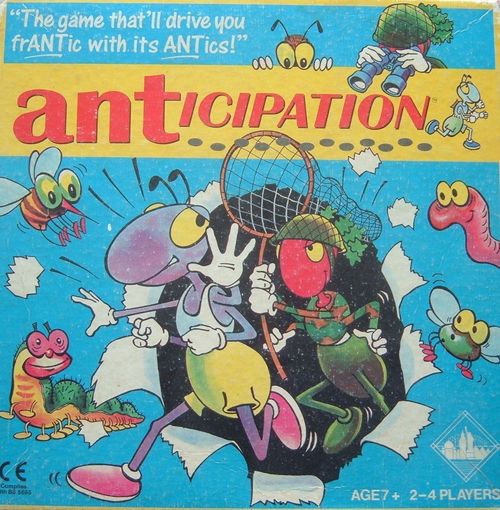
Anticipation
Anticipation Rulebook
Table of Contents
Table of Contents
Equipment
One Playing Board 56 playing pieces consisting of: 14 Yellow Ants, 14 Red Ants, 14 Green Ants, 14 Blue Ants Two Water Barriers Two Dice
Object of the Game
Anticipation is the fun game for ant-lovers! It can be played by 2–4 players. The object of the game is to capture your opponents' ants, bring them back to your nest and from the underside of the captured pieces construct a Queen Ant. The Queen Ant consists of seven segments made from the underside of captured opponents' ants (see outline diagram in nest). If 3 or 4 players take part, the player who completes a Queen Ant first wins the game. If only two players take part, the winner is the first player to construct 2 Queen Ants.
How Do You Do It?
Moving your ants around the board you attempt to capture your opponents' pieces by throwing the exact number on the dice to enable you to move to a square occupied by an opponent's ant. You then place your piece on top of your opponent's ant and if you magnetically attract that ant it is your captive, and is attached to the underside of your piece so that your ant remains on top.
However, if your ant is repelled then your ant is captured by your opponent and is turned upside down and placed underneath so that your opponent's ant remains on top. In the course of a game a 'stack' of ants may develop. There is no limit to the number of captured ants in a 'stack'. But if a stack becomes too high and unstable, the bottom pieces can be removed and placed on the side of the board. When the 'stack' is finally brought into a nest area, the player bringing the 'stack' into the nest collects the pieces from the side of the board.
To Start
Each player selects a set of ants. If 3 players take part 1 set is excluded from the game. If two players take part each has two diagonally opposite sets of ants, either yellow and green or blue and red. Before starting, your own pieces should be THOROUGHLY mixed and placed colour side up in the 14 spaces provided in the nest area. The two Water Barriers are placed anywhere in the Ante-chamber.
NOTE: Once play is in progress no player may look at the underside of their pieces in the nest area. The only unavoidable exception is when sorting through a stack of captured pieces returned to a player's nest which will include some of a player's own ants. Once your ants have returned to your nest area they are again placed colour side up on one of the 14 spaces in the nest area and may be used for further attacks.
Play begins by all players rolling both dice. Highest combined total starts. The starting player rolls both dice again and play continues in a clockwise direction round the board.
The Moves
When moving out of the nest counting begins from either of the squares marked START. To re-enter the nest a player must throw the EXACT number to land on either of the squares marked FINISH.
Players may move their pieces in ANY of the following ways: (For the purpose of this example it is assumed a 4 and a 3 have been rolled on the dice)
- Move two ants, each ant moved according to the scores thrown on the dice. One ant moves 4 spaces, the other moves 3. If leaving the nest, counting begins from the START squares.
- Move one ant 7 spaces ONE way only (i.e. no 'backtracking' is allowed with this move).
- As an alternative to No.2, split the dice score and move one ant in two DIFFERENT directions, each one represented by the individual dice scores. e.g. move 4 spaces in one direction and back 3, or 3 spaces in one direction and back 4. Note: movement backwards and forwards MUST correspond to the individual dice scores. With this score you could not move 5 and 2, or 6 and 1. It must be 4 and 3, or 3 and 4.
NOTE: No ants of the same colour may occupy the same square except as part of a 'stack' of captured ants. In the course of moving around the board ants may pass over other ants, including their own colour. When passing over you are not allowed to capture these ants. To capture, you MUST throw the exact number to land on a square occupied by an opponent's ant.
Returning to the Nest
Once a player has thrown the exact number to land on a FINISH square, a player must dismantle the 'stack' of captured ants. Any of the player's own ants should be placed on any of the 14 squares and can be used again. Captured ants are checked to see if they can be used to construct a Queen Ant. Those that can be used are placed on the relevant segment of the Queen Ant outline. Any Queen Ant segments which are surplus must be returned, colour side up, to the relevant coloured square in the 'Ante-chamber' in the centre of the board.
NOTE: No player may use their own ants to construct a Queen Ant in their own nest. If a player does this, even by accident, the penalty is to lose all segments of the Queen Ant already built. These are placed, colour side up, in the Ante-chamber.
Water Barriers and Double Throws
During the game when any Double is thrown (e.g. two 4's, two 1's, etc.) a player has an automatic second throw and can also bring one of the Water Barriers into play. A Water Barrier placed on the board automatically blocks any route and may not be crossed by ANY ant (including friendly ones!). A Water Barrier should be used to frustrate the movement of opponents' ants and can even be placed at the entrance to an opponent's nest. There are two Water Barriers which can be used on the board. Once Barriers come into play they must remain on the board.
Every time a Double is thrown the player throwing has the option to move a Barrier. The Barrier may be moved BEFORE or AFTER that player has moved his/her pieces in the turn.
NOTE: It is not allowed to block BOTH entrances to any nest. An opponent's ants MUST be allowed access to at least one entrance to their own nest. However, the strategic use of Water Barriers can make this the LONGEST possible route.
The Ante-Chamber
There are four squares at the corners of the Ante-chamber marked with a small ant-in-square symbol (shown on the printed board and rules sheet).
If a player's ant is already on, or subsequently lands on one of these squares, the player is entitled to claim any of the ants of that coloured square which are in the Ante-chamber, or are subsequently placed in the Ante-chamber while their piece remains on that square. All such ants are then attached to the underneath of the player's piece IRRESPECTIVE of magnetic attraction. A player may land on their own colour square at the corner of the Ante-chamber in order to 'rescue' their own ants.
*In the event of a player losing all their ants from their nest and having no 'playable' ants on the board, but having ants captured in the Ante-chamber, the player may stay in the game as follows:
For the next THREE goes when it is that player's turn they nominate any two numbers. If the combined total of the dice amounts to either number, their ants in the Ante-chamber are returned to their nest and they can immediately move their pieces according to the numbers thrown. If, after three turns they have not been able to release their ants, their ants are returned to their nest and a player can restart playing on the next turn.
*NB. If this situation occurs in the two player game then the same rule applies. For example: if blue has no playing pieces in the nest or on the board then the player playing blue and red, when it is blue's turn, must play according to the above rule.
The Game for Two Players
Each player has two diagonally opposite colours. Play should go round the board so that each colour is played in turn, e.g. yellow followed by red, green, blue, then yellow again. When a Double is thrown a player may move ANY Water Barrier. Two Queen Ants must be built to win the game. Both must be built entirely from the two colours of your opponent's ants. You may not capture a friendly colour, e.g. blue cannot capture red, or green capture yellow (unless part of an opponent's 'stack'). If friendly ants are taken into your nest as part of a 'stack', they should be placed in the Ante-chamber when the 'stack' is dismantled.
Pieces of a Queen Ant cannot be "transferred" between friendly nests. If, after capture, some Queen Ant pieces are surplus in one nest, they must be placed in the Ante-chamber. Each Queen Ant has to be constructed from pieces captured and taken into each individual nest.
All other rules for the two player game are the same as the 3 or 4 player game.